



Summary
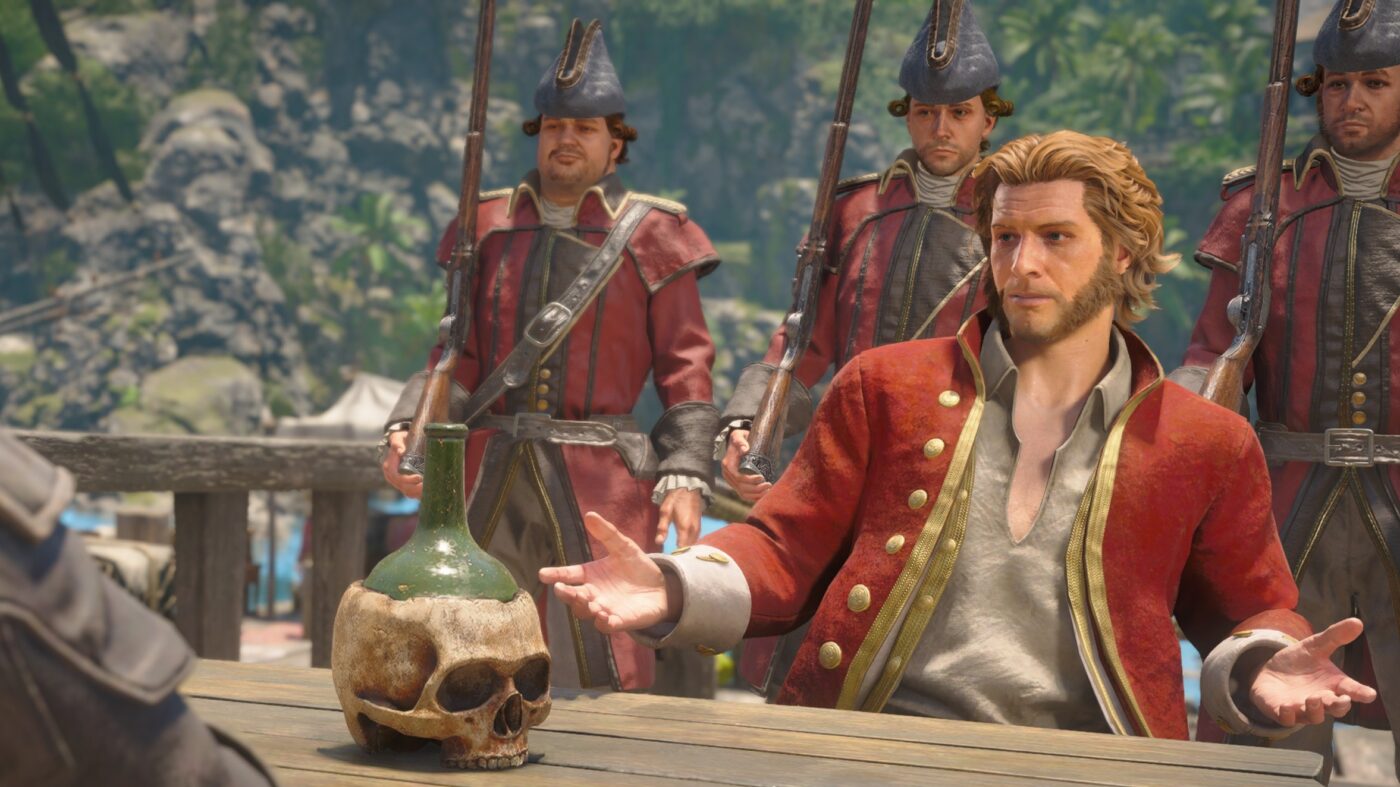
Assassin’s Creed Black Flag Resynced stands out as an exciting experience, though it remains an uneven restoration that occasionally trades away the distinct quirks that gave the original its legendary identity.
Overall
-
Gameplay
-
Visuals
-
Narrative
-
Replayability
Remaking a beloved game is difficult. The original Assassin’s Creed IV: Black Flag remains one of video game developer Ubisoft’s most memorable action-adventure games, combining naval warfare, tropical exploration, and a charismatic lead character. It also offered a welcome change of pace for players who had grown tired of the series’ usual formula.
Assassin’s Creed Black Flag Resynced does more than improve the computer graphics. It rebuilds the Caribbean, changes movement and combat, adjusts stealth game mechanics, expands several characters, and removes some of the original’s more frustrating missions. These updates make the adventure smoother and more approachable, but they also weaken some of the unusual features that gave Black Flag its identity.
The result is a beautiful, exciting pirate game and an uneven remake. Resynced improves many aspects of the original, but not every change feels like a genuine improvement.
The world is the first thing players will notice. The original Black Flag impressed with its ocean, changing weather, and bright tropical landscapes. However, its cities could feel empty, its jungles were often simple, and many interiors lacked detail.
Resynced gives the Caribbean a fuller identity. Havana, Nassau, and Kingston are busier and more detailed. Crowds fill the streets, merchants call from their shops, and soldiers patrol narrow roads. Taverns feel warmer and more atmospheric, while marketplaces are crowded with people, animals, and goods.
These details help the cities feel like places where people live rather than settings built only for missions. Havana feels wealthy and tightly controlled by military power. Nassau is rougher and more chaotic, shaped by pirates and people seeking freedom. Kingston has a more formal, political atmosphere. Each location has its own character.
The natural environments are equally impressive. Trees and grass move in the wind, rain sweeps across the landscape, and tropical cyclones can change the mood of a journey in an instant. The beaches are bright and inviting, while the jungle can feel dark and difficult to navigate. Ruins and abandoned settlements appear throughout the world, giving players reasons to explore even when no mission is nearby.
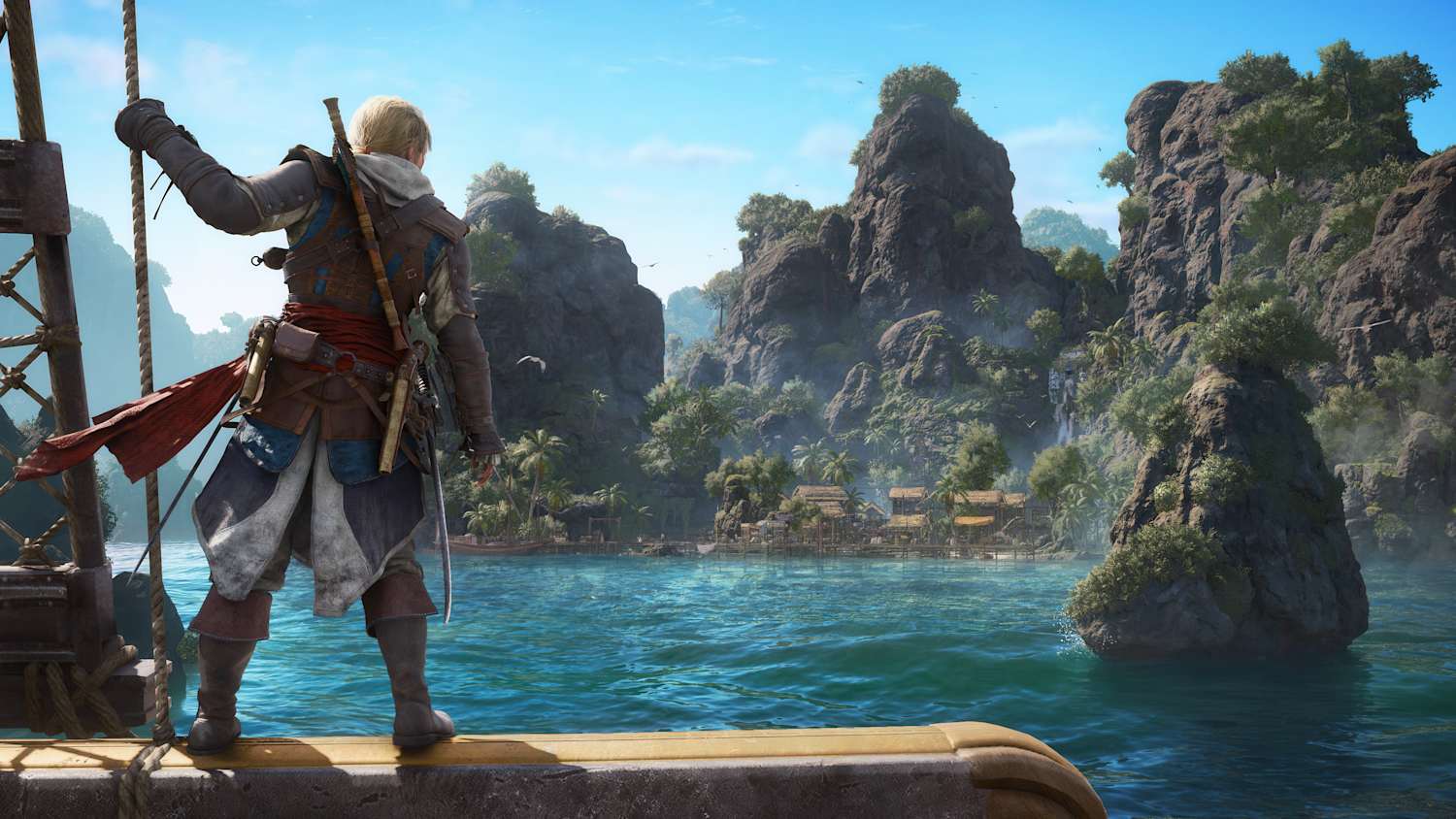
The ocean remains the game’s greatest technical achievement. Wind waves move beneath the Jackdaw, smaller boats rise and fall, and enemy ships leave long trails across the water. During a storm, the sea becomes genuinely dangerous. Lightning flashes, rain limits visibility, and the Jackdaw struggles against towering waves.
Naval gameplay is still the game’s strongest feature. The Jackdaw feels responsive and powerful, but it can be damaged or destroyed by stronger ships. Broadside cannons, mortars, naval mines, chain-shot, naval ramming, and naval boarding actions all return with improved presentation.
The sound design strengthens the experience. Cannons sound heavy, wooden ships creak under pressure, and storms surround the player with wind and thunder. The sea shanties remain a highlight, making long voyages feel personal and reminding players that Edward is not alone. His crew gives the Jackdaw a life of its own.
Edward Kenway remains one of the most interesting protagonists in the Assassin’s Creed series. He does not begin as a trained Assassin or noble hero. He is a privateer who wants money, recognition, and a life beyond poverty.

After Duncan Walpole’s death, Edward takes his identity and becomes involved in the conflict between the Assassins and Knights Templar. At first, he had little interest in the meaning of that conflict. He is mainly after money. This selfishness is central to his character. Edward is charming and brave, but he is also reckless and often fails to see the harm his actions cause.
The remake keeps this journey intact. Edward gradually learns that freedom without responsibility can become another form of selfishness. His transformation from an ambitious pirate into a more thoughtful man remains one of the story’s strongest elements.
However, some new dialogue makes Edward sound more committed to the Assassin cause than he should be. In a few side missions, he speaks against the Templars even when he is still meant to care mainly about his own interests. This does not ruin his character, but it restricts his development.
In a few side missions, he speaks against the Templars even when he is still meant to care mainly about his own interests.
The expanded supporting cast works better. Anne Bonny appears earlier and has a stronger presence throughout the story, giving her later importance more emotional weight. Her relationship with Edward develops across more scenes, and the remake better shows how closely their lives have become connected.
Blackbeard also receives more screen time, adding context to his decisions and showing more of the man behind the legend. Stede Bonnet and several other pirates receive additional scenes as well. Their stories are not always fully developed, but the extra material grounds the world in a stronger sense of history.
Some new characters still do not receive enough attention. They arrive with interesting ideas, but their stories often end before they become important to Edward’s journey. The remake tries to address the original game’s underused supporting characters, yet sometimes repeats the same problem with its new additions.
The new cutscenes have mixed results. Some add emotional depth and strengthen important moments, while others are held back by stiff facial animation. The original performances often relied on small expressions and pauses. In Resynced, some characters look distant even when the dialogue suggests they should be upset.
Despite these issues, Edward remains the story’s emotional center. His mistakes, ambitions, and growing sense of responsibility give the game its strongest moments.
One of the remake’s biggest changes is its pacing. The original included many missions that asked players to follow a target without being spotted. These sections could be slow and frustrating, especially when a mission failed because the player was seen for only a moment.
Resynced removes most of these tailing missions. The campaign moves faster and shifts more often between combat, exploration, sailing, and infiltration. Players spend less time following targets along fixed routes.

For many, this will be a welcome change. The story feels more focused, and the game repeats the same mission structure less often. However, something is lost. Tailing missions were not always enjoyable, but they encouraged players to observe their surroundings and plan before acting. The remake does not replace them with deeper surveillance systems. Instead, it generally favors direct action. This makes the campaign easier to play but less distinctive.
Social stealth is also less important. Players can still hire dancers, blend into crowds, distract guards, and hide among groups of civilians, but missions rarely require these tactics. Edward now has a crouch button, improved cover movement, and clearer stealth information. Hiding behind objects or moving through grass is usually easier than blending in with a crowd.
This makes stealth more reliable but also more familiar. Cover-based stealth is common in many games, while social stealth is unusual and closely tied to Assassin’s Creed. Making it optional gives players more freedom, but it reduces the importance of one of the series’ defining ideas.
Cover-based stealth is common in many games, while social stealth is unusual and closely tied to Assassin’s Creed.
The mini-map is less overwhelming, too. The original quickly covered the screen with icons and activities. The remake introduces locations more naturally through exploration, synchronization points, and travel. A distant fort, a strange ruin, or smoke on the horizon can invite players to investigate without immediately becoming another checklist item.
Some missions also allow for more flexible solutions. Players may use stealth, theft, or exploration instead of simply collecting enough money to buy an item. These changes make Edward feel more resourceful and better suited to pirate life.
Edward moves more smoothly in several ways. He climbs with greater confidence, crosses rooftops more easily, and recovers from mistakes faster. The environment also does a better job of showing where he can go next.
Still, movement is not always precise. Edward may jump toward the wrong surface or stop at an awkward angle. The animations look more modern, but the controls do not always match their polish. The system is better than the original’s, but it is not a complete redesign.
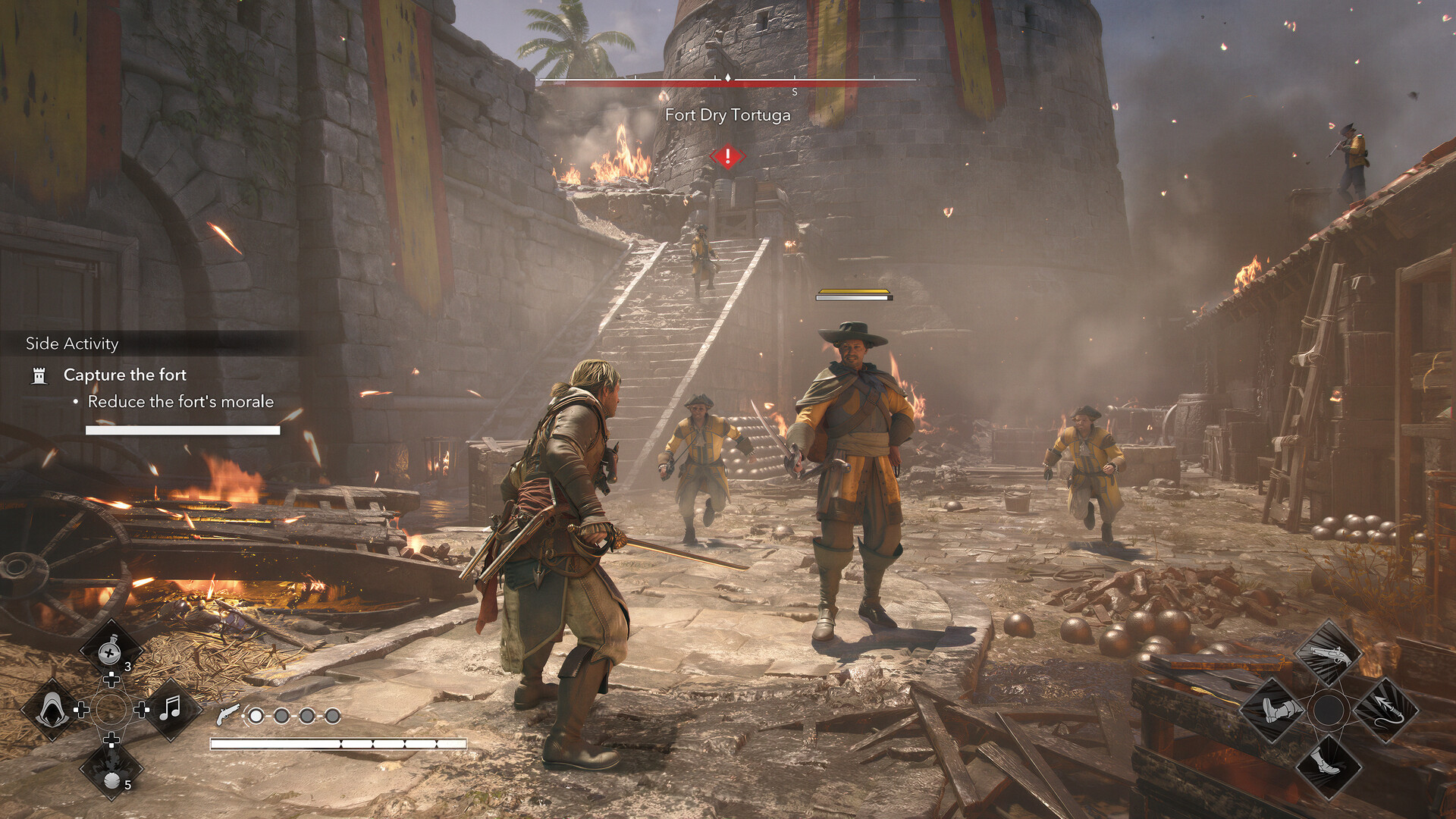
Combat receives a larger overhaul. Enemies have posture bars that players can break with different attacks. Edward can use light and heavy strikes, parries, kicks, pistols, rope darts, and other tools. Battles feel more active than they did in the original, where combat often centered on counters.
The best fights are entertaining. Edward can pull an enemy close with a rope dart, knock another down, fire a pistol, and finish the encounter with a dramatic attack. The system suits the theatrical style of a pirate adventure.
However, combat can become repetitive. Parrying remains powerful, and enemies’ defenses often break quickly. There is not enough variety among opponents to make players change tactics often. Many encounters settle into the same pattern: block, break an enemy’s defense, and perform a finishing move.
The camera can also cause trouble during chain kills and assassinations, especially on ship decks and in small caves where several enemies may surround Edward. The original combat was simpler, but its counters and chain kills had a clean rhythm. Resynced adds options without always making fights more elegant.
New ammunition and recruitable officers add variety. Officers can strengthen the ship’s defenses, improve ramming attacks, or increase its firepower. Heated shot and upgraded swivel guns also give players more options during difficult battles.
The remake’s most controversial choice concerns its modern-day story. The original placed Edward’s memories inside Abstergo Entertainment, a company that turned history into entertainment while secretly searching for information. These sections could interrupt the pirate adventure, but they added mystery and connected Edward’s story to the wider Assassin’s Creed universe.
Resynced removes most mandatory modern-day sections. The Animus still exists, but players are no longer drawn into a major corporate conspiracy between historical missions. Instead, much of the modern story is told through optional content and hidden rifts.
The rifts contain some of the remake’s most interesting ideas. They introduce the Travelers, an artificial intelligence called Ego, and a struggle over how history should be remembered. Ego tries to reshape the lives of Edward, Blackbeard, and Mary Read into safer, more obedient stories.
The rifts contain some of the remake’s most interesting ideas. They introduce the Travelers, an artificial intelligence called Ego, and a struggle over how history should be remembered.
This material connects well with Black Flag’s themes. The game is interested in freedom, rebellion, and people who resist control. Ego’s attempt to clean up history provides an intriguing contrast with the pirates’ unpredictable lives.
Unfortunately, the story is hidden too deeply. Many players may finish the game without finding it, while those who do may not have enough context to understand why it matters. A potentially meaningful part of the remake becomes optional side content instead of a central part of the experience.
The absence of Assassin’s Creed Freedom Cry is also disappointing. Adéwalé’s story offered a different view of the Caribbean and confronted the brutality of slavery and the transatlantic slave trade. Without it, Resynced focuses heavily on the excitement of piracy and gives less attention to the suffering that shaped the world.
Verdict
For new players, Resynced is an excellent way to experience Edward’s journey. For returning players, it offers a different interpretation of a beloved game. It is smoother, more detailed, and more accessible, but it does not always preserve the qualities that made Black Flag special. Resynced succeeds as a pirate adventure. It is less successful as a complete restoration of the original game’s identity.







Leave a Reply