
Summary
The End of Oak Street, directed by David Robert Mitchell and set in the early 1980s, is an ambitious, genre-bending film that blends suburban satire, family drama, and dinosaur adventure when a suburban street is surrounded by a glowing barrier and thrust into a prehistoric wilderness.
Overall
-
Acting
-
Visuals
-
Cinematography
Directed by David Robert Mitchell, The End of Oak Street mixes family drama, science fiction, dinosaur adventure, and suburban satire. In line with creature features, the movie begins with a strong and unusual idea. A quiet American street becomes a dangerous new world where every backyard may conceal a predator and every road may lead to safety or death.
This premise gives the film a clear identity. It places suburban comfort beside dinosaur terror, turning lawns, fences, garages, and station wagons into obstacles, hiding places, and traps. The contrast gives the movie considerable energy, even when it does not develop every idea as fully as it could.
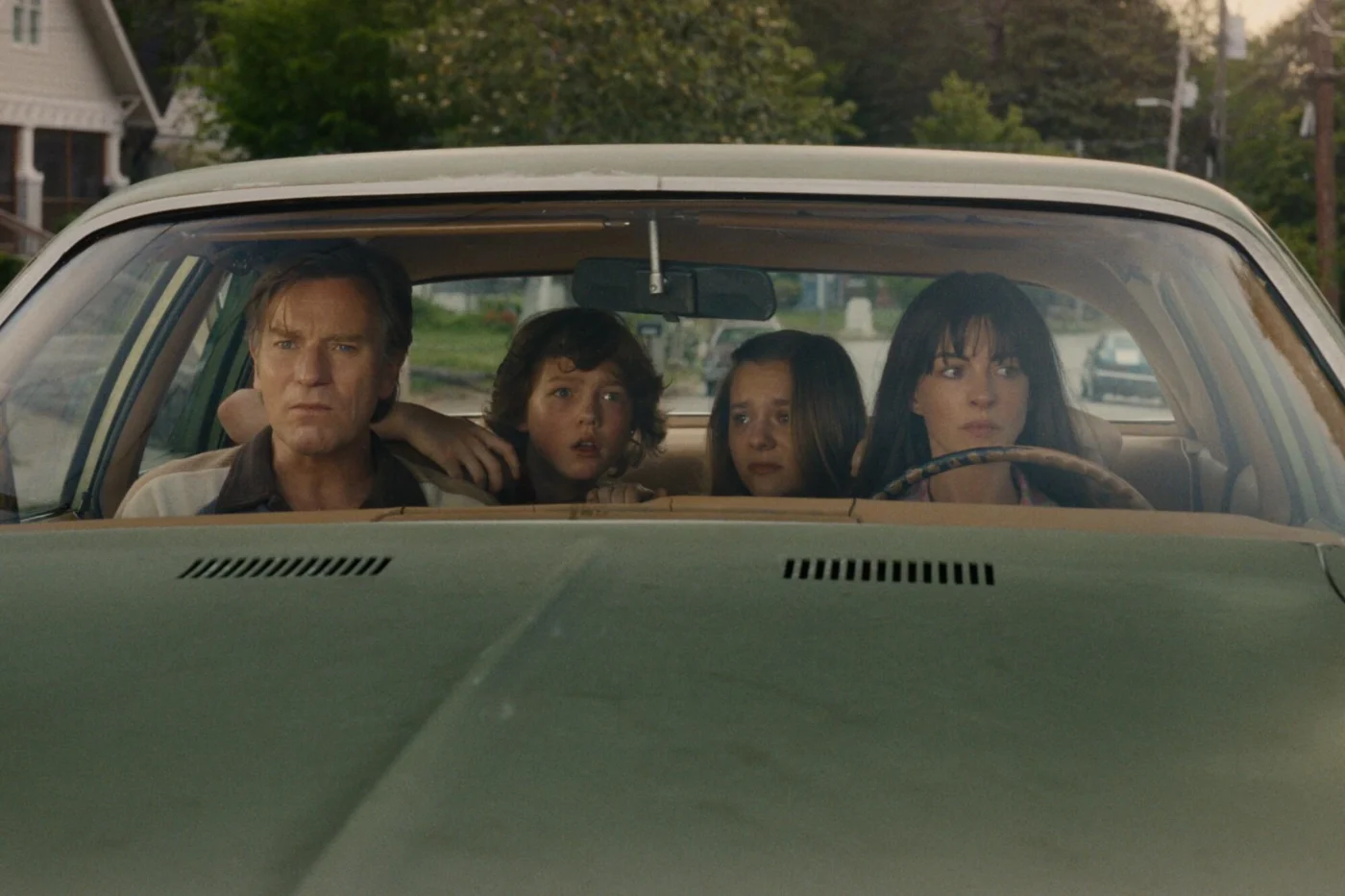
The story follows Greg and Denise Platt, a married couple whose relationship has weakened over time. Money problems, emotional distance, and years of avoidance have damaged their marriage. Greg, played by Ewan McGregor, works extra shifts delivering pizzas. He tries to remain cheerful and dependable, but his optimism often feels forced. He drinks in secret and avoids difficult conversations. When he says everything will be fine, it sounds less like reassurance than denial.
Denise, played by Anne Hathaway, is tired of carrying the family’s emotional weight. She knows Greg’s weaknesses and sees how often he hides behind routine. Their marriage has not been destroyed by one major betrayal. Instead, it has been worn down by countless small disappointments. Denise still cares about Greg, but she no longer knows whether love is enough to repair what has been broken.
Denise’s private writing adds another layer to her character. She is working on a novel about a wife and mother who imagines leaving her family. The idea is simple, but Hathaway gives it real feeling. Denise is not portrayed as selfish or cruel. She loves her children, yet she feels that her own identity has disappeared beneath the demands of family life. She is exhausted by pretending that everything is normal.
Denise is not portrayed as selfish or cruel. She loves her children, yet she feels that her own identity has disappeared beneath the demands of family life.
The children feel the tension as well. Audrey, played by Maisy Stella, is smart, observant, and emotionally aware. She understands more than her parents realize. She notices the silences, the arguments, and the way Greg and Denise avoid each other. Even before Oak Street enters the prehistoric world, Audrey is already thinking about leaving and building a different life.
Brian, played by Christian Convery, reacts more loudly and impulsively. His anger often hides fear. He wants attention, safety, and reassurance. His strongest bond is with the family dog, Starbuck. The dog becomes one of the film’s most effective emotional devices because the movie understands that viewers will worry about him. Every time Starbuck disappears from view, the danger feels more personal.
Before the dinosaurs fully appear, the neighborhood begins to change. The air grows heavy and humid. Strange plants rise in gardens, while unfamiliar sounds come from behind fences and houses. Residents find odd droppings, claws, and scales. A glowing sphere of light surrounds the area, suggesting that something far beyond ordinary understanding has taken place.

The film does not spend much time explaining the event. There are a few radio reports and brief conversations about possible causes, but no one delivers a long speech about time travel or alternate dimensions. This choice preserves the mystery. The movie is less interested in why Oak Street was displaced than in what happens after it arrives.
As a result, the setting matters more than the science. The main question is not how the neighborhood entered the prehistoric world, but whether its residents can survive there. The lack of explanation also keeps the focus on the film’s emotional concerns. The dinosaurs are not merely creatures from another age; they represent the chaos that enters a family when hidden problems can no longer remain hidden.
The main question is not how the neighborhood entered the prehistoric world, but whether its residents can survive there.
Greg can no longer escape into work or alcohol when a dinosaur is outside the house. Denise cannot disappear into her writing when her children are in danger. Audrey and Brian cannot remain quiet witnesses to their parents’ failing marriage. The new world forces everyone to act. Survival now requires honesty, cooperation, and responsibility.
This is where the family drama works best. The dinosaurs created physical danger, but the emotional danger already existed. Greg and Denise have avoided necessary conversations for years. Their new situation does not magically repair their marriage. Instead, it forces them to confront the damage that has been building between them.
Hathaway gives the strongest performance in the film. The crisis Denise faces does not transform her into a flawless action hero. Her strength is practical rather than theatrical. She organizes the family, makes difficult decisions, and refuses to waste time pretending that everything is under control.
Her frustration with Greg remains present even during the most dangerous scenes, which makes her feel believable. Denise does not forget years of pain simply because a tyrannosaur has entered the neighborhood. At the same time, she begins to see that Greg may be capable of change if he stops using optimism as a way to avoid responsibility.
McGregor also brings depth to Greg. The character could easily have become a familiar disaster film father who discovers courage after monsters arrive. Instead, Greg remains awkward, frightened, and uncertain. His promises that the family will be fine often sound like attempts to convince himself. He is not naturally prepared to guide anyone through a prehistoric wilderness.
Greg’s growth is less about bravery than accountability. He must admit what he has hidden from Denise. He must accept that her unhappiness is not an overreaction. He also has to understand that being a father means more than remaining upbeat. His best moments are not the scenes in which he fights danger, but the moments when he finally listens.

The Platt family’s story expands when Audrey and Brian meet Jeannette, a teenage survivor whose family has been destroyed by the disaster. Jeannette brings another kind of grief into the film. Her pain is immediate and impossible to hide.
The relationship between Jeannette and Audrey is handled with restraint. The film suggests a growing emotional connection without forcing it into a standard romance. Their bond develops through small acts of trust, protection, and understanding. Audrey sees someone who understands isolation in a different way, while Jeannette finds comfort in Audrey’s quiet attention.
These relationships help the movie move beyond the Platt household. The characters are not only trying to survive dinosaurs; they are also trying to understand who they are after their old world has disappeared. The disaster creates new connections, but it also exposes old weaknesses.
Mitchell’s visual style supports this emotional distance. Characters often speak through windows, across rooms, or from opposite sides of doorways. Mirrors and reflections divide people within the same framing. Split-focus shots keep the foreground and background sharp at once, showing people who are physically close but emotionally separated.
This style works best inside the Platt home. The house becomes a collection of separate spaces, with family members moving around one another without truly connecting. Rooms that once suggested comfort begin to feel restrictive. Hallways, windows, and doors become signs of distance rather than safety.
At times, however, the filmmaking becomes too obvious. Some images seem designed to announce their meaning before the story has earned them. A family photograph may appear immediately after an argument, or a doorway may be framed in a way that clearly signals separation. These choices can be effective, but they occasionally feel overly deliberate.
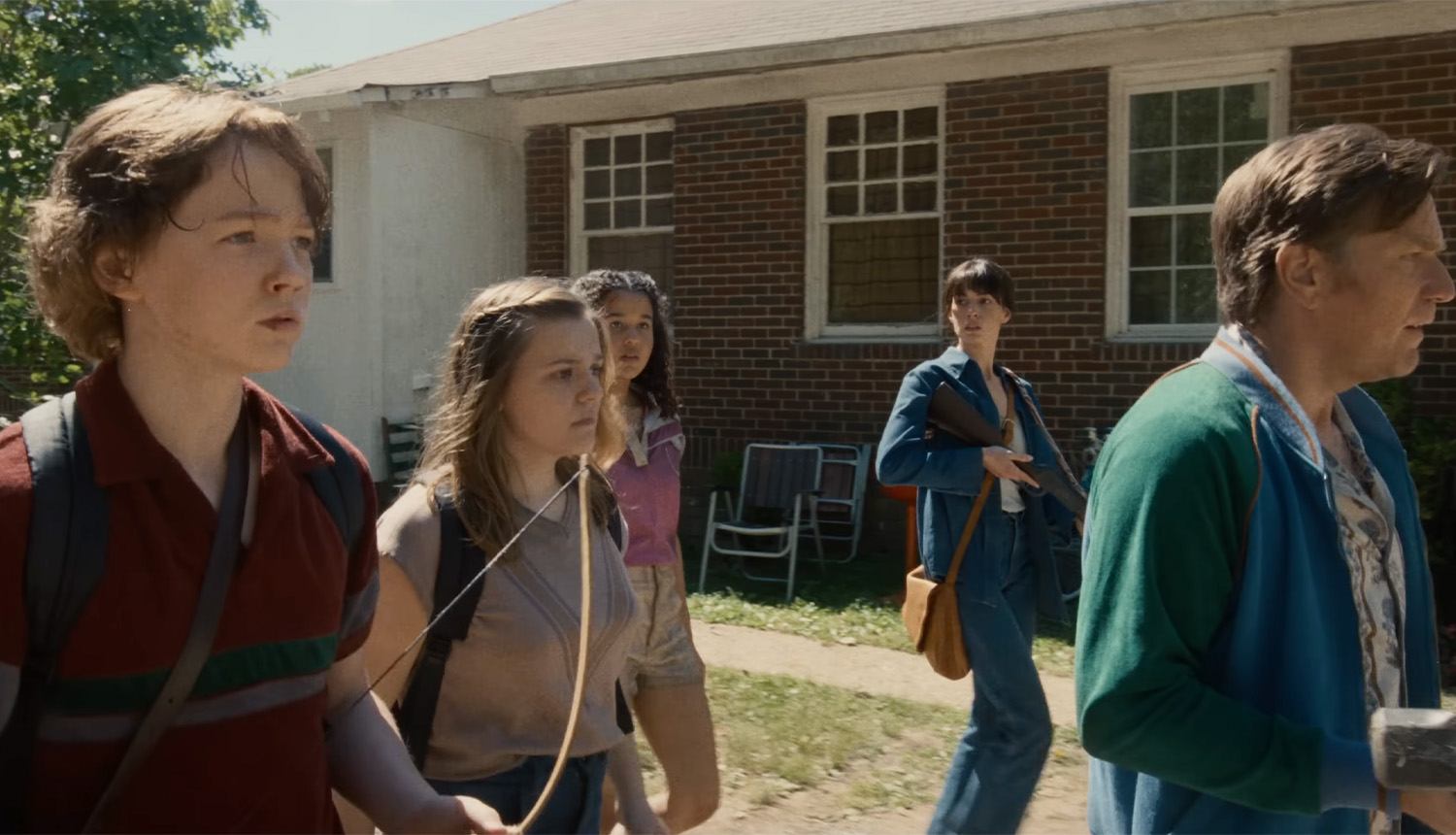
The dinosaurs are another major part of the film’s identity. Their designs are not limited to the smooth, familiar look often seen in blockbuster dinosaur movies. Many of the creatures have feathers, down, or birdlike features. They look stranger and less polished than typical movie monsters, which makes them more unsettling.
The film does not attempt to create a scientifically accurate prehistoric world. Dinosaurs from different geological periods appear together, and the ecosystem follows the needs of the story rather than real paleontology. This is not a serious problem. The creatures are not there to teach a science lesson.
The suburban setting gives the dinosaur attacks their strongest appeal. In an open wilderness, danger would feel expected. On Oak Street, danger appears in places built for comfort. A tyrannosaur peers through a kitchen window. A pterosaur circles above a roof. A backyard swing set becomes a place of fear. The familiar geography of family life turns into a survival map.
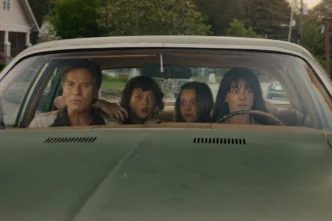
The film’s best action sequence is a lengthy car chase and pursuit involving the Platts, several neighbors, and a pursuing tyrannosaur. The characters run through damaged homes, across lawns, around abandoned cars, and into streets lined with broken fences. The scene is clearly staged, and viewers always understand where the characters are and how close the danger has become.
The sequence also reveals one of the film’s weaknesses. It is exciting, but much of it feels familiar. Running characters, overturned cars, snapping fences, and a charging dinosaur recall earlier creature adventures. The craftsmanship is strong, yet the scene rarely feels as fresh as the premise itself.
The movie also struggles with tone. Some scenes are genuinely frightening. Characters are crushed, dragged away, injured, or discovered in bloody conditions. A severe leg injury is especially difficult to watch. A rooftop attack by flying predators is surprisingly violent, while a stampede turns a damaged car into a helpless object surrounded by enormous animals.
At the same time, the film includes broad slapstick and comedy that does not always fit. There are bodily-function jokes, moments of absurd behavior, and a long sequence involving animal sexual behavior among dinosaurs. The scene is memorable because it is so unexpected, but it interrupts the atmosphere. Rather than making the movie feel bolder, it makes the tone feel uncertain.
The early 1980s setting is filled with period detail. Cars, furniture, clothing, music, and suburban design all help establish the story’s era. These details can be charming, but the film sometimes explains its nostalgia too directly. References to songs and household objects occasionally feel like reminders for the audience.
Cars, furniture, clothing, music, and suburban design all help establish the story’s era. These details can be charming, but the film sometimes explains its nostalgia too directly.
Faith is another theme running through the story. Greg makes general statements about divine protection, while Denise questions whether those statements come from genuine belief or habit. Audrey rejects the idea that faith can explain what is happening, and Jeannette admits that tragedy has made belief difficult. The movie does not resolve these views with a miracle or a speech. It allows uncertainty to remain.
By the end, The End of Oak Street works best as a family story. The dinosaurs provide spectacle, but the real subject is the emotional collapse of a household. Greg and Denise do not become perfect partners. Their problems do not disappear. Audrey still wants a future beyond Oak Street, and Brian still needs recognition and safety.
What changes is the family’s willingness to face the truth. The crisis prevents them from postponing difficult conversations. They begin to understand that survival is not only about escaping danger. It is also about trust, sacrifice, and honesty.
Its best idea is simple: the end of the world does not erase ordinary problems; it makes them impossible to ignore. The dinosaurs may destroy Oak Street, but the family’s emotional collapse began long before the prehistoric world arrived. In the end, the film leaves viewers with a powerful image: a family home surrounded by ancient wilderness, forcing its occupants to decide whether they will continue living apart or finally face danger together.