

Summary
Michael (2026) offers a glossy, highly polished, and tightly controlled chronicle of Michael Jackson’s life from his childhood in Indiana through his iconic late-1980s peak.
Overall
-
Plot
-
Acting
-
Soundtrack
-
Cinematography
Antoine Fuqua’s estate-approved Michael Jackson biopic, Michael, signals its intent from the first frame. The opening credits roll over the polished logo of Optimum Productions, Jackson’s former company. That logo sets expectations. Instead of a bold, questioning portrait, the film suggests something safer. It feels like a carefully managed retelling, made in collaboration with the people who have the most to lose from controversy.
Over the next two hours, that impression holds. Michael is glossy and tightly controlled. It has access to Jackson’s music, image, and public mythology. It restages famous performances. It recreates legendary looks. It moves quickly through milestones fans already know.
A Convenient Timeline
Michael covers roughly 1966 to 1988. It follows Jackson from childhood in Gary, Indiana, through the Jackson 5, early solo success, and the historic run of Off the Wall, Thriller, and Bad. The film ends just before the 1990s, years before the first public allegations of child sexual abuse. A final title card says that “his story continues,” hinting at more installments.
This timeline is not only practical. It is the film’s key creative decision. By focusing on the years before the scandals, the movie builds a clean upward trajectory. A gifted child survives an abusive father. He becomes a superstar. He reshapes pop culture. The arc is clear, easy to follow, and designed to satisfy.
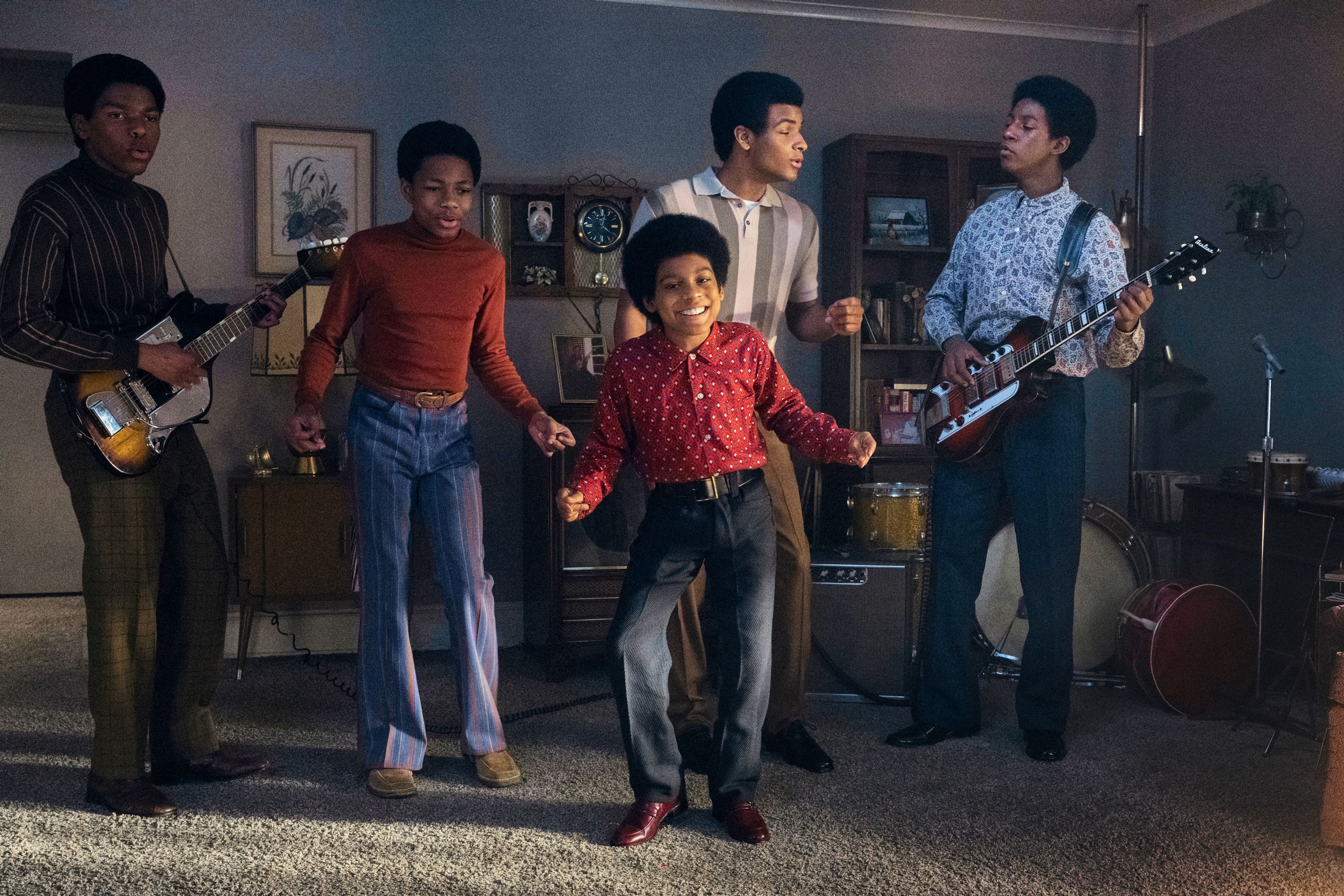
The structure is also rigid. Year markers appear on screen. Each introduces another performance, studio session, or business milestone. We move from local talent shows to Motown, then to stadium tours, music videos, and brand deals. This approach creates a problem the film cannot fully solve. Modern audiences cannot forget what comes later. When the movie shows Jackson building private fantasy spaces—animals, toys, childlike décor—the mind jumps ahead to Neverland Ranch and the allegations that would later surround him. Scenes meant to feel innocent can land with unease. The discomfort does not come from what the film shows. It comes from what the film refuses to discuss.
By stopping in 1988, the movie attempts to claim neutrality. It presents itself as “pre-controversy,” as if that choice is simply respectful or cautious. But the omission becomes a presence of its own. The empty space draws attention. The film does not erase the hardest questions; it only postpones them.
By stopping in 1988, the movie attempts to claim neutrality.
But the timeline also provides access. We see the Jackson 5 drilled into a professional act. We see Motown meetings, hit singles, and the shift to solo stardom. We see the big music videos and the massive tours. We see the Pepsi deal. Each moment is staged with care. The costumes, hair, and sets look researched and precise. The movie often feels like a living museum.
At times, the movie feels less like a drama and more like a guided tour. It plays like a handsome playlist of highlights. It slows down for emotion, then speeds up again before anything sharp can land. For long stretches, the man at the center feels like a bundle of achievements and injuries rather than a complicated human being. This forward rush weakens tension. Conflicts appear—creative control, family strain, business pressure—then fade within a scene or two. The film rarely allows consequences to accumulate. The result is oddly flat. Even history-making moments can feel routine.
Background & Plot
The film was approved by Jackson’s estate, and family members were involved in its development. An authorized biopic can be truthful; insiders can offer details outsiders do not have. But the collaboration also feels protective. The film is willing to show Jackson’s pain and vulnerability. It is far less willing to show his flaws.
An authorized biopic can be truthful; insiders can offer details outsiders do not have. But the collaboration also feels protective.
This Michael is mostly framed as a victim and a dreamer. He is a tender child abused by his father. He is an artist forced to work too hard, too young. He is a sensitive soul misunderstood by the media. He is a perfectionist who wants to spread love. These elements are part of the real story. The issue is what is missing. The film rarely allows him sharper edges. We see little anger. We see little ego. We see little manipulation, even in moments when a powerful celebrity might use that power strategically. When conflict appears, the blame usually falls elsewhere. The villains are cruel parents, greedy executives, or intrusive reporters. Michael remains largely pure.
That choice makes the character easier to admire. It also makes him less interesting. Strong screen characters live in contradiction. Jackson’s public life was full of them: visionary and recluse, canny businessman and wounded child, media victim and media strategist. By sanding down those contradictions, Michael trades complexity for safety. The film’s central moral storyline becomes simple. Michael must escape Joe. Then he must replace Joe with kinder adults. Once that happens, the film implies, his real self can finally emerge. It is emotionally direct. It is also incomplete. It overlooks the harder question of what happens when the once-powerless child becomes powerful.
Bold Casting Choices
At the center is Jaafar Jackson, Michael’s real-life nephew, in his first major screen role. The challenge is enormous. The world has seen countless impersonations. Every gesture is familiar. Every movement invites comparison. Jaafar approaches the task with discipline. His physicality often matches Jackson’s stage presence. The posture, the hand shapes, the coiled stillness before a move—all are carefully observed. At times, the resemblance is uncanny.
In quieter scenes, he reveals potential for greater depth. His Michael can appear shy and wounded in one moment, then focused and demanding in the next. He hints at a tension the film rarely allows to develop: the need to be loved and the need to control. Yet the film’s approach keeps him boxed in. It emphasizes recognizable moments, vocal cadences, and “Michael-isms.” It leaves limited room for ambiguity. We see soft speech and hesitant smiles. We see sensitivity. We do not often see darker emotions, moral complexity, or genuine unpredictability. The result is a lead performance that feels committed, and occasionally moving, but constrained by the film around it.

A Michael Jackson biopic cannot belong to Michael alone. His life was shaped by family, collaborators, managers, lawyers, and the culture that profited from him. Michael includes many supporting characters, yet few become fully realized.
Joe Jackson is depicted without ambiguity. He is controlling and violent. He uses the belt as “motivation.” Colman Domingo plays him with intensity. Heavy prosthetics, however, make the character appear stiff, sometimes flattening the subtler choices in Domingo’s performance. Joe becomes more symbol than person: the embodiment of oppressive parenting and the obstacle Michael must overcome.
Jackson’s brothers appear often, especially in performance scenes. As individuals, they remain thinly sketched. The film hints at jealousy and rivalry as Michael becomes the focal point, but it does not dramatize these tensions. The brothers are defined more by choreography and wardrobe than by inner lives.
Janet Jackson’s near absence stands out. Her omission feels intentional rather than accidental. Including her in a meaningful way would raise complicated questions. It would require the film to explore gender dynamics, sibling rivalry, and parallel success. It would also mean examining shared trauma within the same household. Those topics might disrupt the streamlined narrative, so the film avoids them.
Janet Jackson’s near absence stands out. Her omission feels intentional rather than accidental.
Among the adult allies, some figures have clearer roles but still limited depth. John Branca, Jackson’s attorney and business strategist, is framed as a steady counterweight to Joe. He functions as a “good father” figure: calm, professional, reliable. When Branca helps Michael push Joe out of control, the film treats it as liberation—one of the few moments when Michael asserts power directly.
Other figures, such as bodyguard Bill Bray, appear and disappear. Bray’s worried looks suggest a grounded perspective. He is close enough to observe Michael’s isolation but not powerful enough to change it. The film never fully develops that viewpoint. These supporting characters become emotional evidence—proof that Michael was loved—rather than engines of drama.
Music – The Saving Grace
The soundtrack is one of the film’s strongest assets. The catalog is legendary: “Don’t Stop ’til You Get Enough,” “Human Nature,” “Billie Jean,” “Beat It,” “Thriller,” “Bad.” The songs carry built-in force. Fuqua uses that force to maintain momentum. Dialogue scenes are broken up by rehearsals, concerts, and video shoots. Transitions are often smooth. On a surface level, the film remains watchable because the music is so potent.
The problem is how often the music performs narrative labor the script avoids. Songs arrive as finished spectacles. They serve as time markers and emotional boosts. We see elaborate sets and intricate choreography. We rarely see the difficult process behind the work: the songwriting, the studio experimentation, the arguments over sound, the risks of reinvention. That choice keeps the pace brisk. It also makes the hits feel like decoration rather than expression. The songs do not always seem tied to a developing inner life. They can feel like a convenient way to move through years while keeping the audience entertained.
Underlying Themes and Symbolism
Throughout the movie, Michael surrounds himself with symbols of childhood. We see playful animals, amusement-park aesthetics, and a growing desire to build a private wonderland. The film frames this as understandable, treating it as a response to trauma. In this telling, fantasy becomes a way to reclaim what was taken.
Yet the omission of the later allegations makes these images unstable. Many viewers will not experience them as simple sweetness. They will feel the weight of what comes later. The film seems aware of that tension. It approaches ambiguity, then retreats, returning to safer language about innocence and healing. The result is unresolved discomfort. The film creates it, then refuses to name it. It wants the symbolism of arrested development without engaging the public meaning that symbolism now carries.
Concluding Remarks
On a technical level, Michael is consistently competent and sometimes impressive. The production design convincingly tracks multiple decades. Costumes and makeup recreate famous looks with care. The cinematography remains clean and accessible. The pacing is brisk enough that the film rarely drags, even when the storytelling becomes shallow.
The larger question remains: what does Michael ultimately want to be? At times, it gestures toward character study. It hints at loneliness, body insecurity, and the strain of being turned into a symbol. At other times, it resembles a premium fan package—a cinematic companion to a greatest-hits album, complete with reenacted videos and stadium-scale applause.
Whenever complexity threatens to surface, the film tilts back toward celebration. It seems designed not to challenge the audience too deeply and not to unsettle the stakeholders who helped shape it. That caution becomes its defining feature.
The closing note—“his story continues”—underscores the film’s ambivalence. A later installment would have to confront the most difficult terrain: the allegations, court battles, media frenzy, and physical decline. Whether a future chapter would step outside this protective framing remains unknown.
As it stands, Michael offers a partial story. It honors a staggering run of artistic achievement. It avoids the ethical and emotional questions that now define public debate about Jackson. Its strengths—polish, music, and a committed central performance—cannot be separated from its limitations. It is watchable and sometimes moving. Viewers who want a respectful, sanitized account of Jackson’s rise, backed by lovingly staged versions of his biggest moments, will likely be satisfied. Viewers looking for a portrait that confronts his contradictions will find that this authorized film stops short of the sharpest edges.