




Summary
Lust Stories 3 is an engaging anthology film exploring sexual desire, emotional neglect, fantasy, and power dynamics across four distinct segments directed by Vikramaditya Motwane, Kiran Rao, Shakun Batra, and Vishal Bhardwaj.
Overall
-
Plot
-
Cinematography
-
Acting
-
Visuals
For many years, Hindi cinema kept sex at a distance. Desire was suggested through rain, music, glances and carefully placed flowers. Characters rarely said what they wanted. Romance was wrapped in metaphor.
The Lust Stories anthology helped change that conversation. It placed sexual desire, especially women’s desire, at the centre of its stories. The films did not always handle the subject perfectly, but they created room for conversations that mainstream Hindi cinema had often avoided. Lust Stories 3 continues that approach with four stories about marriage, loneliness, psychological manipulation, fantasy and emotional neglect. Vikramaditya Motwane, Kiran Rao, Shakun Batra and Vishal Bhardwaj each bring a different style to the film. One chapter is warm and funny, another is a tense thriller, while the remaining stories explore relationship breakdown and private imagination.
Across the four stories, lust becomes a response to boredom, loneliness, frustration, insecurity and fantasy. The women are not presented as perfect symbols of freedom. They can be confused, impulsive, funny, thoughtful and selfish. Their choices may not always be admirable, but the films take their desires seriously. That gives Lust Stories 3 much of its energy.
For some, desire means excitement and variety. For others, it means safety, sexual pleasure, independence or control. The stories recognise that people do not always want sex for its own sake. They may be looking for attention or reassurance. They may simply want to escape the roles that marriage, family and society have assigned to them.
The anthology moves across different periods and social settings. It features married women from a middle-class world, a young woman caught in a dangerous urban scheme, a couple facing marital separation, and a literature teacher in 1980s Hyderabad. This variety gives the film range, though the stories do not always connect smoothly.
The strongest link between them is the idea that desire often reveals what is missing in someone’s life. In one story, it exposes the boredom of marriage. In another, it becomes a tool for survival. Elsewhere, it offers temporary relief from pain or a way to express thoughts that cannot be spoken aloud.
Motwane opens the anthology with its most accessible and entertaining chapter. Konkona Sen Sharma and Radhika Apte play Shonali and Padma, two married women who feel ignored by their husbands.
Shonali is married to a distracted man played by Abhishek Banerjee. Padma’s husband, played by Vijay Varma, is inattentive in a different way. Neither man is presented as a cruel villain. Both have simply become too comfortable. They assume their marriages are fine because their wives have not openly said otherwise.
A birthday trip to Khandala gives Shonali and Padma the chance to speak honestly. Away from home, they discuss their marriages, frustrations and the romantic fantasies they have developed through Korean dramas. The attentive men on screen seem very different from the husbands they have left behind in Kandivali.
That contrast provides much of the humour. “Woh Korea hai aur yeh Kandivali,” one character says, pointing out the gap between television romance and daily life. The line is funny, but it also captures the women’s disappointment. They know fictional romance is exaggerated. Even so, they want some excitement and attention in their own lives.

Their conversation leads to an unusual experiment involving seduction and the possibility of exchanging partners. The premise could easily become loud or vulgar, but Motwane handles it gently. Much of the comedy comes from the women’s awkwardness and uncertainty.
Konkona gives Shonali a restless, playful quality. She uses humour to hide her dissatisfaction, but she clearly wants more than routine. Apte plays Padma as curious but nervous. She is drawn to the idea of excitement, yet fears being judged.
The performances work well together, and the women’s friendship gives the story its emotional centre. They are not simply searching for new partners. They are trying to find versions of themselves that feel less invisible.
Banerjee and Varma are convincing as husbands who do not understand the problem. Their characters are ordinary men who have stopped paying attention, not monsters. The story suggests that emotional neglect can happen quietly. It does not always involve cruelty or infidelity. Sometimes, it begins when one person assumes a relationship no longer requires effort.
The story suggests that emotional neglect can happen quietly. It does not always involve cruelty or infidelity.
The ending is easy to anticipate, but the emotional idea works. Shonali and Padma want to feel noticed again. Their desire is not only physical; they want to feel attractive, alive and important.
Rao’s contribution is the anthology’s most plot-driven chapter. Set in Mumbai, it follows Karan, a pizza-delivery worker played by Gurfateh Pirzada, and Lisa, a nail artist played by Sana Thampi.
Their first meeting suggests a sudden, casual attraction. Soon, however, it becomes clear that both are hiding something. Karan is connected to a criminal operation, and his twin brother, Arjun, becomes part of the deception. Money, identity and manipulation turn the relationship into a dangerous game.
Here, desire is closely linked to power. Attraction becomes a tool the characters use against one another. Sex is not presented only as an expression of intimacy; it can also provide leverage in a world where everyone is trying to get something.
Lisa understands the influence she has over those around her. She is not merely manipulated by men. She studies the situation and learns how to use attraction to protect herself and pursue her goals. This gives her a measure of control and makes her more interesting.
Thampi makes a strong impression as Lisa. She is confident and mysterious, but the performance does not reduce her to glamour. The audience is left wondering how much of her behaviour is sincere and how much is part of a plan.
Pirzada has the difficult task of playing two characters connected by identity and deception. He handles the changes with ease, though the script does not always give Karan and Arjun enough emotional distinction. Their roles are shaped mainly by the demands of the plot.

Rao uses Mumbai effectively. The city feels crowded, restless and full of people trying to survive. Its movement and cramped spaces suit a story in which everyone is looking for money, safety or opportunity.
The chapter’s main weakness is that its plot twists are stronger than its emotional development. The characters are difficult to trust, which creates suspense but also keeps the audience at a distance. We may want to know what happens next without feeling deeply invested in the people involved.
Still, the idea is engaging. Lust can be used as currency: to gain information, create confusion or seize control. In this world, intimacy is not necessarily a path to closeness. It is another part of the struggle to survive.
Batra’s chapter is the anthology’s strongest and most emotionally mature film. Radhikka Madan and Ali Fazal play Sailee and Varun, a married couple in the process of separating.
They met in 2019, fell in love quickly and married after only a few months. Two years later, their relationship is full of anger, disappointment and unfinished arguments. They know the marriage is breaking down, but they cannot completely let go of each other.
There is one thing they still share: sex.

For Sailee and Varun, physical intimacy offers a brief break from conflict. They may be unable to speak without arguing, but they can still find comfort in each other’s bodies. Their psychotherapist asks a pointed question: is lust a painkiller or a cure?
The story’s answer is clear. Lust may ease pain for a while, but it cannot repair the damage that caused it.
Varun believes he has been a responsible husband. He works hard, provides financial stability and takes care of practical matters. He sees these efforts as expressions of love and feels they have gone unrecognised. Sailee sees things differently. For her, material support cannot replace emotional attention.
Neither is entirely right or wrong. Varun is not heartless, and Sailee is not unreasonable. They simply have different ideas about what love should look like. He believes in providing; she wants communication, tenderness and emotional presence.
Neither is entirely right or wrong. Varun is not heartless, and Sailee is not unreasonable.
Fazal gives Varun a tired, defensive quality. He feels his efforts have not been appreciated, yet he has failed to understand what Sailee needs. Madan is excellent as Sailee. Her anger is clear, but so is her remaining affection for Varun. She is frustrated because she still cares. If she felt nothing, leaving would be easier.
Their arguments have the repetition of real relationship conflicts. They return to the same wounds because neither has truly listened. The fights do not always reveal anything new. Instead, they show how old problems continue to shape the present.
Batra understands how desire can exist alongside resentment. Two people may still want one another while being unable to live together. They may share physical closeness even when emotional communication has almost disappeared.
That is why this chapter has the greatest impact. It treats lust neither as a scandal nor as a form of freedom. For Sailee and Varun, it is one of the last languages they still understand.
Bhardwaj closes the anthology with its most colourful and theatrical story. Set in Hyderabad in 1987, it follows Saira, a literature teacher played by Aditi Rao Hydari.
Saira is intelligent, educated and imaginative. She reads Manto, encourages her students to think independently and carries a private world of fantasies she cannot discuss openly.
At home, she is married to Badru, a doctor played by Siddharth. He is charming and attractive, but he does not fully understand her needs. His approach to sex is direct and practical. Saira wants patience, attention and imagination.
Her frustration is not that she wants more sex. She wants intimacy to be more thoughtful. She wants to know that her pleasure matters. Her comparison between women and candles rather than light bulbs explains her point: desire needs time and care. It cannot simply be switched on.
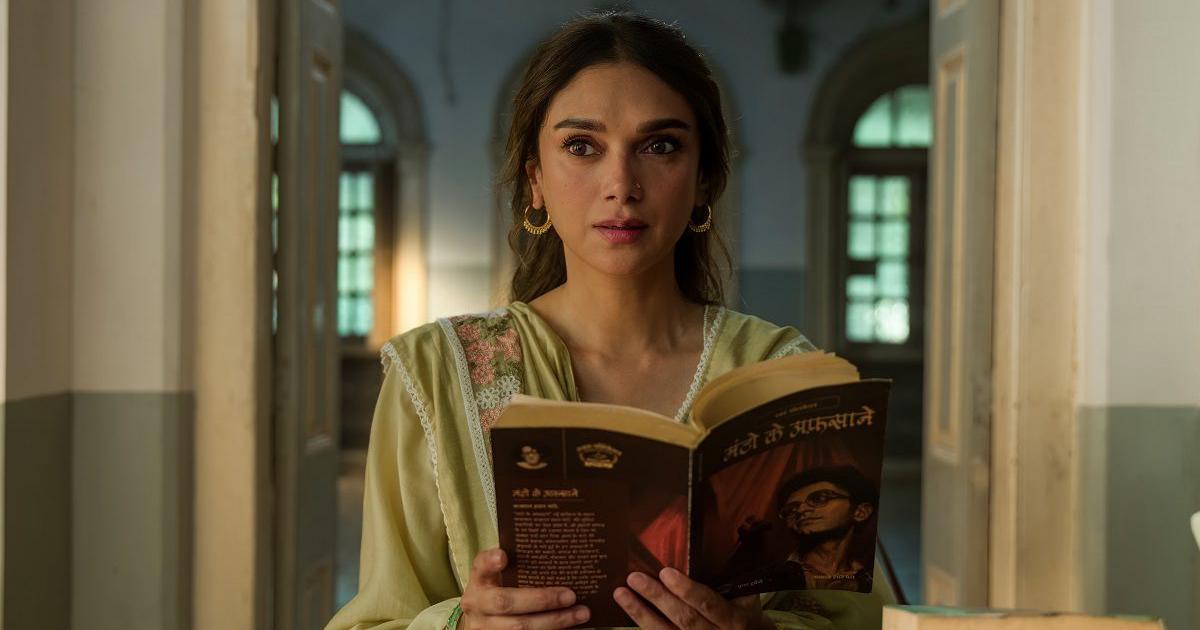
Unable to speak freely, Saira begins writing erotica. Writing gives her a private space to express thoughts she cannot share in everyday life. On the page, she can be bold and adventurous, free from the limits imposed by marriage and society.
Hydari brings warmth and humour to the role. Saira is sensual, but also nervous and occasionally awkward. Her imagination is powerful, yet she is unsure how to express it in real life.
Siddharth makes Badru appealing without turning him into a perfect romantic hero. He is not cruel; he simply does not understand that love requires attention. His relationship with Saira suggests that people can care for each other and still fail to understand each other’s needs.
Siddharth makes Badru appealing without turning him into a perfect romantic hero. He is not cruel; he simply does not understand that love requires attention.
Bhardwaj fills the story with rich interior design, poetic dialogue and heightened performances. The colours, costumes and interiors give Hyderabad a strong visual identity. The film feels shaped by Saira’s imagination.
At times, the style becomes excessive. The emotional truth of Saira’s loneliness is occasionally buried beneath the decoration. Yet the theatrical approach also serves a purpose. Her inner world is larger and more colourful than the life she has been allowed to live.
Gajraj Rao is enjoyable as Saira’s eccentric father-in-law, adding humour and warmth. The story takes time to find its rhythm, but it eventually reaches a gentle understanding. Saira and Badru may not be completely incompatible. They need to learn that intimacy is more than physical access; it also requires curiosity and care.
On the whole, Lust Stories 3 is an entertaining but uneven anthology. It works best when it looks beyond physical desire and asks what its characters are really seeking. Not every chapter reaches the same level, and some ideas are stated more directly than necessary. Still, the anthology is a worthwhile weekend watch. It offers enough humour, drama and emotional insight to remain engaging.







Leave a Reply