
The first encounter I had with Odysseus came during my literature studies in the undergraduate reading Tennyson’s The Lotos-Eaters. It gave a brief moment from Homer’s epic when Odysseus and his men arrived on an island where they consumed the mysterious lotos flowers and lost all desire to return home. It’s quite melancholic of how Tennyson described it; and only after so many years do I understand that adapting a literary work as culturally significant as Homer’s epic is not simply a matter of transferring a narrative onto the screen; as The Odyssey (2026) attempted to do. It requires negotiating between preservation and reinvention – between remaining faithful to a text that has shaped western storytelling for nearly three thousand years and finding a perspective that speaks to a contemporary audience.
The oral storytellers carried it forward which eventually reached us in classrooms thousands of years later. Chris Nolan’s interpretation approaches the epic not as a fixed historical artifact but as something that has always evolved through generations. And Nolan didn’t have the fear of altering a sacred classic to us; rather he treated Odyssey in a motion. Ancient myths survived because they have been constantly reshaped, interpreted and reimagined.
From the Bard’s opening scene, the film showcases the whole plot in just one line with flashbacks –
“ A face…a fleet…a war…a man…a thought…a trick! A trick to break the walls of Troy…and burn it, screaming to the ground!”
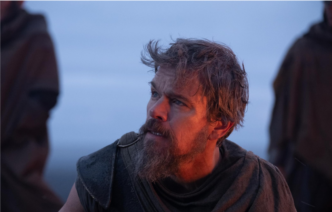
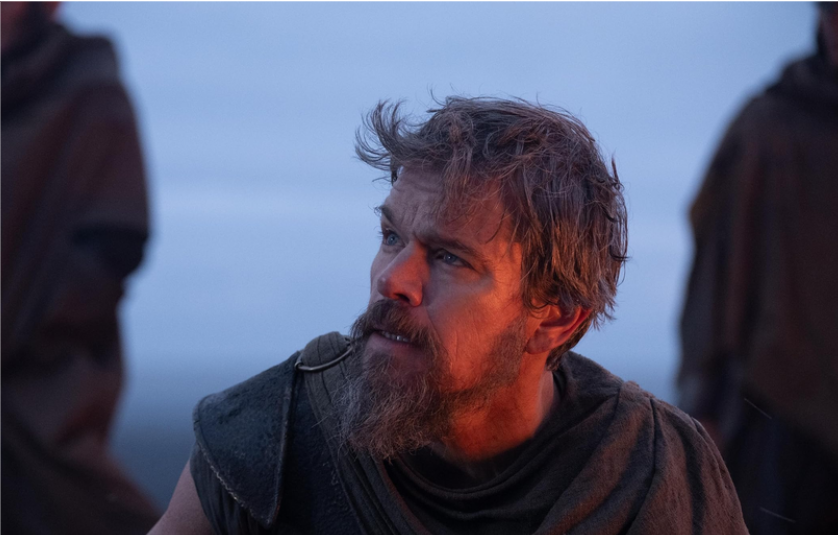
Odysseus’s journey home is not just about across oceans and unfamiliar lands, it is also an internal journey through everything he has lost and everything he must confront. Matt Damon’s portrayal as the lead captures that complexity. Despite being a brilliant strategist and legendary warrior celebrated in ancient texts, he is just a man worn by years of conflict. A survivor forced to live with the consequences of his choice. His greatest battles are less against mythical creatures or divine forces and more with his own guilt and pride.
Technically, the film does not rely on the visual grandeur alone; apart from its casting controversies or Zendaya’s ethereal premier looks, its creative choices reveal a deliberate connection between form and theme. The cinematography, sound design, editing structure or use of physical environments are carefully constructed to reflect the uncertainty and isolation at the center of Odysseus’s journey.
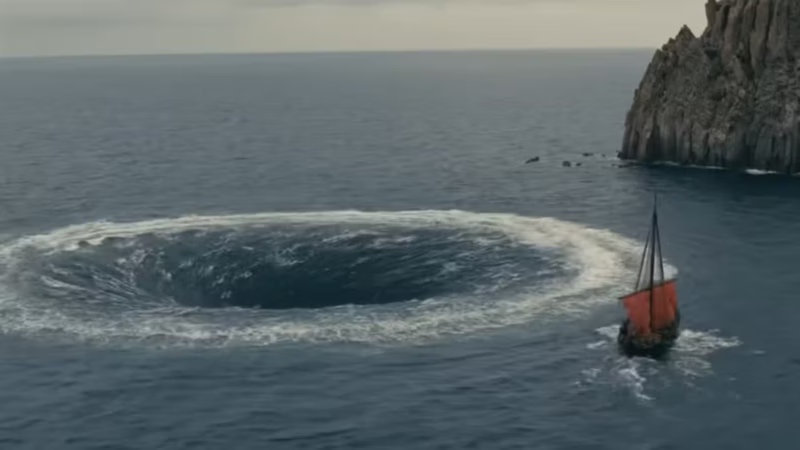
Using Hoyte van Hoytema as the cinematographer is another major strength of the film. Having previously worked with Nolan in Interstellar (2014), Dunkirk (2017) and Oppenheimer (2023), van Hoytema brings his signature large -format approach to The Odyssey. The camera movement, lighting and wide composition, carefully controlled depth of field creates a visual contrast between landscapes and intimate character moments. IMAX cameras are traditionally associated with large action sequences because of their size and mechanical limitations, yet Nolan and his team developed new solutions to use the format for quieter dramatic scenes as well. This reflects Nolan’s broader filmmaking philosophy: the epic moments matter because of the human experiences happening within them. The use of 15- perf/65mm IMAX film camera is therefore not only a stylistic device but also a storytelling one, turning the sea, storms and lands into visual reflections of Odysseus’s psychology.
The decision to shoot the film entirely on IMAX film gives it a physical presence that emphasizes texture, spatial depth, and material details, giving the mythological setting a convincing sense of physical reality. The colour design also plays an important role in separating the different emotional spaces of the story. As I see it, the film uses naturalistic tones and shifting palettes that can be a tool to mirror Odysseus’ changing state of mind. The contrast suggests the emotional distance between who he was and who he became.
Similarly, the soundscape avoids treating mythology as something distant or unreal. The siren’s sequence is one of the most striking audiovisual moments in the film.
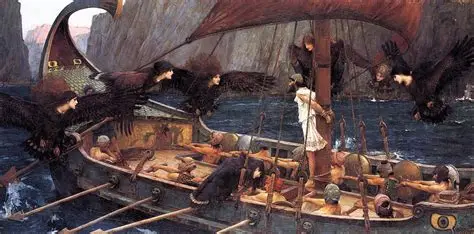
Greek sirens were half birds, half woman as Homer’s scripture described the details in a much larger portion. Odyssey merely showed us any of that. But Ludwig Göeasson’s score in this particular scene filled up that gap. His use of recurring musical themes including the tavern-like scales creates a sense of grandeur like none other throughout the whole movie.
If I talk about the characters, Anne Hathaway’s Penelope embodies her character perfectly. The film complements her a lot; becoming a figure of endurance, intelligence, and quiet strength of womanhood. But what I found particularly compelling were the portrayals of Circe, Agamemnon, and Antinous. The film gives each of them a distinct presence. Circe is presented with an intriguing balance of wisdom and ambiguity, making her feel less like just a mythical enchantress. She is a woman who has learned to wield power in a patriarchal world that has repeatedly underestimated her. Robert Pattinson as Antinous makes the most of his limited screen time. The shared time of him and Tom Holland felt like a treat to be honest. Who knew Nolan would give us the Spider-Man vs Batman face- off in togas?
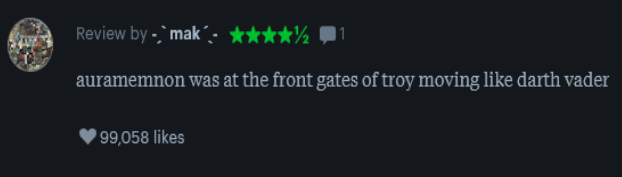
And I have to mention – Benny Safdie’s portrayal of Agamemnon left a lasting impact on the theater as the foil to Odysseus. Both returned to their wives but one got murdered, and another got embraced. By using The Odyssey to reflect on the erosion of civilizations, Christopher Nolan places Agamemnon at the center of the film’s larger thematic vision. Nolan delivered him almost as this ominous symbolic figure rather than just a king; a harbinger of death disguised as a conqueror. Much of the promotional material focuses on his imposing spine-like golden helmet rather than on a recognizable face. The choice is telling: the helm evokes military, imperial ambition, and the legacy of the Trojan war. By foregrounding this iconography, the film’s artwork depicts Agamemnon into the embodiment of imperial power or, to borrow Gen Z vocabulary from Letterboxd, pure “aura farming.”
Nolan’s greatest success is that the technical ambition serves the narrative instead of replacing it. The film could easily have become another effects-heavy fantasy epic, but its filmmaking choices repeatedly return the attention to humans. The monsters, gods, and impossible challenges are visually impressive, yet Nolan engages with an audience already familiar with large-scale mythological films such as Troy (2004) and The Return (2024).
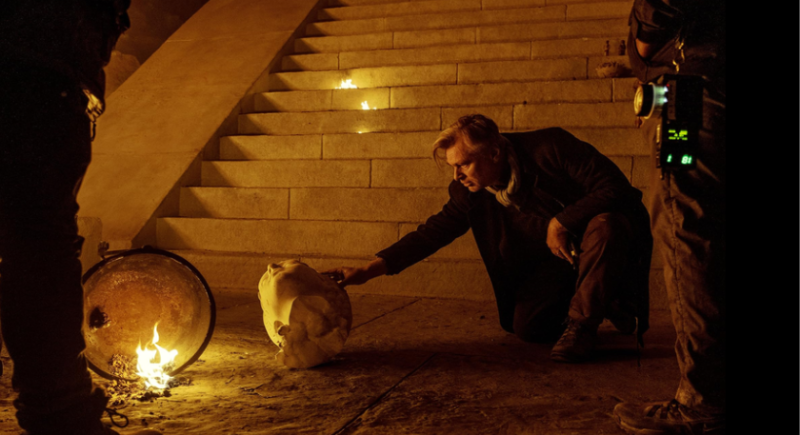
Even today the islands scattered across the Ionian sea continue to compete for the honor of being the real Ithaca, while caves in Sicily are still identified by some possible dwelling place of Polyphemus – the Cyclops. History, geography, and even myth have intertwined, making it almost impossible to separate the world of legend from the traces of the past.
Today when Hollywood is filled with remakes, sequels and reboots, it is easy to be skeptical of another adaptation. And that’s okay. Nolan’s version is not the first, and certainly will not be the last. Yet it earns its place by showing that an ancient epic still has a lot to say to the modern audience. Perhaps that is why he succeeded in finding the heart of the same old classic; by looking beyond the myth to the people at its centre. Surely, Odyssey stands among Nolan’s one of the strongest films. It is proof that for a tale that has travelled across countless retellings, it still has room for one more. And that is ultimately what makes this adaptation worthwhile.