


The classroom fan turned. The air stayed exactly where it was.
Zayan Chowdhury watched a bead of sweat track down the neck of the girl in front of him and calculated how many words he could write before the seminar ended. Only forty-seven minutes left. He could finish the blog post about supply chain logistics and maybe start the product descriptions for that furniture company.
Professor Ansari was saying something about the anthology.
“A prestigious publication. An exceptional opportunity.”
Zayan had heard this speech before from various professors, all of whom thought prestige was the price of admission. Two hundred taka paid for every hundred words. Prestige was what people who didn’t need money called success.
He lit a cigarette in his mind—the phantom smoke he allowed himself during class because actual smoking would require going outside, losing fifteen minutes, and fifteen minutes was three hundred words at his going rate. Three hundred words were sixty taka. Sixty taka was the difference between riding the bus and walking home in the heat. Small calculations added up, determining whether the month ended in black or red.
His mother called them “Zayan’s numbers.” The constant mental accounting had started the day after his father’s funeral seven years ago, when he’d opened the red notebook above the gas burner and understood that the world was divided into two types of people: those who could afford not to count and everyone else.
“I’d like to open this project to volunteers,” Ansari said, his voice carrying that academic enthusiasm that always sounded to Zayan like someone trying to sell you something you’d already decided not to buy.
The room stayed quiet. Twenty-three people with various degrees of interest; nobody was stupid enough to volunteer for extra work. At least his classmates understood basic economics.
A hand shot up from the corner of his eye. Mira Hossain’s hand had gone up. Zayan’s pen stopped mid-word.
She sat two rows diagonal, her hand raised with the kind of certainty that made people nearby sit up straighter. She spoke in seminars as if she were grading everyone else’s contributions—not unkindly, which somehow made it worse. Polished. Certain. The silver rings she wore, shimmering when she gestured, were genuine silver, not the cheap alloy that turned your fingers green after a week. She’d gotten a higher score than him on the last essay. He’d been writing professionally for six years.
He’d noticed her the first week of the semester. It was difficult not to, considering she’d corrected Professor Ansari on a citation. The professor had checked, found she was right, and thanked her. She nodded as if being wrong was the natural order of things, and she was its exception.
“Wonderful,” Ansari beamed at Mira. “I’ll pair you with someone for the technical submission process. You’ll hold the authorization code.”
Zayan’s hand was up before the thought finished forming.
He didn’t know why he’d done it. The movement had bypassed his usual cost-benefit analysis entirely. His brain was still back on the product descriptions, while his hand had apparently decided to volunteer him for unpaid labor with the one person in the seminar who made his jaw tight just by existing in his peripheral vision.
Mira turned around. Hazel eyes found him immediately. Her eyebrows rose slightly. One of her rings caught the light, throwing a small bright spot onto his notebook.
He looked back down at his notebook.
“Perfect,” Ansari said. “Mira will hold the authorization code. Zayan, you’ll assist with the technical submission. I’ll email you both the details.”
The seminar room door was three inches open and permanently broken, and through it, Dhaka conducted its usual business: the rickshaw bells, the azaan from three different mosques arriving at slightly different intervals, the bus conductors yelling destinations in that particular Dhaka rhythm that sounded like music if you stopped listening to the words. Zayan had stopped listening to the words a long time ago. He just let Dhaka be Dhaka while he moved through it with the efficiency of someone who couldn’t afford to be charmed by his city.
He went back to his product descriptions. He typed another hundred and forty words about the lumbar support and breathable mesh backing. Behind him, someone whispered something.
Laughter rippled through the back row. He didn’t turn around. Other people’s amusement wasn’t billable.
When class ended, Mira left without looking at him. He was already typing.
He packed his laptop, his notebook, his pen—his mind buzzing with the numbers floating around that should help him pay his rent this month, although he had his doubts—and walked to the library steps, on the side entrance facing away from the main gate, and lit his second cigarette of the day. Gold Leaf. Cheaper than Benson, better than the local brands. Four cigarettes budgeted per day. Forty taka total.
His phone buzzed. A text from his sister, Riya:
Ammu is asking when you’re coming home. You haven’t visited in two weeks.
He typed back:
Soon. Have to finish work first.
You’re always finishing work.
That’s how rent gets paid.
Three dots appeared. Disappeared. Riya knew better than to push.
The evening call to prayer started. He checked his phone: six forty-seven. The furniture deadline was nine. Two thousand words left. If he focused, he could be done by eight-thirty.
Numbers. Always numbers.
Someone sat down next to him. He didn’t look. The steps were public property. Then he smelled that floral shampoo (expensive, probably some imported brand) and kept his eyes on his phone anyway.
“You smoke a lot,” Mira said.
He took a drag before answering. “Four cigarettes a day. That’s not a lot.”
“It’s four more than zero.”
“Congratulations on your math skills.”
A pause. He could feel her looking at him the way people looked at things they were categorizing. He stared at the middle distance.
“I’m surprised you volunteered,” she said. “For the anthology.”
“Mm.”
“Don’t you want to know why I’m surprised?”
“Not particularly.”
Another pause. Longer this time. “Because we’re going to have to work together,” she said, her voice taking on the particular tone of someone deciding to be patient. “I’d prefer it not be completely miserable.”
“If you wanted someone easy to work with, you should have waited to see who else volunteered.”
“Nobody else was going to volunteer.”
“How do you know?”
“Because I’ve been in class with these people for four months, and I know exactly what they’re willing to do for free.” She finally turned to look at him directly. He caught it in his peripheral vision—that direct, assessing gaze. “Why did you volunteer?”
“Does it matter?”
“It might.”
He took another drag. Said nothing.
The rickshaw bell rang. The city did what it always did.
Mira closed her book. “The code arrives tomorrow. We need to decide how we’re splitting the work.”
“You write, I submit. That’s the split.”
“I meant the technical coordination. The formatting, the file preparation, making sure everything meets the submission requirements.”
“I’ll handle it.”
“Have you read the requirements?”
“I’ll read them when I need to.”
“They’re twelve pages long.”
“Then I’ll read twelve pages.” He finally looked at her, squinting against the sun setting behind her head. “Is there a point to this conversation?”
Something shifted in her expression. Not a smile exactly, but the recognition that she’d been right about something she’d suspected. She stood and walked back toward the library entrance, her shoulders back, her head up.
He checked his phone: six fifty-three. Seven minutes over budget. He went inside to finish the furniture descriptions.
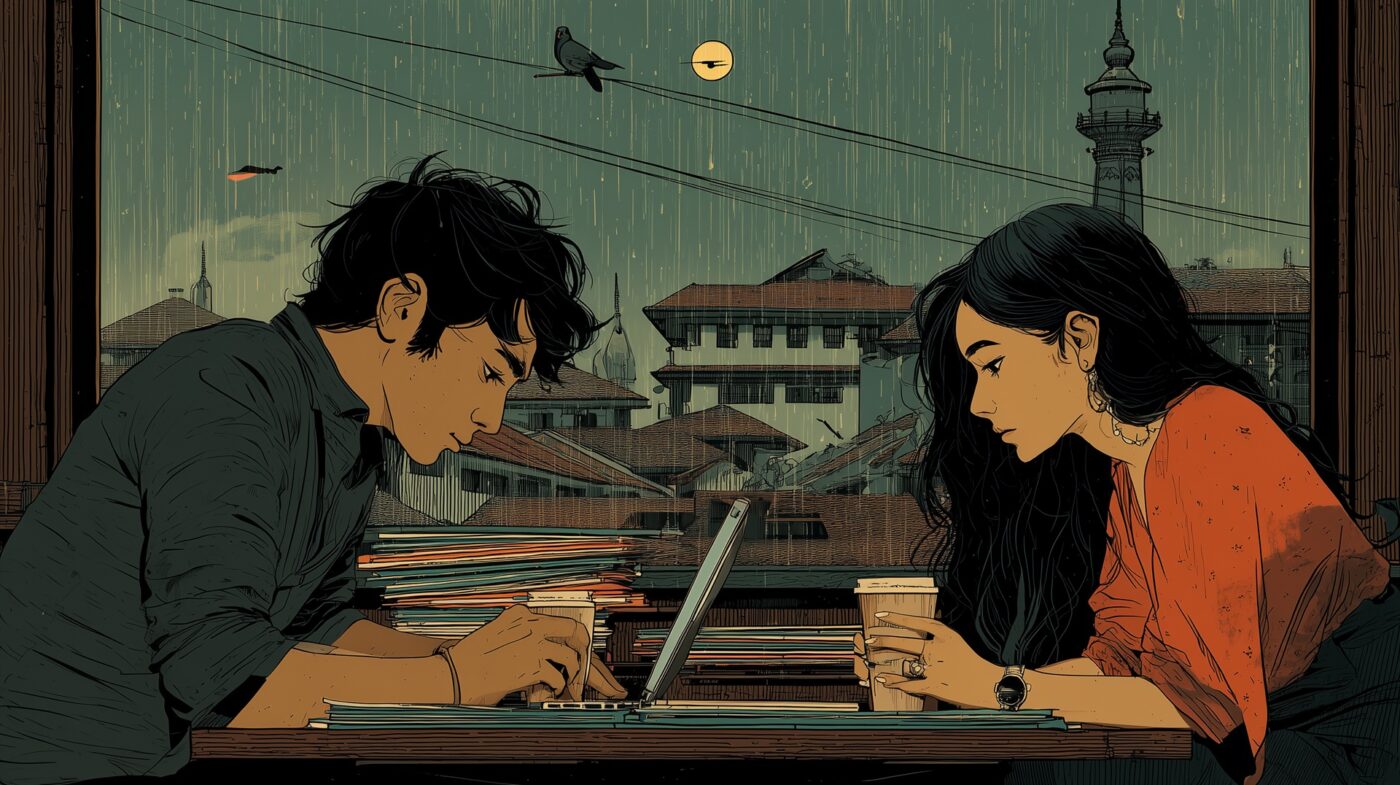
The library’s third floor smelled like old paper and the specific mildew of Dhaka buildings where the AC fights a losing battle against humidity. Zayan had claimed a table near the window two months ago—good wifi, decent light, far enough from the librarian’s desk that nobody bothered you about eating in the study areas. He knew the table like he knew his own room: the wobble in the left leg, the scratch on the surface that he’d started using as a margin guide.
He was four hundred words into the furniture piece when Mira sat down at his table. Not across from him. At his table, in the chair diagonal to his, close enough that he could smell her shampoo and see the small scar on her left eyebrow.
He kept typing. Made it another two sentences.
“We need to talk about the timeline,” she said.
His eyes didn’t leave the screen. “Email me.”
“I’m sitting right here.”
“I’m working.”
She opened her laptop. Set it down with a small decisive click. Pulled out a printed document and smoothed it flat on the table. Then she pulled out a second document. Color-coded tabs. He registered all of this in his peripheral vision and kept typing.
“The submission portal opens in two weeks,” she said. “The deadline is November twenty-third at midnight. That gives us—”
“Seventeen days. I can count.”
She looked at him. He could feel it—the quality of attention shifting, getting more precise. “Can you also cooperate, or is being difficult your only setting?”
“I have two settings. Working and not working. Right now I’m working.”
“On the anthology?”
“On paying my rent.”
She glanced at his screen. He should have minimized the window. The document was visible: “Product description: ErgoMax Executive Chair Series.”
“That’s an ad for office chairs,” she said.
“It’s five hundred words at two hundred taka per hundred. Which makes it worth a thousand taka. Which makes it more valuable than this conversation.”
Something flashed across her face. She closed her laptop with a decisive click. Gathered her things—sharp, efficient, a person used to knowing when she wasn’t wanted and leaving before she could be told. “Fine. I’ll email you the timeline. Please make sure to review it before the deadline passes.”
She stood.
“You live alone,” Zayan said.
She stopped. “What?”
“Your apartment. You live alone.”
Her cheeks had gone slightly pink. “How do you know that?”
“You’re here every evening until closing. Nine PM, like clockwork. You don’t check your phone the way people with roommates check their phones. And you just said ‘I’ll email you’ instead of ‘let’s meet.’” He shrugged. “You live alone.”
“That’s a creepy amount of observation.”
“That’s basic pattern recognition.”
“It’s still creepy.”
“Probably.”
She stood very still for a moment. “Do you watch all your classmates this closely, or am I special?”
He looked back at his screen. “I notice things.”
“You notice things,” she repeated. Then she left.
He kept typing. The words came out wrong for the next ten minutes—kept losing the thread of the lumbar support copy, kept having to delete and restart. He blamed the humidity. He blamed the fan that wasn’t working. He didn’t think about her at all.
The timeline arrived at eleven PM in an email with three attachments.
He opened the first: a twelve-page requirements PDF, already annotated in the margins in handwriting so small it looked typeset. Notes cross-referenced to other pages. Arrows connecting related specifications. The submission code written at the top of page nine and underlined twice, as if she’d anticipated forgetting.
The second attachment was a timeline, color-coded by task owner. His tasks were in blue. Hers were in green. The formatting column was entirely blue.
The third attachment was a checklist.
He read through all three. Then he opened a reply, typed “Received,” and closed his laptop.
He lay on his bed in Mirpur, in the room where the walls were thin enough to hear his neighbor’s TV and the fan squeaked and the bathroom was shared with three other tenants, and thought about the twelve-page requirements document with its tiny, precise annotations. The person who’d made those notes was not careless. She was the opposite of careless in a way that probably exhausted everyone around her.
He didn’t think that was a compliment. He wasn’t sure it wasn’t.
They worked around each other for the first week more than together. She’d occupy the library table to his left, spreading her color-coded folders across her half of the surface with the precision of someone demarcating territory. He’d type. She’d type. Occasionally she’d ask him something about file formatting or submission protocols, and he’d answer in the minimum number of words, and she’d type the answer into what appeared to be a master document of some kind, as if she were building a record of everything he said in case she needed to cite it later.
It was, objectively, a deeply irritating way to work with someone.
On the fourth day, she sent him a message while they were sitting two feet apart:
Have you started the formatting yet?
He looked at the message. Looked at her. She was looking at her screen. He typed back:
I’m sitting right next to you.
Her response came immediately:
I know. But I didn’t want to interrupt your work.
He put his phone down and went back to his product descriptions and did not, under any circumstances, smile.
On the fifth day she arrived at the table with two coffees. Set one down next to his laptop. Said nothing. He looked at the coffee. Looked at her. She was already opening her own laptop.
“What’s this?” he said.
“Coffee.”
“I can see that.”
“I got it from the cart downstairs. The one near the exit.”
“I know which cart.”
“Oh.” She typed something. “I got you one because I was getting one anyway.”
He looked at the coffee again. It was still hot. She’d timed it to arrive while it was still drinkable. He pulled it toward him and kept working. The coffee was good. Stronger than he usually made it, with less sugar. He didn’t tell her that was exactly how he liked it.
The funny thing—the thing neither of them planned—happened on day eight, a Sunday, in the library’s third floor when they were supposed to be doing a dry run of the submission process.
Mira had brought her laptop, her blue folder, her green folder, her yellow folder, a printed copy of the requirements doc, and a small sticky-note diagram she’d made of the submission portal’s page flow. She unrolled the diagram on the table like a general presenting a battle map.
Zayan looked at it. “You drew a diagram.”
“It helps me visualize the process.”
“It has color coding.”
“Yes.”
“The portal is three pages. Login, form, upload. That’s it.”
“I know, but—” She smoothed a corner of the diagram. “I needed to see it laid out.”
He turned to his laptop. Navigated to the portal. Clicked through the three pages. Turned the laptop toward her. “Login,” he said. “Form. Upload.”
“I see that.”
“Okay.”
She folded the diagram carefully and put it away. He went back to his screen. She opened the blue folder and began cross-referencing specifications. He pulled up the essay file to check the formatting. Everything was fine. It was always going to be fine. The deadline was nine days away and the essay was nearly done and the only thing left was a straightforward upload that any functioning adult could manage.
He navigated to the submission portal again, just to verify the file size limit. Clicked login. Entered the test credentials Ansari had sent. Hit enter.
The page went white.
Then it loaded. A banner across the top read: MAINTENANCE MODE—PORTAL UNAVAILABLE 14:00–17:00 SUNDAYS.
It was 14:06.
He stared at the screen. Then he checked the maintenance schedule, which was listed at the bottom of the page in a font that appeared specifically designed to be ignored. Every Sunday. Right there.
“The portal is down,” he said.
Mira leaned over. Read the screen. “Since when?”
“Since six minutes ago. Every Sunday, apparently.”
“That’s not in the requirements doc.”
“It’s on the portal’s own front page.”
She took the laptop from him and read it herself, as if his summary might have been inaccurate. He watched her read the same three sentences twice. He watched her check her blue folder. He watched her flip to page seven of the requirements doc, scan it, flip back.
“It’s not listed anywhere in the official documentation,” she said.
“It is listed. On the portal. Which we’re currently looking at.”
“It should be in the documentation.”
“It should be. It isn’t. The portal is still down.”
She closed the blue folder. Opened the green folder. He had no idea what she thought the green folder was going to contribute. He turned away to look out the window while she worked through whatever internal escalation procedure she used when reality failed to match her documentation.
When he turned back, she was on her phone typing an email to Ansari, by the looks of it—three paragraphs about the undisclosed maintenance window and its impact on their submission timeline preparation and could he please confirm the portal would be fully functional by the following Sunday.
“Mira.”
She held up a finger. Still typing.
“The portal comes back up at five. We can do the dry run then.”
She finished the email and sent it. Then she set down her phone, folded her hands on the table, and looked at him with the expression of someone who has handled the situation.
“We can do the dry run at five,” she said.
“That’s what I just said.”
“Yes, but now Ansari knows about the documentation gap.”
He was quiet for a moment. “What would you like to do for the next three hours?”
She thought about this seriously. “We could review the essay’s formatting against the style guide. Or I could walk you through the cross-reference system I’ve set up for—”
“We’re not doing that.”
“Or we could—”
“We have three hours and nowhere to be. We’re going to sit here like two normal people who are not working.”
She looked at him like he’d suggested something mildly illegal. “And do what?”
“Nothing. Whatever. Talk.”
“About what?”
He thought about it. “Tell me something true that has nothing to do with this essay.”
The expression on her face cycled through several things quickly: surprise, suspicion, something that might have been amusement. She looked down at her hands.
“Something true,” she repeated.
“Yes.”
A long pause. “I have an irrational fear of pigeons,” she said.
He turned to look at her fully for the first time in about a week that wasn’t about work. “What.”
“Not all birds. Just pigeons specifically. They move wrong.” She was very serious. “Their heads. That thing they do when they walk—the back-and-forth. It looks like they’re planning something.”
“They’re not planning anything. They’re looking for food.”
“That’s what they want you to think.”
He stared at her. She stared back. Then he looked out the window, and there, on the library’s outer ledge, directly level with the third floor, was a pigeon. It was walking in that particular mechanical way pigeons walked, its head punching forward with each step like a tiny man arguing a point no one had asked about.
“Mira.”
She followed his gaze. Went very still.
The pigeon stopped. Turned its head. Looked directly through the window at them with the one orange eye that faced their direction. Then it resumed its walk.
“See?” she said, quietly, without moving. “Planning.”
“It’s looking for food.”
“It’s looking at us.”
“It can’t see through the—” He stopped. The pigeon had turned around and was walking back the way it came, its head doing the thing, its one eye coming back around toward them at intervals. “Okay. That one’s a little suspicious.”
“They’re all like that.”
“They’re not.” He paused. The pigeon had stopped again. It was just standing there now, very still, facing the window. “What is it doing.”
“What did I say.”
“They don’t have the brain capacity to—”
“Zayan.”
“I’m just saying.”
“Zayan, it’s been standing there for thirty seconds.”
He checked his phone. He’d been watching the pigeon for forty-five seconds. The pigeon had not moved. It appeared to have forgotten to be a pigeon and was just standing very still on the ledge, looking through the glass, possibly thinking about whatever pigeons think about, which Zayan had always assumed was nothing in particular but which he was now slightly less certain about.
“It’s fine,” he said.
“Is it?”
“Pigeons do this.”
“Do what? Stare?”
“They—” The pigeon blinked its one visible eye. Very slowly. “They sometimes just stop moving for a bit.”
“And stare at people?”
“I don’t think it’s staring, I think it’s…” He looked at the pigeon. The pigeon continued to look back. “Okay,” he said. “I concede that this particular pigeon is staring.”
Mira exhaled, shoulders slumping. “Thank you.”
“It doesn’t mean they’re planning anything.”
“It doesn’t not mean that either.”
He turned back to his laptop, ever so slowly. But it was there. He could feel it. He was smiling. He felt her glance at him. He kept his eyes on the laptop.
“Something true from you,” she said. “That has nothing to do with the essay.”
He thought about it. “I failed my first driving test.”
“Everyone fails the first—”
“Twice.”
She didn’t say anything for a moment. “How do you fail twice?”
“The first time I panicked and went the wrong way down a one-way street.”
“And the second time?”
“Same street.”
The silence that followed had a specific quality of someone trying very hard not to laugh. He kept his eyes on his screen. He heard the small, quickly suppressed sound that she made. Then another one. Then a cackle.
“It was a stressful period,” he said.
“Of course,” she said, and her voice was wrong in a way that meant she was definitely smiling. “The street is confusing.”
“Obviously.”
“The signage is inadequate.”
“Completely.”
He glanced at her. She was looking at her folder with an expression of intense focus that was not actually intense focus. Her shoulders were doing something. He looked back at his screen.
“Also,” he said, “the examiner the second time was the same examiner as the first time.”
That did it. She laughed—a real one, sudden and unguarded, her hand going up to cover her mouth about a second too late. The laugh transformed her face completely; she looked younger, less armored, like someone who’d forgotten for a moment to be competent.
“His face,” Zayan said. “When he saw me again.”
“What did he do?”
“He looked at his clipboard. Looked at me. Looked back at the clipboard. Like he was checking whether it was a mistake.”
“Was it?”
“He asked me twice if I was sure I wanted to attempt the exam. In front of the other candidates.”
She was laughing properly now, covering her face with both hands, her shoulders shaking. One of her silver rings caught the light. He watched the dissolution of the careful composure she normally wore like a second layer of clothing.
“I eventually got it,” he said, fully smiling now. “The license. Third time.”
“Same examiner?”
“Different examiner. I specifically scheduled a different examiner.”
“Smart.”
“That’s what I thought at the time. Unfortunately, the new examiner and the original examiner were apparently friends. I could tell because when I pulled up, the original examiner was standing near the office window, and the new examiner saw him and made a face.”
She made a sound that might have been a squeak. “He didn’t.”
“He absolutely did. Some kind of look,” Zayan considered. “Some kind of ‘good luck, you’re going to need it’ look.”
“And did you? Need luck?”
“I passed.”
“You passed.”
“I went the correct direction on every street.”
She laughed again. When she looked up, her eyes were bright, a few strands of hair escaped from where she’d had it pinned back. The pigeon, Zayan noticed, had at some point left the ledge. Its absence felt like permission.
“I have a confession,” Mira said.
“What.”
“I’ve never learned to drive.”
“That’s not a confession.”
“It is here. My father tried to teach me twice and both times I cried.” She said this with the perfectly flat affect of someone who has processed the memory and filed it under character-building. “Not from fear, really. From frustration. I couldn’t do it immediately and that upset me more than the driving did.”
He looked at her. The pigeon had come back. Neither of them mentioned it.
“That tracks,” he said.
“It does, doesn’t it.”
“Very much.”
She smiled at him, and went back to her folder. He went back to his screen. The afternoon light moved. They worked, and didn’t work, and the three hours passed in a way that time rarely passed for him: without counting.
The following week settled into a library-table ritual they’d somehow agreed to without discussing it: same table, seven PM, two coffees from the cart downstairs. Zayan stopped noticing the coffees in the way you stop noticing things that have become part of the furniture. He stopped minimizing his work windows when she arrived. She stopped color-coding things that didn’t need color-coding, at least not while he was watching.
The essay was nearly done.
“I’m having trouble with the ending,” she said one evening, without preamble.
He kept typing for a moment, finishing his sentence. “What kind of trouble.”
“It needs to do something I don’t know how to do.”
“Which is?”
“Matter.”
He stopped typing. He’d read the draft she’d sent. First the introduction, then the body in pieces, each one better than the last, each one with that quality of precision that he was starting to recognize as distinctly hers. Not effortful precision. Structural precision. She thought in architecture.
“What’s it about,” he said. Not a question exactly.
“Loss. How it changes time. How you wake up three months after someone dies and the world is exactly the same. The same traffic, same food, same arguments—but you’re different. You’re walking around in a life that doesn’t fit anymore.” A small, sharp gesture. “Like wearing clothes that used to fit perfectly. Too big or too small. And everyone expects you to just adjust.”
He leaned back. Outside, the evening call to prayer had started, arriving from three different mosques in overlapping waves. “You’re trying to resolve it.”
“I’m trying to end it.”
“Same problem. Loss doesn’t resolve. So an essay about loss can’t conclude. It just stops wherever you choose to stop examining it.”
She looked at him with the full-focus version that he was starting to be able to read as distinct from the categorizing look. “That’s not how essays work.”
“It’s how true things work.”
She was quiet for a moment. Then she opened her laptop and pulled up the draft. He went back to his own screen. They worked without talking for a while, and he was aware of her presence differently than he’d been in the early days. Not harmonious, exactly. But not discord either.
“Show me what you’ve written,” she said. “For work.”
“Why.”
“Because I want to see if you’re actually good or just thorough.”
“Those aren’t the same thing.”
“I know. That’s why I’m asking.”
He should have said no. But he found himself reaching for a different file. Something he’d written at three AM last week, the kind of thing he usually deleted. A paragraph about standing in line for the bus in the rain, about how everyone in the line was equally miserable but pretending not to be, about how Dhaka taught you to perform normalcy because admitting things were hard was a luxury no one could afford.
He turned the screen toward her. Said nothing.
She read it. He watched her face without watching it—peripheral attention, the way he’d been tracking her for weeks. Saw her eyebrows shift. Saw her lips move on certain phrases. Saw her reach the end and scroll back to the beginning.
“You delete these,” she said.
“Yes.”
“Why.”
“Because nobody pays me for them.”
She turned the screen back to him. But her finger lingered on the trackpad a moment. “Don’t delete this one.”
“Why not.”
“Because it’s raw. It’s good and it’s raw and those don’t usually happen at the same time.” A pause. “And because I just showed you something unfinished. Now you have to show me something back. That’s how this works.”
“I didn’t agree to any rules.”
“Too late. I’m making them retroactive.”
He didn’t smile. He was very careful not to. But his jaw had unclenched at some point in the last few minutes without him noticing, and when he went back to his own work, the words came easier.
The collaboration had a texture now. It existed in specific increments: the coffees, the parallel silences, the way she’d occasionally read something aloud from the essay and wait for his response, the way little kids wait when they want to know if they’ve gotten something right. The way he’d occasionally turn his screen toward her without explaining what he wanted, and she’d read it and tell him which sentence was wrong and where. She was usually correct. He didn’t tell her that either.
He’d started reading the essay the way you read something that matters. Not as an editor (though he made notes in the margins when she sent sections) but as a reader. As someone who recognized the thing she was building. He told her this in an email at three AM when he couldn’t sleep and the words came easier because it was dark and he could pretend he was writing to the essay itself rather than to her.
She responded at three-fifteen:
Are you always awake at 3 AM?
When there’s work.
That’s not healthy.
It’s functional.
Zayan.
What?
Go to sleep.
He didn’t. But he appreciated that she’d said it.
On Sunday the following week, she brought him coffee and set it down without a word. He pulled it toward him without a word. They were four days from the deadline. The essay was done except for the ending. Everything else—formatting, file preparation, the twelve-page requirements checklist, the submission portal’s quirks, the specific naming convention for the file—was handled, documented, cross-referenced. He’d handled most of it. She’d documented all of it. It was the most efficient collaboration he’d had with anyone who wasn’t a client.
“Do you care about this essay,” she asked suddenly, “or are you just thorough?”
He looked up from his screen. She was watching him with that full-attention look. No rings today. He’d noticed she sometimes removed them when she was working seriously. Dark circles she hadn’t tried to conceal.
“I care,” he said.
“Why.”
“Because it’s good. Because you’re saying something true about something that matters.” He looked back at his screen. “Because watching you fight for this made me remember what it feels like to fight for something besides money.”
Mira was very quiet. He didn’t look at her.
“You can’t just say things like that,” she said finally, her voice doing something he didn’t have a name for.
“Why not.”
“Because I don’t know how to respond.”
“You don’t have to.”
“Yes I do.” A pause. “You said something real. Now I have to—match it. Return serve. Whatever the metaphor is.”
“There’s no rule about that.”
“There should be.”
They looked at each other. He let it hold for a moment. Then he looked back at his screen, and after a beat, she did too.
Neither of them said anything else for a while. It was, he thought, the most comfortable silence he’d had with another person in about seven years.
Two days before the deadline, the tension broke.
It had been building for a while, if he was honest. The kind of pressure that accumulates in small increments. Her corrections that didn’t need to be corrections, her cross-references to documents he’d already read, the way she’d double-check things he’d just told her as if his word alone required verification. And his own responses, which had been getting shorter and flatter in a way he recognized as a warning sign he was choosing to ignore.
It started with the file name.
“You named it wrong,” she said, pulling up the requirements doc to show him.
He looked at the file. “Hossain_M_AnthologySubmission_Nov23.pdf. That matches the naming convention.”
“It should be Hossain_M_BRAC_AnthologySubmission_Nov23.pdf. Page seven. The institution abbreviation is required.”
He pulled up the requirements doc himself. Read page seven. “It says the institution abbreviation is optional.”
“It says ‘recommended,’ which in submission contexts means—”
“It means recommended. Not required. Optional.”
She typed the corrected name into her master document. “I’d prefer to include it. It reduces ambiguity.”
“The essay is the only submission in your name. There’s no ambiguity.”
“There could be.”
“There’s not.”
“Zayan.” She looked at him the way she looked at things that were failing to meet a documented standard. “I just want it done correctly.”
And there it was: that word, that tone, the quiet implication that his version was somehow not correct. He’d been hearing it for two weeks in small doses. The cross-check emails sent while they were sitting two feet apart. The documentation of things he’d already confirmed. The sticky-note diagram of a three-page portal.
“It is done correctly,” he said. “The requirement is optional. I’m not including it.”
“I’m going to include it.”
“Fine. It’s your submission. But stop acting like I made a mistake.”
“I’m not saying you made a mistake. I’m saying there’s a more thorough approach.”
“You’re saying my approach is insufficient.”
“I’m saying my approach reduces the margin for error.”
“For an error that doesn’t exist.”
She opened a new tab on her laptop. He watched her pull up the portal’s general FAQ page, looking, he was almost certain, for a citation to support her position. The fact that she needed a citation to win an argument they’d already finished was so precisely her that he felt something tip over inside him.
“Mira. Put it down.”
“I’m just checking.”
“You’re documenting a disagreement. You’re making a record of it. You’ve been doing that since day one. Every time I tell you something, you put it in a document, like you need proof later, like you’re planning to—” He stopped. Started again, slower. “Like you don’t actually trust me to handle any of this.”
She closed the laptop. Her expression had shifted. There was something tightening around the eyes. “That’s not what I’m doing,” she said.
“Then what are you doing.”
“I’m being organized.”
“You’re being controlling.”
“I’m being thorough.”
“Because you think if you don’t control every element it’ll fall apart. Because you think I’m going to miss something, or do it wrong, or let you down, and you’d rather exhaust yourself cross-referencing everything I’ve already handled.” He heard his own voice getting harder, sharper. “Just trust that it’s handled.”
Mira’s jaw tightened. When she spoke again, her voice had taken on that other quality—the one he’d only heard once before, the one she used when she’d decided to be the most competent person in the room regardless of the cost.
“I trust you just fine,” she said. “I just prefer to verify.”
“There’s a word for that.”
“There’s also a word for someone who shows up three minutes late and tells you their product description is more important than a project you’ve been preparing for for weeks.”
“I showed up.”
“After I’d been here for twenty minutes, setting everything up, organizing the—”
“Nobody asked you to organize everything. I told you I’d handle the technical side.”
“And the technical side was one sentence in an email, Zayan. No timeline, no process doc, no—”
“Because it didn’t need a process doc. It’s three pages on a portal.”
“And what if something goes wrong? What if the portal crashes, or the file format is wrong, or the naming convention—”
“Then we handle it.”
“How? With what plan?”
“With the plan we make when it happens.”
She stared at him. He could see the frustration in the specific set of her shoulders, the precise, controlled way she held herself when something was failing to go correctly.
“That’s not a plan,” she said. “That’s just hoping nothing goes wrong.”
“That’s called managing reality instead of managing documentation about reality.”
Her color had risen to that pink he knew, but colder now, less vulnerable. “You think my system is excessive.”
“I think your system is designed to make you feel like you’re in control of something you’re afraid of.”
The silence that followed was the kind that had a shape.
When she spoke again, her voice was very quiet. “You don’t know what I’m afraid of.”
“You’re afraid the essay won’t be good enough. You’re afraid Tariq’s death will mean nothing if you can’t do this one thing right. So you make color-coded folders and cross-referenced timelines and process documents for a three-page portal, because if you’ve done everything correctly, if you’ve covered every margin for error—” He stopped. The words had gotten away from him. He looked down at his hands.
The silence stretched.
“You know what,” Mira said. Her voice was controlled in the way that things are controlled just before they aren’t. “You think you understand me because you notice things. You think being observant makes you insightful. But you don’t know why I do what I do—you just decided you do, and then you built a whole theory, and now you’re telling me my grief is—what? A management failure? A documented anxiety?”
He opened his mouth.
“I have a dead brother,” she said, “and I am trying to keep a promise to him, and yes, YES, I make folders, and I cross-reference things, and I send follow-up emails, because when I feel like something is slipping out of my hands I need something to hold onto that I can control. And you can call that excessive. You can call it whatever you want. But don’t—” Her voice broke, just slightly, and then she got it back. “Don’t you DARE tell me what my grief means.”
He didn’t say anything.
She started gathering her folders. Moving with that sharp efficiency he now knew was anger wearing the clothes of competence. The folders went into her bag. The laptop went into its case. The requirements doc was folded carefully and placed on top.
He should let her go. She was right that he’d gone too far. She was also right that he was tired, and when he was tired the filters went down, and without the filters he said the specific true things that were more painful than lies because they were aimed.
But he was also right about the fear underneath the folders. He knew it because he recognized it. He’d built his own version of her folders. He’d just named them differently.
She slung her bag over her shoulder. He started packing his own laptop.
“Okay,” she said.
He looked up.
She was standing very still, her bag on her shoulder, looking at the table. Not at him. Really at the table, at the empty surface where her folders had been.
“Please stay,” she said. Quietly. “I’m asking.”
He set his laptop down.
She put her bag on the floor. Sat back down in the chair diagonal to his. She set her hands on the table. She looked at them for a moment.
“I do that,” she said. “What you said. The control thing. My mother used to call it—” She choked up, eyes welling. “She called it my armor. The organizing. The systems. She said I’d been doing it since I was eight, making lists of everything that needed to happen so that the thing would go right.” A pause. “After Tariq died, it got worse. More elaborate. Because the thing I couldn’t put in a list was the thing that went wrong.”
He put his own hands on the table. Said nothing.
“And you’re right that I don’t fully trust you to handle things,” she said. “Not because I think you’re careless but because the last time I trusted that something would go right, it didn’t. And nobody could have prevented it, and no checklist would have helped, and it went wrong anyway.” She looked up. Her eyes were bright, dry. “So. Yes. I verify things I’ve already confirmed. I know it’s excessive.”
“I went too far,” he said. “With the grief comment.”
“You did.”
“I am sorry.”
She looked at him for a moment. “You were also partly right,” she said. “Which is worse.”
“Usually.”
“The file name,” she said.
He looked at her.
“Let’s include the institution abbreviation.”
“Okay,” he said.
“Okay?”
“Yeah. It doesn’t hurt anything.”
She nodded once, opened her laptop, updated the file name. He watched her do it. He noticed the way her hands had steadied.
“I’m sorry too,” she said, without looking up. “About the three-minutes-late comment.”
“I was late.”
“I know. But I was keeping score.”
“You always keep score.”
“I know that too.” She looked up. “I’m working on it.”
They looked at each other across the table. Something had cracked open during the last twenty minutes and hadn’t fully closed again, but what was visible in the crack was more honest than what had been visible before.
He picked up his coffee. It had gone cold. “I need to tell you something,” he said.
“Okay.”
“About why I volunteered. At the beginning.”
She waited.
“I didn’t think about it. My hand just went up. And I’ve been trying to understand why ever since, because it’s not like me—I don’t do things without calculating them. I don’t have the margin for it. But I saw you raise your hand in that seminar for something that had nothing to do with money, and I—” He looked down at the cold coffee. “I couldn’t remember the last time I’d wanted something for a reason that wasn’t money. And then you wanted this thing, and I thought—” He stopped. Shook his head slightly.
“Thought what?” she said.
He looked at her. “I didn’t want you to do it alone.”
She was quiet for a long moment.
“You’re very strange,” she said finally.
“I know.”
She looked down. The pink had started, traveling up from her collar. “That’s the nicest thing anyone’s said to me in months.”
“It wasn’t intended to be nice.”
“I know. That’s why it is.”
He didn’t know what to do with that, so he looked back at his laptop. His jaw had unclenched sometime in the last few minutes without him telling it to.
That night he thought about the last time someone who mattered to him had died.
His father’s funeral had been seven years ago, but the memory was as sharp as yesterday: the white shroud, the graveyard in Azimpur, his mother standing very still while Riya cried into her shoulder. He’d been sixteen. He hadn’t cried at the funeral. Hadn’t cried after, when relatives filled every room and uttered things like “Allah’s will” and “he’s in a better place,” which felt like platitudes he couldn’t afford to believe.
He’d cried later, alone, when he’d opened the red notebook and seen the numbers.
The debt had been manageable. His father hadn’t been reckless, just unlucky. Medical bills, mostly. Three weeks in a private hospital in Dhaka meant numbers that grew and grew until they stopped meaning anything except “impossible.”
His mother had sold her jewelry. Her wedding bangles, her nose ring, the gold set her own mother had given her. It covered the immediate crisis but not the ongoing one: his father’s salary gone, Riya still in school, rent due regardless.
Zayan had started writing the week after the funeral. Data entry first, then product descriptions, then anything anyone would pay him to do. He’d learned to write fast, clean, and functionally. He’d learned to eliminate any style, voice, or personality that didn’t add value. He’d learned to view language as a means of production.
He’d learned to be glass.
And somewhere in those seven years, he’d also learned not to want things he couldn’t afford. Friendship took time. Dating took money and attention and emotional bandwidth. The most expensive luxury was the kind of dream where you wanted something just because.
He’d had a friend, once. Imran, from school. They’d been close. They’d spent hours talking about nothing and everything, showing each other music and books, half-formed thoughts about what kind of adults they wanted to become. After his father died, Zayan had stopped returning calls. Stopped showing up. Imran had tried for a while and then stopped trying.
Zayan had let him go. Friendship required reciprocity, and he had nothing left to give.
He lay in the dark, listening to his neighbor’s TV through the walls, and thought about Mira’s hands on the table. The way they’d steadied. The way she’d said please stay like she’d meant it exactly, no more and no less.
He’d thought the answer to why he’d volunteered was dangerous. He was right. He’d also stopped caring.
Four days until deadline.
They met at Mira’s apartment on Wednesday to do a final review. He’d said yes before calculating the time cost. Just yes.
Her apartment in Mohakhali was small but organized, everything placed with intention. Books everywhere, shelved and stacked with the same system she applied to everything. The walls were bare except for one photograph: Mira and a boy who had her eyes, both of them laughing at something outside the frame.
“That’s Tariq,” she said, following his gaze.
“You look happy.”
“We were.” A beat. “That was two days before…it.”
She made tea, and they sat on floor cushions near the desk. The essay was pulled up on her laptop. Through the window, Dhaka settled into evening, the light going from orange to purple to dark, the city sounds shifting.
“Can I show you something?” Mira asked.
She pulled out the pendrive—an orange, ugly thing on a tourist-shop lanyard—and opened a folder labeled “Tariq.” She played the first voice note.
Tariq’s voice filled the apartment: young, energetic, alive. Arguing about her thesis statement, cutting paragraphs, making jokes about semicolons. At the end: “This is excellent, Apu. Really good. Don’t back out like you always do.”
When the note ended, Mira closed the laptop. Her face was wet.
“He made me promise,” she said. “That night. That I’d submit it even if I was scared.”
Zayan looked at her sitting in her small apartment with her dead brother’s voice on a pendrive. “He sounds like he was a pain in the ass,” he said, quietly.
Mira laughed through tears. “The worst.”
“The way he argued about your semicolons. That’s love.”
“I know.”
“You’re lucky to have had that.”
“I know that too.”
They sat in silence. Then Zayan said something from the drawer he kept locked:
“I had a friend. Imran. We were close the way you and Tariq were close. Not siblings, but chosen family, you know? After my father died, I stopped answering his calls. He tried for a while, and then he stopped.” He looked down at his tea. “I let him go because it was easier than explaining why I couldn’t be a person anymore.”
“Do you regret it?”
“Every day.”
“You could reach out. It’s not too late.”
“It feels too late.”
“Feeling and being aren’t the same thing.”
He looked at her. “When did you become wise?”
“I’m not wise. I’m trying to figure out how to keep going when someone’s gone. And sometimes that means telling other people not to make the same mistakes.” She twisted one of her rings. “Having someone see the essay as more than just an assignment.” She stopped. “Thank you.”
“You’ve already thanked me.”
“I’m thanking you again.”
They worked for another two hours. She read sections aloud and he made notes on rhythm and pacing. They ran through the submission checklist: format, naming, code, deadline. Everything ready.
At ten PM, she walked him to the door.
“Three days,” she said.
Then, before he could leave, she reached out and hugged him. Brief and quick, her arms around his waist, her head against his chest. He froze. Physical affection wasn’t something he was practiced at. Then he carefully put his arms around her. He could feel her breathing.
When she pulled back, her face was flushed. “Sorry. I just needed to.”
“It’s okay.”
She looked at him with an expression he couldn’t quite read. Then she smiled and stepped back.
He walked home to Mirpur. It took an hour. He didn’t mind.
The day of the deadline.
November twenty-third arrived with rain.
Not the brief afternoon showers Dhaka got in November, but serious rain—the kind that turned roads into rivers and made the city slow down and reconsider. By six PM, power was out in half the city. By seven, the water was ankle-deep on the roads.
Zayan’s phone buzzed at eight-thirty:
Power’s out at my place. Going to the library. Meet there?
He texted back:
Same. See you in 20.
The bus took an hour because of flooding. He arrived at the library soaked through, his laptop clutched to his chest in its waterproof case. The library was running on generator power. There were dim lights, no AC, wifi struggling.
Mira was already there at their usual table, hair wet, kurta sticking to her shoulders.
“Power’s back but wifi’s dead at my place,” she said without preamble. “And my data ran out. I tried the cafe across the street and they’re closed.”
He sat down. “We’ve got three and a half hours. Portal’s working?”
She checked. “Yeah. Everything’s ready. We just need to enter the code and upload.” She reached for the orange pendrive on her wrist and stopped.
The lanyard hung loose, the clasp open. Empty.
She stared at it. Turned it over. Stared again. “The pendrive,” she said. Very quietly. “It’s gone.”
She was already standing, checking her bag, her pockets, under the folder, along the floor. He watched her check the same spaces twice, three times, the movements accelerating.
“When did you last have it?” he asked.
“At home. I put it on my wrist before I left, I always—” Her hands had gone still. “The clasp. In the rain, I was running for the bus—”
“Mira.”
“The essay backup is on there.” Her voice had the specific flatness that came just before something broke. “Tariq’s voice notes are on there. Everything I saved because I couldn’t—” She pressed her hands flat on the table. “Okay. Okay. The essay exists on your laptop.”
“Yes.”
“And the code.” She reached for the blue folder with the submission requirements, twelve pages, highlighted and annotated. She flipped to page nine.
There, in the upper corner, written in her small precise hand and underlined twice—but the ink had run. The rain, the walk to the bus stop, the soaked-through bag. The numbers had bled into each other, the KhG blurred, the 9 and m nearly merged, the last four characters reduced to a dark smear.
Mira stared at it. Set it down. Picked it up again. Her hands were not steady.
“I can’t read most of it,” she said.
“Most isn’t all.”
“I know that.” She pressed her fingertips together, thinking. Then: “Walk me through what you remember.”
“From the email?”
“You read the email once, standing in line at the canteen. What do you remember?”
He closed his eyes. “Four characters, hyphen, four, hyphen, four, hyphen, four. Mixed case. Started with a four.”
“Yes. Four, capital K, lowercase h, capital G. That part’s clear.” She tilted the folder toward the dim generator light. “The second group starts with a nine, and then—m. Or n.”
“Lowercase m. I remember because it looked like Ansari’s initials.”
“9mPL. I can see the P and L even with the bleed.” She wrote it on the edge of a clean sheet. “Third group: 3n—and then it blurs. Was it a Q or a G?”
“Q. Definitely Q. Then lowercase w.”
“3nQw.” She wrote it. “Last four: 8—and then I can’t tell.”
Zayan took the folder from her and held his phone’s flashlight directly against the paper. The ink had bled sideways. But underneath the smear—a ghost of the original marks.
“First character is an X,” he said slowly. “See the vertical stroke? That’s not a V.”
“8X.”
“And the last two.” He tilted the folder. “One has an ascender. Could be b, d, or capital T.”
She closed her eyes. “I wrote it twice. From the email, then again when I put it on the pendrive.” She pressed her fingers against her temples. “The last one, when I wrote it the second time, I remember thinking one character looked like a V but taller.”
“Capital V.”
“And the last—I remember thinking the code had even symmetry. The last character felt like an even number.”
“8XvT,” he said.
She opened her eyes. They both looked at the laptop. The portal, open, the authorization code field waiting.
“4KhG-9mPL-3nQw-8XvT,” she said. “That’s what I have too.”
She typed it. Hit enter. The portal spun.
Then: Access Granted.
Mira let out a breath that had been building for twenty minutes. He leaned back and let the tension leave his shoulders.
“Your margins,” he said.
“My paranoia,” she said. But she was almost smiling. “It worked.”
“We both remembered it.”
She looked at him. “Together.”
He didn’t argue with that.
One hour until deadline.
Zayan pulled up the essay file. Mira sat next to him—not across, next to, her shoulder against his. She was still trembling slightly.
“You okay?” he asked.
“No. But I will be.”
They worked quickly and carefully. He saved the essay in the required format. She wrote the abstract—150 words about grief and time and continuation. They filled in every field together, double-checking each specification from the twelve-page document.
At eleven-fifteen, everything was ready. Mira’s hand hovered over the submit button.
“Wait,” she said.
“What’s wrong?”
“Nothing.” She looked at him. “Can you read me the last paragraph?”
He scrolled to the end. Read aloud: “My brother made me promise to submit this essay. I keep that promise not because I think he’ll know, but because promises to the dead are promises to yourself about who you want to be after loss. I’m continuing the conversation we never got to finish. I’m writing into the space where his voice used to be. This essay is not closure. It’s just proof that I’m still here, still trying, still choosing to make something out of the grief instead of letting the grief make nothing out of me.”
When he finished, Mira’s eyes were wet.
“He would have argued with that last sentence,” she said. “Would have made me split it into two.”
“Would he have been right?”
“Probably. But I’m keeping it anyway.”
“Why?”
“Because it’s true. And truth matters more than perfect.”
She clicked submit.
The portal spun. The seconds stretched. The clock read 11:47 PM.
Submission received: November 23, 11:47:32 PM. Thirteen minutes to spare.
Mira put her head down on the table, her shoulders deflating, all the tension that had been holding her upright releasing at once. Zayan put a hand on her back and felt her breathing gradually slow.
“We did it,” she said, muffled against the table.
“You did it. I just helped.”
She sat up. Looked at him with red eyes and wet cheeks. Gave him the most genuine smile he’d seen from her. “Tonight in the rain, when you said you cared…I hope you know that mattered. More than the essay. You let me see you. Not the functional you.”
“I’m not good at this,” he said.
“At what?”
“At being a person. At wanting things. At letting people matter.”
“I noticed.”
“I had a life,” he said. “Before my father died. I had friends and plans and this dream about being a writer. An actual writer. And then my father died, and the math changed, and I chose useful. Because useful kept people fed.” He looked at his hands. “But watching you fight for this essay made me realize I’ve been lying to myself. I’m not functional. I’m scared. Scared that if I let someone matter, they’ll leave or die or disappoint me and I won’t be able to afford the breaking.”
Mira was very quiet. Then she reached across and took his hand. Her fingers were cold from the rain.
“You’re not empty,” she said. “You’re full. So full that you’ve convinced yourself that’s all you are.” She squeezed his hand. “But you’re also the person who went into the rain with me. Who read the requirements doc and made his own notes. Who told me the truth when I needed it even though truth isn’t billable.”
“That doesn’t make me—”
“It makes you someone I care about.” She went pink—that familiar pink, his new favorite color for a reason he’d stopped examining. “I want to keep knowing this person.”
“In what capacity?”
“In whatever capacity you’re willing to offer.”
They sat in the dim library, holding hands across a table full of scattered notes and color-coded folders and two laptops showing a successful submission. Outside, Dhaka at midnight: the rain slowing to a drizzle, the generators winding down as power came back in patches.
“I don’t know how to do this,” he said.
“Neither do I. So we’ll both be terrible at it together.”
“That’s not reassuring.”
“It’s honest.”
He smiled, small and genuine, something unlocking. “Okay.”
“Okay what?”
“Okay, let’s be terrible together.”
And then, because the moment required it, because they’d survived something and survived it together, because he’d spent the entire semester wanting to and being too stubborn to admit it: he kissed her.
Brief. Careful. More a promise than a declaration.
When he pulled back, Mira’s face had gone completely red—eyes wide, cheeks flushed up to her ears. Then her hazel eyes softened into something that looked like relief.
“That was—” she started.
“I know.”
“You can’t…just—”
“I know.”
“We should probably—”
“I know.”
She kissed him back. Harder, less carefully, her hands in his hair, his hands gripping her waist. It wasn’t perfect: their noses bumped, someone’s laptop nearly slid off the table, and they were both still damp from the rain. But it was real. True. And he was, oh, so warm against her cold frame.
They packed up slowly. The library was announcing closing time. Outside, Dhaka after rain: the streets slick and reflective, catching light from shop signs and streetlamps, the city washed clean in that temporary way that never lasted but was beautiful while it did.
“Walk me home?” Mira asked.
“Always,” Zayan said.
They walked through the quiet streets, past the shuttered shops, the late-night tea stalls, the stray dogs that ruled the city after midnight. Past all the familiar landmarks of Dhaka at night, the city that had shaped them both, and now watched them become something else.
At her building, she stopped at the entrance.
“Hey, Zayan?”
“Yeah?”
“The paragraph you showed me. The bus line in the rain. Don’t delete it.”
“Why not.”
“Because I want to remember that you wrote something true and shared it with me.” She smiled, the kind that made her look like the person she’d been before loss taught her to be guarded. “That’s who I want you to be. Not the functional you. The true you.”
He didn’t know what to say. So he just nodded. She went inside.
Zayan walked home to Mirpur. It took an hour because the buses had stopped running, and he couldn’t afford a CNG. But he didn’t mind.
When he got back to his room, he opened his laptop. He opened the paragraph about the bus line. Read it. Saved it—not in a hidden folder. Right there on his desktop: “Bus Line: Keep.”
Then he opened a new document and started writing. Not content. Not product descriptions. Just words. True words. About the rain and the library and the girl who had argued with him about semicolons until he remembered why he’d ever wanted to say anything in the first place.
He wrote until dawn. Three thousand words. Not billable. Not useful.
Just real.
He saved that too.
Three weeks later, the anthology was published.
The graveyard in Banani was quiet at four PM on a Tuesday.
One year. Mira stood looking at the grave marker, Tariq’s name and dates. The marigolds in her hand felt absurd. Bright orange, aggressively alive.
“He hated these,” she said.
Zayan stood next to her, close enough that their shoulders touched. “I know. You told me last month at the flower shop.”
“He got stung three times by bees because he wouldn’t stop smelling every marigold in the garden. The teacher told him to stop and he said—” She smiled, the memory sharp and sweet at once. “‘And then I got stung immediately on the nose.’”
“How old was he?”
“Eight.” She set the flowers on the grave. “I thought it would be funny. An inside joke he can’t argue about.”
“Is it funny?”
“I don’t know yet. Maybe later.” Her hands went still on the flowers. “Maybe I’m just trying to keep the conversation going. Even if it’s one-sided now.”
Zayan’s hand found hers. “He’d probably argue it’s not one-sided. That you’re still hearing him in your head, so it counts.”
“He would say that. Annoyingly philosophical. Irritatingly correct.” She squeezed his hand. “Ready to go?”
“Whenever you are.”
“I’m never ready. But let’s go anyway.”
They walked out together through the gate with its peeling green paint, onto the road where Dhaka was conducting its afternoon business. A rickshaw puller called out. Zayan waved him off.
“We could take one,” Mira said. “Your knee’s been bothering you.”
“My knee’s fine.”
“You were limping this morning.”
“I was walking with deliberate care.”
“That’s called limping, Zayan.”
“You’re twenty-three years old. You’re not allowed to have joint problems yet.”
“Tell that to the seven years I spent hunched over a laptop writing about office furniture.” He was smiling as he said it—that small smile still rare enough to be precious. “Besides. I want to walk. With you. Is that allowed?”
“It’s allowed.”
They walked in comfortable silence for a while, letting the city move around them. A street vendor arranging tomatoes in a pyramid that looked architectural. Schoolkids running past, arguing about cricket.
“Your mother called me yesterday,” Mira said.
Zayan’s hand tensed in hers. “When?”
“Around eleven. She wanted to know when I’m finally coming to Mirpur for dinner. Said she’s been patient, but patience has limits.”
“I told her soon.”
“She said ‘soon’ is not a timeline. Also—and I’m quoting—‘If he’s embarrassed of us, just tell me now so I can scold him properly.’”
“I’m not embarrassed.”
“I know. She knows.” Mira reached up to straighten his collar even though it didn’t need it—just wanting an excuse. “I told her Friday. Is that okay?”
“She’s going to interrogate you.”
“I can handle interrogation. I lived with Tariq for twenty years.”
They turned toward a tea stall and Zayan steered them toward it without asking.
“Two malai chaas,” Zayan said. “And shingaras, please.”
They sat at the plastic table that wobbled when you leaned on it. The chaa arrived sweet and milky. The shingaras came hot, still steaming at the center.
“You got shingaras,” Mira said.
“You like shingaras.”
“You don’t like them.”
“I like watching you eat them.” He said it to the middle distance, in the flat tone he used for most things that cost him something to admit. “You make this face. Like the world briefly makes sense.”
She stared at him. The flush climbed from her collar to her temples.
“You can’t just—” she started.
“I know.”
“—say things like that without warning.”
“I know.”
She picked up a shingara and bit into it, mostly to have somewhere to put her face. He watched the side of her profile—the way she was trying very hard not to smile. The afternoon light caught the edge of one silver ring.
They sat like that for a while. The city moved around them. The tea cooled. Nobody said anything important, and everything important was said anyway.
“The anthology came out last week,” Mira said. “Page forty-seven. ‘Continuing After’ by Mira Hossain.” She said it quietly, still getting used to it. “I put it on the shelf next to Tariq’s photo.”
“He’d be proud.”
“He’d critique my dependent clauses in the third paragraph.”
“He’d do both.”
“Yes.” She looked down at her cup. “He’d do both.”
They paid. Zayan counted exact change—the small ritual he still performed even though things were better now. She watched him do it and said nothing, because she’d learned some habits were less about money than about feeling the ground.
At the corner where their paths split, they stopped.
“Friday,” she reminded him. “Your mother’s. Six PM.”
“She’s going to feed you everything.”
“Good. I’m prepared.” She adjusted his collar again. “Text me when you get home.”
“You text me when you get home.”
“I always text you when I get home.”
“So do I.”
“I know. But say it anyway.”
“Text me when you get home, Mira.”
She smiled. Then he kissed her. Properly, his hands on her face, her hands gripping the front of his shirt, right there on the corner where anyone could see and neither of them cared.
When they broke apart, she was still holding his shirt.
“Go,” he said.
“I’m going.” She smoothed where she’d crumpled it and stepped back. “Friday.”
“Friday.”
She walked toward Mohakhali. He watched her until she turned the corner. Then he turned toward the bus stop, hands in his pockets, and let the city carry him home.
That night, her text arrived at the usual time:
Home. Fed the cat. Thinking about your face.
He read it twice. Then typed:
You don’t have a cat.
Not yet. Manifesting one.
What kind.
Orange. Loud. Will definitely knock things off shelves.
He smiled at his phone in the dark, in his small room in Mirpur with the thin walls and squeaky fan.
That sounds like you.
Three dots. Disappeared. Then:
I love you, Zayan. Go to sleep.
He didn’t. But outside, Dhaka moved in the evening as it always did. Generators humming, traffic building and breaking and building again, the azaan starting from three different mosques at slightly different intervals, creating that sound that was chaos and harmony at once.
He opened a new document. Wrote the first line and kept going. All was well.




Leave a Reply