


Ahsan woke to his pillow slick with sweat. The flat vibrated—not with sound, with readiness. Nusrat stalked room to room, redrawing lines of defense. His mother barked at invisible underlings in the kitchen. Even Abbu, who usually groaned through his morning prayers like a dying engine, moved with purpose: scooping prayer caps into a drawer, running a lint roller over his only suit jacket. The hallway reeked of bleach. Every surface gleamed.
He found Sadia in the guest bath, bent at the mirror, thumb wrestling a contact lens. The sari hung on the door behind her—magenta and warning yellow. She wore a loose tee and leggings, hair in a ponytail, lips bare. Almost herself.
She caught his reflection. “You’re up early.”
“Couldn’t sleep.” He stared at the beige towel around her neck, at the way she braced against the sink like she expected a hit.
She pressed the second lens in, blinked until her eyes cleared. “It’s going to be fine.”
He didn’t answer.
The kitchen hissed and popped. Ginger, dried chili, mutton bones. The air thick with ghee, but through the haze Ahsan tracked the quiet calculus behind every movement—his mother’s strategic deployment of praise (“Sadia, your hair is shining so nice today!”), her economic use of threat (“If Nusrat is late, I will cancel everything, I swear on the Quran”). Nusrat chopped cucumbers into hexagons at the table, thumb bandaged from a near miss. She glanced up. For a fraction of a second, the two of them—Nusrat and their mother—looked at each other with an understanding that came from years of fighting the same war.
His mother sized up Sadia in the tee-shirt. “You must wear the sari before they come. Otherwise they’ll think you are not serious, baba.” A sentence handed down by the Supreme Court.
Sadia nodded. “Of course, Ammoo. Just wanted to finish breakfast first.” Practiced. Abashed.
Ahsan waited until they were in the guest room, door locked. “We have twenty minutes before the whole army arrives. Let’s game-plan.”
Sadia, who had grown up in suburban Ohio and thought of family as a resource to be rationed, regarded him with a calm that made him want to shake her. “Ahsan, it’s just dinner. We survived Thanksgiving with your aunties in Michigan.”
He sat. The mattress gave like an old man’s handshake. “This is all of them. Three chachas, two khalas, their spouses, all the cousins—they haven’t seen me since grad school. Some have never met you. They’re here to inspect.”
She shrugged, reached for the sari. “What do I need to know? Besides not calling Ammoo ‘Mom’ by accident again.”
“Don’t mention cricket. Don’t mention politics. If they start speaking too fast, just smile and look at me.”
“Is that all?”
He searched her face. She fixed her hair in the mirror, aligning the part with military precision. “If they ask about your parents, just say they’re doing fine.”
“They are doing fine.”
“But don’t say too much. They’ll use it.”
She stopped, bobby pin in her teeth. “You think your family is out to get me?”
“Not you. Me. You’re just the best way in.”
She laughed—small, metallic. “So you’re the weak link?”
He bristled. “I’m the target. You’re the test case.”
Mock offense, all eyebrows. “Great. Just what I always wanted.”
He watched her wrap herself in the sari, tucking and pleating. Slower than his mother, more methodical, arms slightly stiff. But the result wasn’t so different.
By the time the elevator coughed up its cargo of relatives, Sadia’s hair was smoothed, her sari pleats crisp. She perched at the bed’s edge, hands folded, studiously nonchalant. Ahsan listened to the approach: the hush-whisper of socks on tile, the staccato burst of cousin voices, the kingfisher cackle of a distant khala. His jaw recalibrated into the not-quite-smile he’d worn since arriving. He wanted to warn her again. But she was already armored.
The living room filled fast. Coats shed, shoes aligned in a crescent by the door. Perfume collided with turmeric and Lysol. The kids—four, maybe five, all under ten—instantly everywhere: bouncing on the sofa arms, stalking the perimeter for contraband sweets. Sadia got a quick up-and-down from each set of auntie eyes. The older ones registered her presence like a mouse in a bakery. Unexpected, maybe unwelcome, but worth watching.
He hovered by the drinks table, pretending to organize plastic tumblers. His mother, chin high, surveyed the room like a general. “Everyone is here. Come, first we will eat, then we will talk.” As if the latter might be easier with biryani insulation.
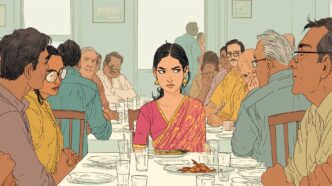
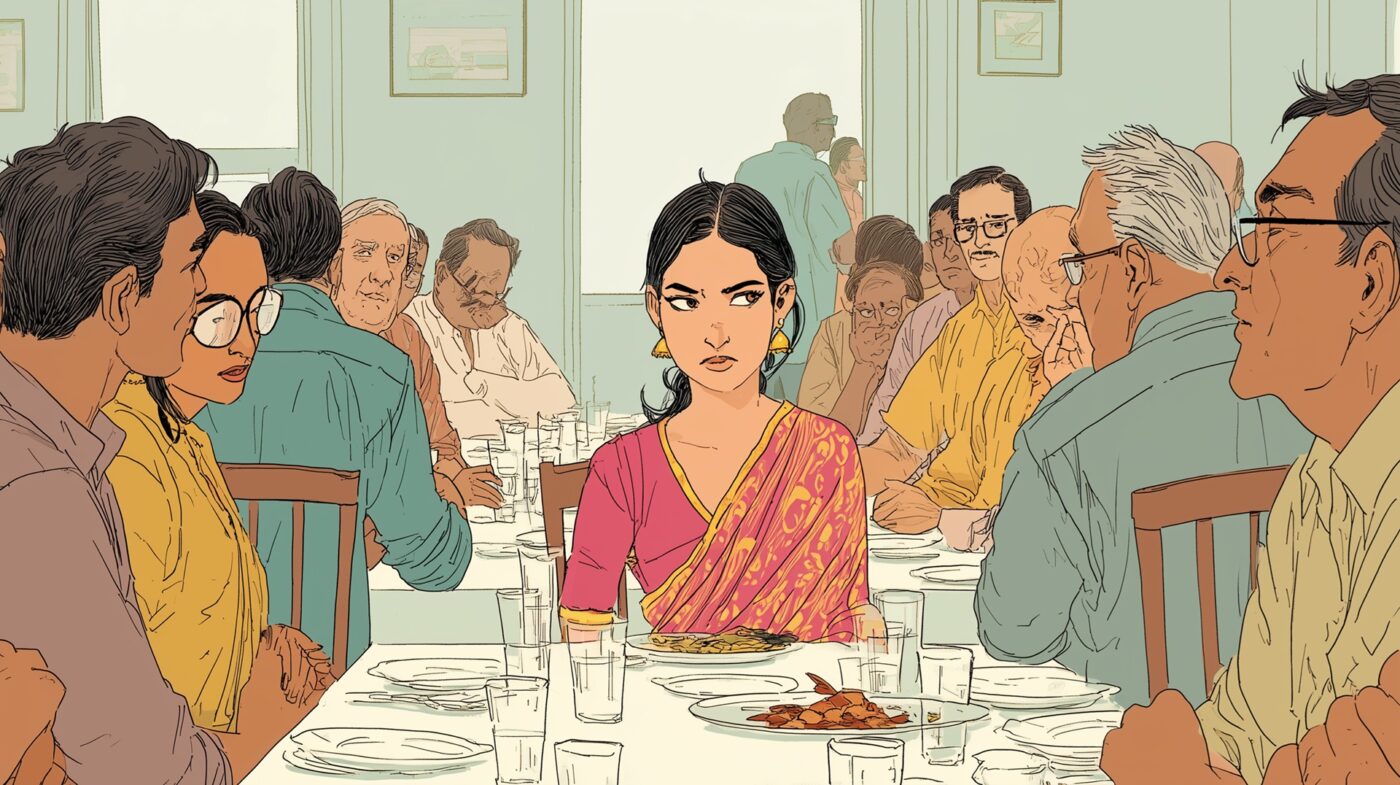
They crowded the table, the extension leaf groaning under platters. Someone insisted on putting Sadia at the center—a coup that left her flanked by two of the more aggressive khalas. Conversation began with the usual opening parries: What did she think of Dhaka traffic? Had she ever eaten true hilsa? Did she find the sari comfortable, or would she rather “return to jeans”? Sadia fielded these with the fluency of someone who’d survived American potlucks where everyone asked if you missed the “old country.” She smiled. Nodded. Parried with small compliments about the spices, the weather, the children’s “excellent English.”
Ahsan, boxed in at the far end by three uncles and a cousin home from Canada, kept half an ear tuned for trouble. Sadia reached for salad, praised the pickled mango, asked earnest questions about wedding preparations. The posture of a diplomat sent to a minor but belligerent nation. He tried to project calm. Tried not to watch her too closely.
It was going fine.
For a minute, he believed it.
Then the tone shifted. He caught it in the way Auntie Razia’s hand hovered just a second longer on Sadia’s wrist, then in the way the cousin from Canada stopped eating to actually listen. The questions sharpened. Did her parents ever come back to Pakistan? What did her father do? (Banker.) Was he in Lahore last year for that conference? (No, he hated traveling.) Did they have relatives in Karachi, or the “lesser cities”? (No, just Lahore, all the way back.)
Sadia’s answers came calm, even bored. She tried to bring him in—“Ahsan, didn’t your mother say the fish is from Sylhet?”—but his mother rerouted every turn.
A small hush fell.
Ahsan’s uncle Bashir (retired colonel, notorious for playing patriotic songs at max volume on national holidays) cleared his throat. He spoke in Bengali, slow and measured, never looking at Sadia. “So, in all of America, you could not find a Bangladeshi girl?”
The words dropped like a litchi into hot oil.
His mother flashed a warning smile. Sadia, picking at cucumber, didn’t look up.
He answered in the same language, voice steady. “We met at university, Uncle. We were in the same project group.” He forced a small laugh. “I think you could say it was fate.”
The uncle grunted. “I see. But you know, our history is not simple, nephew. It is written in graves and rivers. Sometimes it is better to remember.”
The familiar pulse at his temple. Blood in his ears. He wanted to end this, to take Sadia by the hand and vanish into the airless corridor. But he knew exactly how that would look. He reached for water, let the glass sweat in his palm.
A spoon clattered.
The room pulsed, then froze. Silence, raw and absolute, pressed down. Even the AC hushed. Ahsan’s jaw locked. His tongue found the sharp edge of a molar and pressed, hard enough to taste blood. Every gaze in the room: his mother’s, holding its smile like a dying battery; Nusrat’s, averted, fingers tightening around a napkin; Sadia’s, fixed somewhere left of her plate.
Ahsan stood. Too abrupt. Chair legs shrieked on tile. Heat flooded his neck, flushed his ears. He didn’t trust his voice. Not yet. So he let the silence grow. It swelled, greedy and total—a black hole centered on him and the uncle who wouldn’t look up.
He imagined launching. A full-throated, righteous monologue. Malcolm X and Audre Lorde. Railing against partition, the manufactured myth of borders. Telling this retired colonel that history was—
But the faces.
His mother’s chin quivering, lips still twisted into a party-host grin. His father, staring at the rice, hands folded as if in prayer. Even Nusrat, who would normally relish this kind of explosion, sat braced for impact, eyes clamped shut. Waiting for a bomb to detonate.
Ahsan heard it all at once: the clink of glass, the rumble of traffic stories below, the breathless anticipation of a hundred invisible ancestors.
He opened his mouth.
The uncle had not moved. Just sat there, picking at fish, knuckles white.
A hand on his arm—cold, dry, insistent. Sadia, smiling in a way that would fool a customs agent, said, “Uncle Bashir?” and waited until the old man glanced up.
She launched her opening volley in Bangla. “Ami boro sorry. Amar Bangla is… not Olympic level. I learning from YouTube, very difficult. But I try.”
Wrong verb. Wrong tense. Maybe the wrong country. But the table twitched. Even Bashir blinked out of his lecture posture.
Sadia pressed on. “Uncle, border banai politicians, but appetite banai Allah. And my appetite for Ilish”—she pointed at the fish on his plate—”is larger than my appetite for any man. Even my husband.” She flashed a lopsided grin. “Jai Bangla! Jai Fish!”
The silence inverted—imploded, then exploded, the way glass shatters in slow motion.
The youngest cousin, Saikat, snorted so hard rice came out his nose. The Canada cousin—Mahdi, maybe?—laughed open-mouthed, then translated the joke for the stragglers, making it worse. The uncle in question raised his eyebrows, lips quivering, then let out a sound like someone untwisting a pickle jar. Half snort, half reluctant approval.
Sadia looked at Ahsan. “Did I say it wrong?”
He managed a smile. A real one this time. “No, that was perfect.”
Bashir pivoted. “You see, this is good. You are learning. It is important, for the children—”
“They don’t have any yet,” Razia Auntie said, and the word “yet” rang like a wedding bell.
The cousins cackled. Someone started chanting “Ilish Bou, Ilish Bou,” which made no sense, but the tide had turned. Sadia took a bow, knocked over her glass. Another round of laughter. Even Nusrat looked at her, grudging respect hovering at the corners of her mouth.
Ahsan thought the meal might actually end in peace. Sadia made a show of refilling Bashir’s plate, using both hands to pass the biryani, nodding solemnly at every inquiry into her family tree. She’d dodged the worst of it. The uncles turned their attention to cricket and politics, the eternal back-and-forth about who had ruined the country most efficiently. The mothers huddled at the other end, arms locked, heads touching, comparing health updates and recipes.
Sadia leaned over, whispered in his ear. “I watched every episode of Learn Bangla in 10 Days for this. You owe me a back rub.”
“Deal,” he whispered back. He caught the faint floral spice of her perfume under the ghee and fish. He could almost forget the earlier tension, the way his shoulders had nearly fused to his neck.
Almost.
The game, once resumed, was no longer about food. Sadia, now dubbed “Ilish Bou,” fielded requests from the cousin swarm: to say “shosha” for cucumber, to try “tok” for sour, to repeat “kharap” when something was bad, which they all agreed was “Uncle Bashir’s politics.” The table dissolved into giggles. Mahdi recorded a Snapchat of Sadia pronouncing “lingonberry”—a word learned from a Scandinavian grocery trip that derailed into a ten-minute tangent about IKEA cafeteria offerings—and spliced it with her attempt at “panta bhaat.”
He couldn’t join in. Every smile at her expense stung like a mosquito bite he wasn’t allowed to slap. His mother had relaxed into the spectacle, dispensing spoons of firni, biting back corrections. Nusrat had abandoned the table but drifted back now, standing in the kitchen archway, arms crossed, eyes narrowed. Watching him fail to stand up for himself or his wife.
He felt useless. The anger in his chest had nowhere to go. The table didn’t need him. Sadia didn’t need him. He dropped his gaze to the blur of hands passing sweets, the rattle of teacups, the chorus of “just one more” for every dish. The moment had passed.
Sadia caught his eye and pantomimed a fish face. The cousins howled.
He tried to smile back. It felt like showing his teeth to a dentist.
***
Nusrat watched from the kitchen, half in shadow. One ear cocked for her mother’s summons, one hand on the doorframe. She might need to intervene. Keep the peace. She saw every ripple the same way she saw the cracks in the apartment walls—emerging, inevitable, ultimately hers to patch.
Her husband, Rashed, snuck up behind her and made a show of reaching for more sweets. In the hush between cousin shrieks, he leaned in, loud enough for only her: “Look at them. The ‘foreigner’ is trying to learn our language, and the ‘son of the soil’ is refusing to speak it.”
She didn’t answer. She watched her brother instead. Cheeks hollowed out with the effort of holding in everything he wanted to say. He looked like a kid forced to watch his own birthday party through glass. His wife, meanwhile, had already learned to weaponize her own cluelessness.
Nusrat could almost admire it.
She thought she should say something to him—something sisterly, something that would remind him he wasn’t alone. But the moment didn’t call for rescue. Instead, she watched as Sadia, emboldened by sugar and encouragement, asked in careful Bangla if she could help clear the table.
The room went briefly silent, then exploded in applause.
Her mother wagged a finger—guests never worked in this house, never, especially not in sari—but Sadia stood and started stacking plates anyway. The cousins followed, turning the cleanup into a chain gang, everyone elbowing, dropping raucous commentary. For a moment, even the uncles were forced to pause.
Ahsan remained seated. Hands knotted, wrists bright with sweat.
Nusrat watched him as he watched Sadia. The way he slid his chair back from the table, letting the laughter move ahead without him.
He looked smaller. Like he had no idea how to put himself back together.
She left her post and entered the fray, shooing the smallest cousin away from the glassware. In the kitchen, she found Sadia at the sink, sari hiked to the knee, scrubbing with the determination of an athlete. The other women had already retreated to the balcony with their tea, relishing the rare moment off duty. Nusrat grabbed a towel and started drying without a word.
They worked in silence at first. The only sound: the wet slide of plates, the distant bellows of Bashir Uncle now holding court on the living room carpet. Nusrat waited until the last of the biryani trays was wiped down.
“You handled them well.”
Sadia grinned, fighting the urge to push a stray hair out of her face. “They’re not so scary.”
“They’re much scarier when you’re their own blood.” Then, softer: “Is he mad at you?”
Sadia shook her head, but her hands trembled on the next plate. “He hates these dinners. He wants to be the one making the jokes, not the one everyone’s talking about.”
Nusrat nodded. She recognized the pattern in her brother—a tendency to take every slight like a punch, to bristle and sulk instead of letting things fall away. She dried the last plate, stacked it with pointless precision, then looked at Sadia.
“He was always like this. Even as a kid. Used to make up imaginary rules for how Eid was supposed to go. Would cry if anyone broke them.”
Sadia laughed, a real laugh, the kind that cracked open the shell around the words. “He still does that. Just with taxes and airline luggage limits.”
Nusrat smiled, then watched as Sadia rinsed her hands and dried them carefully. She wanted to say something about how family worked here—how love and violence were often the same thing, how every party was a tug-of-war even when it looked like a celebration.
But Sadia already seemed to know.
A voice called from the living room—Ahsan’s mother, demanding someone bring out the sweets. Nusrat handed Sadia the towel, and together they carried the plates to the living room, where the cousins had already started a new game: teaching Sadia words in Bangla that had no translation in English. She watched as Sadia repeated “oshanti” and “jugaad,” then gestured for Ahsan to join her on the floor.
He did. He flopped down, back to the sofa, a half smile on his face as Sadia tried to mimic the exact intonation of “pagol”—crazy—while the cousins egged her on. Nusrat felt a quiet kind of pride in that moment. Not for her brother. Not for her new sister-in-law.
For the mess itself.
The way it always seemed unbearable right before it became something else.
The sweets circled, the jokes spun out, and the night unspooled as it always did: loud, a little mean, but never less than alive.
When the last uncle had left and the children had been peeled from the floor, Sadia and Ahsan retreated to their room. Nusrat could hear their voices through the wall: Sadia’s laughter, Ahsan’s low, apologetic rumble. She lay in her own bed, lights off, phone dead, and listened.
Somewhere in the building, a generator thrummed to life as the power flickered. Nusrat waited for the old anger to return: the resentment, the fatigue, the fear that everyone was performing the same tired script. It came, but weaker than before, and was soon replaced by the memory of her brother’s face at the dinner table.
Not defeated.
Just human.
She turned over. Sleep came easy.
In the dark, the city’s noise seemed softer, as if, for a night, it too had run out of things to say.






Leave a Reply