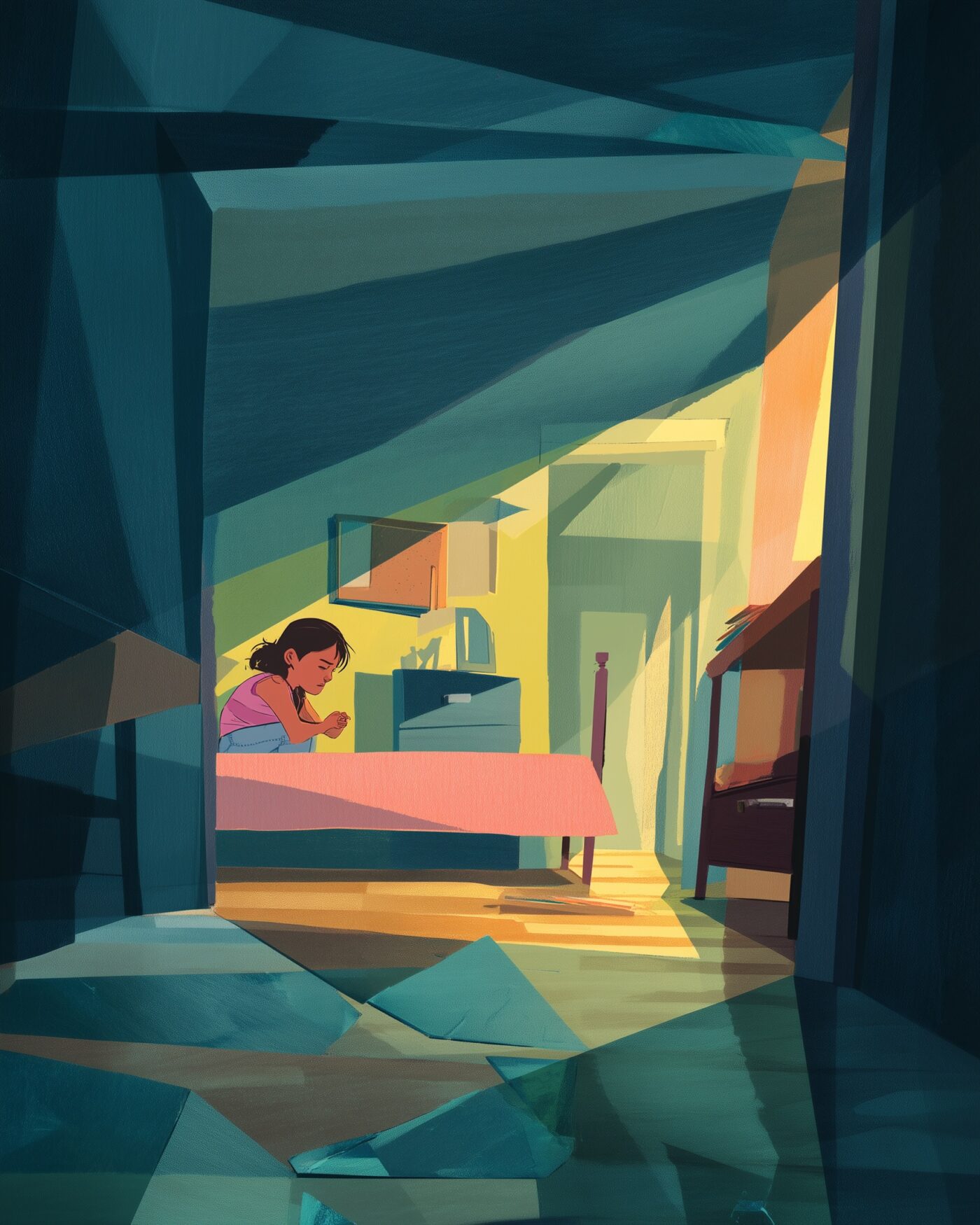

I am seven years old, hiding under the bed with my hands tightly wrapped around my ears, but like the rush of waves which hits against the shore, the violent noise seeps through. The sound of raised voices melt into a tub of anxiety, the sound of glass shattering makes me shudder in bone-chilling fear. In the midst of trying my best to shut out the frantic yelling, the dominance of voices, I hear a loud, jarring slap, the echoes of it reverberate through the sudden silence in the room. The silence is a living, breathing thing. And, it threatens to choke me with what it implies. My mother’s quiet sniffles travel all the way from the dining room to the hidden corners of a child’s bed.
That is the first time I realize the house I live in is a tapestry built by my mother’s tears.
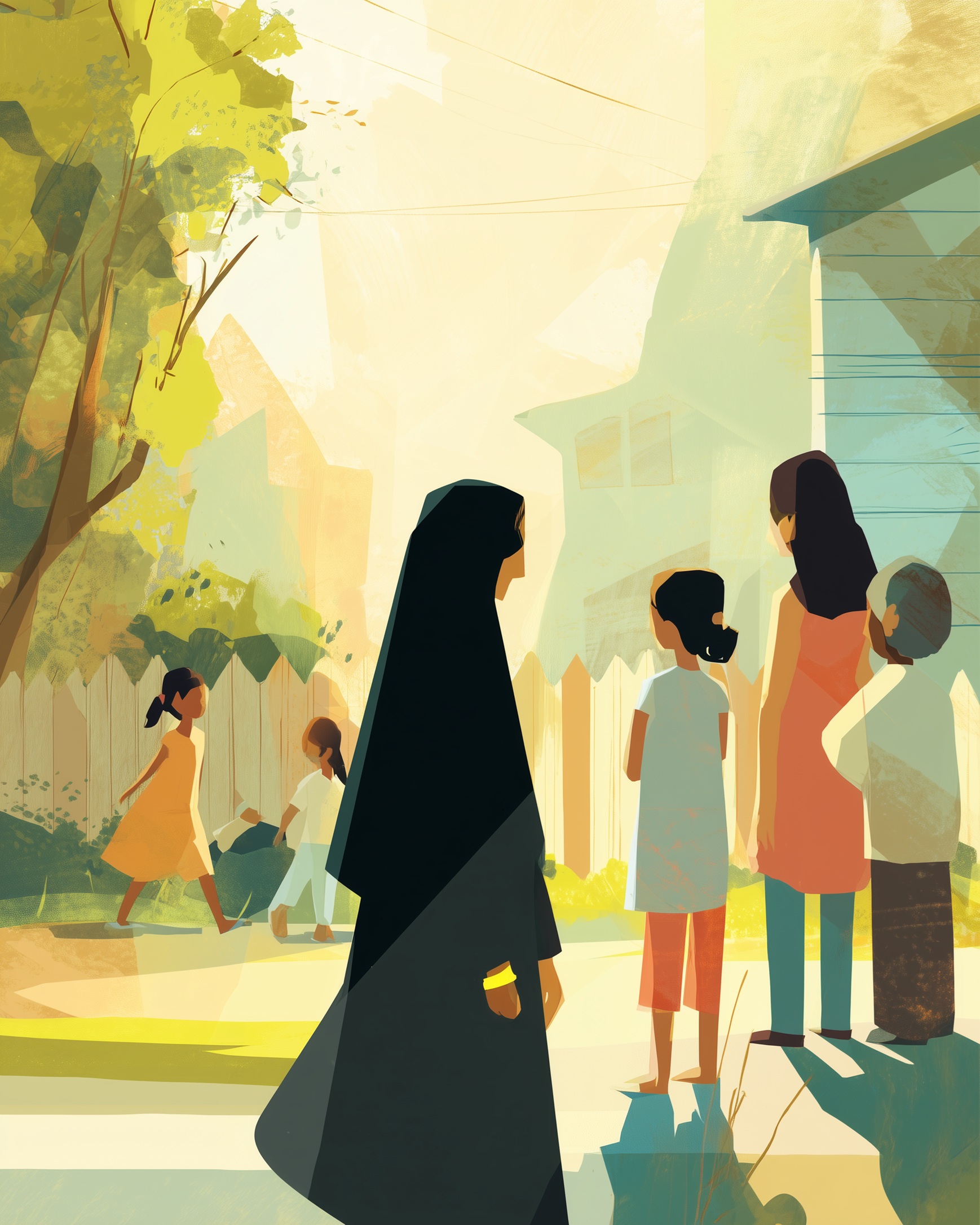
I am twelve years old, playing with my friends in the park when the light of my mother’s golden bangle catches my wandering eye. My pace slows down and I forget my friend’s frantic shout to focus on the game. I watch her talking with the women, the glint of her bangle bright as she moves her hand animatedly.
My mother’s face is covered by the niqab, but with the slight shaking of her shoulders, I can tell she’s laughing. Her eyes look alive. I remember thinking that her eyes looked different at home. More vacant, more subdued. When we return home, her eyes take on the color of a hollowed out cave, abandoned, empty and dark.
I am sixteen years old, and I am seething with rage. It is directed at my mother. Her face is crumpled in agony, as my words pelt her from every direction, ‘You should have left him. How could you tolerate all of this for so long? Why would you? And, don’t tell me it’s for me! I am as unhappy as you are here, ma.’ My mother’s voice shakes as she rasps out, ‘I didn’t know. I didn’t know how to. Your grandmother used to tell me to be patient, that it was common for a man to vent an entire day’s work at home, I should be more forgiving. I listened.’ My heart falls on the mosaic floor of our living room as my eyes note the cascading tears on her cheeks, the brokenness in her eyes. I slowly sink into the cushioned surface of the sofa. She remains standing, her fingers visibly trembling at the aftermath of us. We are wretched reflections of each other. Mother and daughter, broken pieces of an entangled puzzle. It is the day I realize she has never gotten the chance to become anything other than a caring mother and a dutiful wife.
I am eighteen, my head bent low as I tend to my mother’s wounds. ‘Next time this happens, shout, scream back, do something.’ Silence greets my frustrated remark until a tired voice answers, ‘Okay.’ My hand freezes for a moment before returning to the bloodied spot, cleaning it as carefully as I can.
I imagine living with an angry man for more than twenty years must have eradicated her perception of her own worth, must have made her feel every bit of the worthless, useless wife my father proclaims her as. Bit by bit, I am starting to understand why she always takes the hit. It is to protect me as much as she’s unable to protect herself. As she silently sits before me, her arm splayed out on my lap, parts of it mottled and clotted with blood, I grieve for the woman before me, for the life she could have had if she hadn’t met my father.
I mourn myself, because I have spent too many years living with fear for my mother, and terror at the sight of my father. My mother’s arm, the floral bed sheet underneath it becomes blurry until all I see are jagged lines of red and pink. It is only when the weight of her hand firmly falls on my shoulder, that I am shaken out of my trance.
I look up, the tears pouring freely when she gently murmurs, ‘It’s okay. One day, it will be better. We won’t have to live like this anymore. One day.’ I tamp down my roaring voice of pessimism and throw a tentative smile her way. I will not take away the sliver of sun she holds onto when she has been encased in darkness all her life. Her answering smile breaks my heart a little.
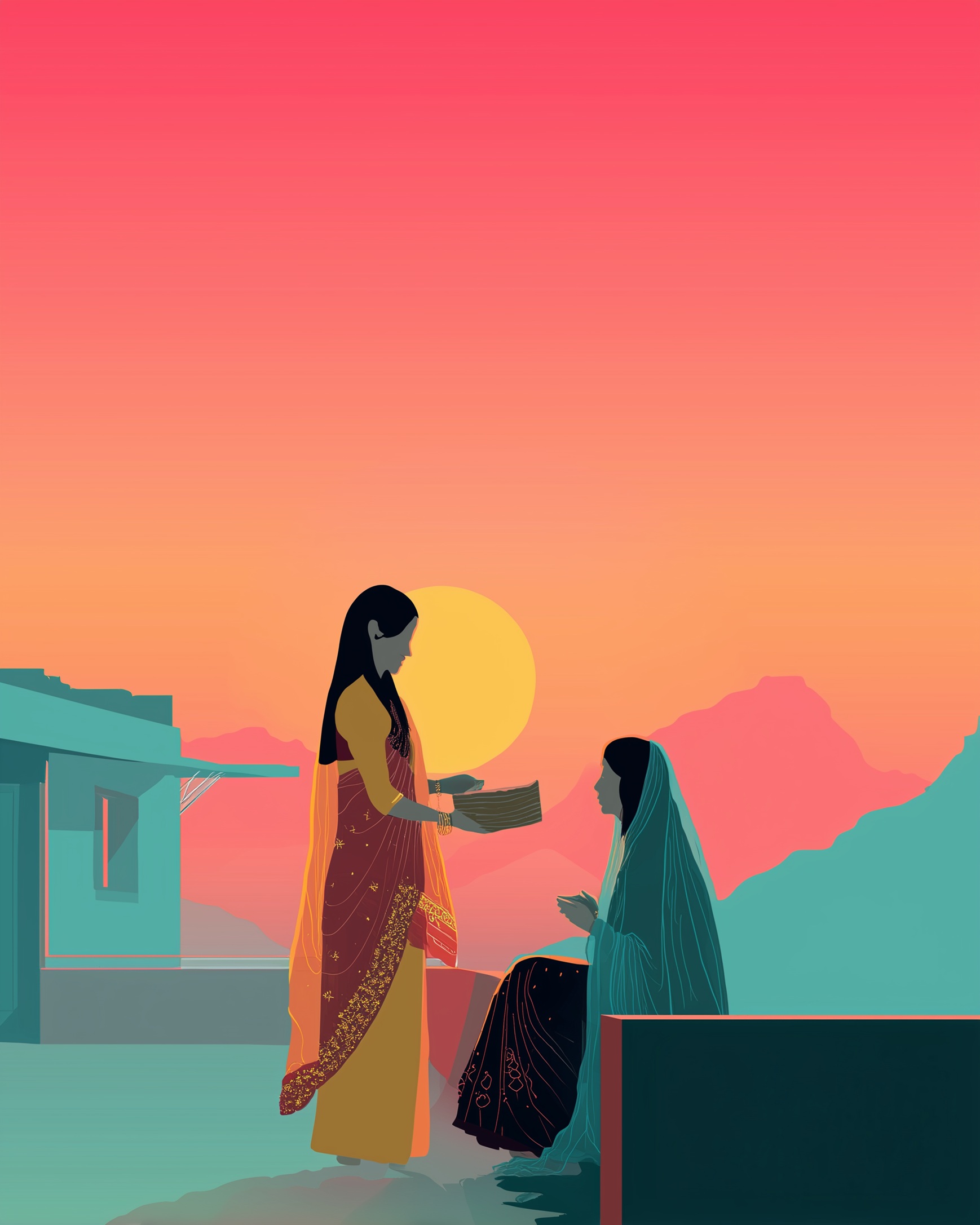
I am twenty-one, and I buy a golden embroidered saree for my mother. It is bought with my first paycheck of the tutoring job I have hidden from my father. I hand it to her on a fine afternoon, as the sun slowly makes its descent towards the horizon. The sky outside has a soft hue of pink and orange, and as I watch my mother’s expression change from stunned shock to pure, unfiltered joy, I marvel at how similar the sky and she is. Both are breathtakingly beautiful and soothing.
My teenage anger and resentment towards her inability to do anything have changed to a deepening understanding and a softer place of warmth for her. I become her treasured confidante, a resting place when the world is too harsh. She tells me tales of her childhood, her days spent with her friends frolicking and picking fruits from orchards. In turn, I tell her my dreams, how I want to earn enough money to set us both free, how I am waiting for the day I can board on my first plane, and never turn back. Whenever I say things like this,my mother always has a small smile she tries to hide by the tightening of her lips. To her, it’s an impossible dream. For me, it’s the fuel keeping me alive.
When I turn twenty-five, I board on that plane with my mother. It is our first flight, and only we know the revolution sparked inside the walls of our house for us to step inside the airport. Five years studying the law with a critical lense has paid off. I have succeeded in instilling a little bit of fear in him. The legal repercussions have been made crystal clear to him. So, when I hold my mother’s hand, and guide her outside the tapestry of tears, he only looks up from the dining table, his eyes furrowed in disapproval, but his mouth firmly shut. Of course, there are consequences of being a defiant, unruly daughter.
I am sporting a black eye, as I take a peek at my mother sitting next to me in the plane. She seems happy, her fingers tracing a pattern in the window, her eyes taking in the world outside the porthole. Warmth seeps in me as I note how lighter her gaze is, how even her complexion has regained some of its healthy color back.
And, when she looks back at me, with eyes full of childlike wonder and a full-blown smile, I realize everything I have learned about womanhood stems from the kindest woman I know. My mother is a quiet force of nature, she’s no roaring fire, but the wind of spring which has rooted my life in colors. Someone who wouldn’t hesitate to stain her hands in turmeric powder to make my favorite dishes, but she would never strain her own voice for wishes and hopes. I add that to my list of things I want her to see and learn.
Womanhood is a glorious spectrum, and she has been at the receiving end of it for far too long. I want to build a house, made by the music of my mother’s laughter and joy.
So, I smile back at my mother’s shining face. This time, without restraints and with a promise for hopeful beginnings, not just a tapestry of tears.