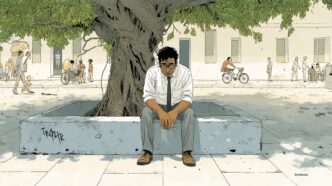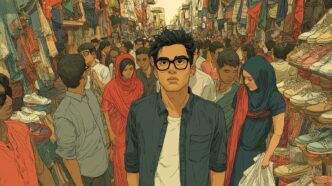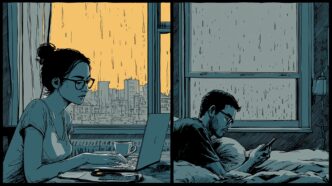

Akib’s left heel squeaked against the Red Brick Road. Every step announced him—a traitor’s Morse code that pulled eyes like magnets. He kept his gaze down, watching the sun-bleached pavers blur past his Bata shoes.
His collared shirt clung to his back. Sweat pooled at his spine. The white fabric betrayed him: thin enough to show the blue-black outline of the tattoo on his ribcage, a remnant from Sylhet, from before.
The crowd ahead parted. Laughter rippled through the heat haze.
Zareen perched on the lobby steps, one leg crossed over the other with surgical precision. Her sunglasses were mirrors—weaponized accessories that could reflect a man’s soul back at him. Akib looked. A mistake. He caught his own warped reflection: small, hunched, sweating.
“Omg, isn’t that Rafiq Bhaiya’s brother?” Sugar and acid in equal measure. “The one who got cancelled? I heard the whole family is blacklisted from the Debate Circuit.”
Oil on water. The crowd shuddered.
Akib’s hands locked behind his back, fingers twisting. Thirty meters to the nearest exit. He could sprint. Risk the mud and the cameras. The calculus didn’t add up.
A boy in a blue kurta slowed. Stared. Pity mixed with forensic curiosity, burning hotter than the sun.
Akib thought about stopping. Turning around. Assembling his defense in thirty seconds flat—skip the vowels, debate master’s trick. The silence afterward scared him more than Zareen’s precision gossip. They’d already decided his narrative. Anything he said now would just fill margins.
He pressed forward.
The lobby doors swallowed the humidity and most of the noise. Inside, the AC hit like a slap. His glasses fogged over, the world gone milky. He navigated by memory—hard left at student affairs, beeline to the elevators.
He jabbed the call button. Too sharp. Too eager.
The brass doors reflected a warped, shrunken version of himself. He tried to arrange his face. Show no tells. Leave no angles uncovered. Rafiq’s voice in his head, back when they still spoke.
The elevator dinged.
Click of heels behind him. Zareen and her retinue trailed in, imported perfume preceding them by a full meter. She positioned herself in the mirrored corner. The rustle of her sari made it clear: Akib was meant to feel small.
He did. One breath.
Then he squared his shoulders, exhaled, met her eyes in the glass. Her smile was thin, surgical. His was thinner.
The doors closed. Ten seconds suspended together. No air, no narrative. Just the hum of machinery.
The elevator spat him out on the third floor.
He stepped into the corridor, didn’t look back.
***
Dhara wedged herself between bodies that pressed closer every time the admin said, “Next!” First day of semester. The fourth floor hallway transformed into a livestock pen—students jostling forward with drooping, sweat-stained forms, shouting over each other in the universal language of panic.
She balanced her slip and registration form on the glass counter edge. The admin’s sari blazed red. Woman barely looked up.
“You did not attach the pink copy, dear.” Dog urinating on a prayer mat tone.
“I didn’t get a pink copy.” Dhara enunciated, keeping her vowels single-file. If she didn’t, they’d slither back toward Chittagonian singsong. “The last page is white. See, miss?”
The admin stared. Your problem.
Behind Dhara: sighs, shoe scuffs, a girl’s phone tap-dancing against her palm. Someone’s bracelet grazed her neck. She flinched.
“White or pink, I am needing the last page only. You are next.”
Dhara opened her mouth. The girl behind her swept forward on a tide of entitlement. Vanilla body spray—expensive, medicinal—hit first. Then the voice.
“Sorry to interrupt, but could you hurry? I have a class in ten and we’re all dying here.”
English that sounded imported. Vowels stretched and flattened by years of Netflix and international schools. Hair blown out to hotel-pillow sheen.
Samara Khan.
Dhara turned. Smiled the way her mother did right before setting a rat trap. “You can wait. I am still talking, thank you.”
Samara didn’t move. Two perfectly synchronized minions flanked her—pale blue shalwar, headband that cost more than Dhara’s entire Eid outfit. The trio radiated cool privilege, like they’d been born with permanent access to the city’s best WiFi.
Samara leaned in. Close enough that Dhara could see the gleam of clear braces.
“Excuse me, sweetie, did you say ‘pree-sentation’? At IAB, we say ‘preh-sentation.’ You might want to fix that before you open your mouth in class. It hurts the brand.”
Dhara’s face went pleasantly numb. Seventh grade trick. She met Samara’s eyes, smiled barbed wire.
“And does the brand cover basic manners, or is that an elective you skipped in A-levels?”
The air stilled. Hallway noises receded under fluorescent hiss.
Then: laughter. Too loud, brittle. Samara’s minions snorted in stereo.
Dhara let her smile widen, turned her back on the trio, addressed the admin in Chittagonian. The admin’s mouth twitched before she slammed the stamp down with unnecessary force.
Dhara stepped out of line. Victorious. Shaking.
She felt Samara’s eyes boring into her spine the whole way down the corridor. Threat and promise rolled into one.
At the hall’s end, she stopped. Floor-to-ceiling windows overlooked the quad: lush, manicured, crawling with students who’d never fake an accent to be heard. She pressed her forehead to the glass, let the chill bleed heat from her cheeks.
She would not give them tears. Rule one.
Her phone buzzed.
Hey, you alive? Or did the line eat you? Meet me by the canteen, I have your favorite. —Reshma
Dhara stared at the text. A tiny smile built in the back of her throat. If anyone could make her laugh about Samara, it was Reshma.
She squared her shoulders, smoothed her shirt, started walking.
Tomorrow, she’d practice her English harder. Sharpen her vowels, camouflage the edges.
Today, she’d eat shingaras and let the city’s noise drown out her doubts.
War was war. Dhara would play to win.
***
The lecture hall felt like a meat locker. Rows of fluorescent bulbs hummed overhead, refracted through condensation pooling along the AC vents. New plastic and old ambition in the air. Amphitheater seating held over a hundred—each seat a red vinyl trap, lined up with military precision. At the front, a tiered dais overlooked the crowd like a battleship bridge. Glass, steel, wiped-smooth laminate. Even the chalkboard was digital.
Akib scanned for an empty seat that didn’t leave him exposed. He spotted a few in back. The Notre Dame Grinders had annexed the area, defending it with calculated glares. He settled halfway up, wedged between a guy already asleep and a girl sketching henna on her palm.
The room filled fast. The air lost what little warmth it had.
At 8:29, the professor swept in. Short, thick through the torso, jaw set like a man prepared to wage bureaucratic war. Suit the color of wet cement. Tie so tight it made Akib’s neck itch.
“Welcome to Introduction to Business 101. Please do not thank me for this opportunity.” American accent, maybe Chicago, vowels bludgeoned flat by years in Dhaka. “I am Dr. Imtiaz. You may call me Doctor, Sir, or Professor. Never ‘Boss.’ I have a PhD for a reason.”
Ripple of relief-laughter swept the room.
Dr. Imtiaz fired up the digital board. Terms and diagrams bloomed behind him.
“We will begin with what matters: teamwork. The world is group projects, and group projects are the world. Look to your left and right. These are your business partners. Choose wisely. Bankruptcy is ugly.”
Collective shudder. The self-sorting began.
The Gulshan Glitters—Samara’s clique—linked arms like an ancestral ritual. Across the aisle, the Notre Dame Grinders formed a circular phalanx, heads close together. The rest split into smaller, nervous constellations.
Within thirty seconds, the in and out became clear.
Akib resisted the urge to look for Rafiq or anyone who might rescue him. He’d made that mistake last semester. The memory still ran cold through his veins. He waited, hands folded, as the leftovers sorted themselves into a loose cluster near center.
He saw her there.
Dhara, from the registration line. Bruise-colored ink stain on her thumb. Looked like she’d been shoved through a revolving door. She clocked Akib immediately, offered a nod. Neither hostile nor inviting.
Most honest greeting he’d had all day.
A chair scraped. Kabbo dropped into the seat with exhausted grace—child after a sugar binge. Kabbo did slam poetry about microeconomics on TikTok, wore the same faded “Free Palestine” t-shirt every Tuesday. He stared out the window, humming what sounded like the Nokia ringtone, absently tapping a pen against his teeth.
Dr. Imtiaz surveyed the groupings with mosaic-tile satisfaction.
“Now. Group 7. Where is Group 7?”
Akib froze.
No one moved.
Dr. Imtiaz’s gaze found their island of stragglers, pinned them in place.
“You three. And…”
His finger hovered.
The doors banged open. Rattled. Arafat stumbled in—sunglasses on, shirt half-untucked, radiating Axe and last night’s Red Bull. He flashed a peace sign, slumped into the nearest seat, didn’t pretend to be sorry.
“You are now Group 7. Please introduce yourselves and prepare a five-minute case study on any local company that recently failed. You have fifteen minutes. If you cannot agree, I will assign you Biman Airlines.”
He killed the board, retreated to his desk, began destroying an apple with his teeth.
Akib turned toward his new teammates. Dhara fished in her bag. Kabbo kept tapping, staring at the ceiling like answers might drift down.
“So, uh. Anyone have a company in mind?”
Kabbo didn’t look away from the window. “Does Biman count as recently failed or permanently failing?”
Dhara smirked. “It’s never not failing. We can do better.”
Arafat slid his sunglasses down his nose. “What about that burger place? The one that poisoned half the model UN last year.”
Akib’s stomach clenched. He remembered the story in the group chats. “Burger Daddy?”
Dhara nodded. “They tried to rebrand as ‘Burger Papa.’ Everyone knew.”
They looked at each other. Grins crawled across their faces.
Kabbo twirled his pen. “Burger Daddy dies so Burger Papa can live. There’s a metaphor in there somewhere.”
“Why not go with that?” Dhara shrugged. “It’s local, it’s messy, and we can all pretend we did actual research.”
Arafat put his feet up on the chair ahead. “If we win, do we get free coupons?”
Kabbo finally looked at Akib. His eyes were unexpectedly kind. “You’re good at presentations, right? I saw you win that debate last year.”
Akib tried to keep his face neutral. His ears burned. “I’m okay.”
Dhara gave him a look—respectful, expectant. After the rumors, after the campus cold-shoulder, it felt like stepping onto a tightrope in front of a live audience.
“Okay.” Voice soft. Steady. “We’ll do Burger Daddy. I’ll put together the slides if someone else does the research.”
He looked at Dhara. She nodded. “I’ll handle the numbers.”
Kabbo raised his hand. “I’m good at graphics and memes.”
Arafat slouched lower. “I’ll, like, do the executive summary.”
Weakest handshake of a partnership in academic history.
A start.
They got to work. Kabbo passed scraps of paper between them. Arafat somehow already asleep. Dhara scrolled through financial reports on her phone, muttering under her breath in a language Akib didn’t recognize.
The rest of the world melted away. The gossip. The side-eyes. Even the bone-deep chill of the AC.
He let himself laugh. Just a little. Just enough to feel blood moving.
Fifteen minutes later, Dr. Imtiaz barked out their number.
Akib stood, palms slick with sweat.
Something else too—shaky, unearned optimism.
The elevator doors always closed. They always opened again.
Maybe this time, there’d be air on the other side.
***
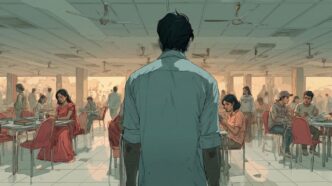
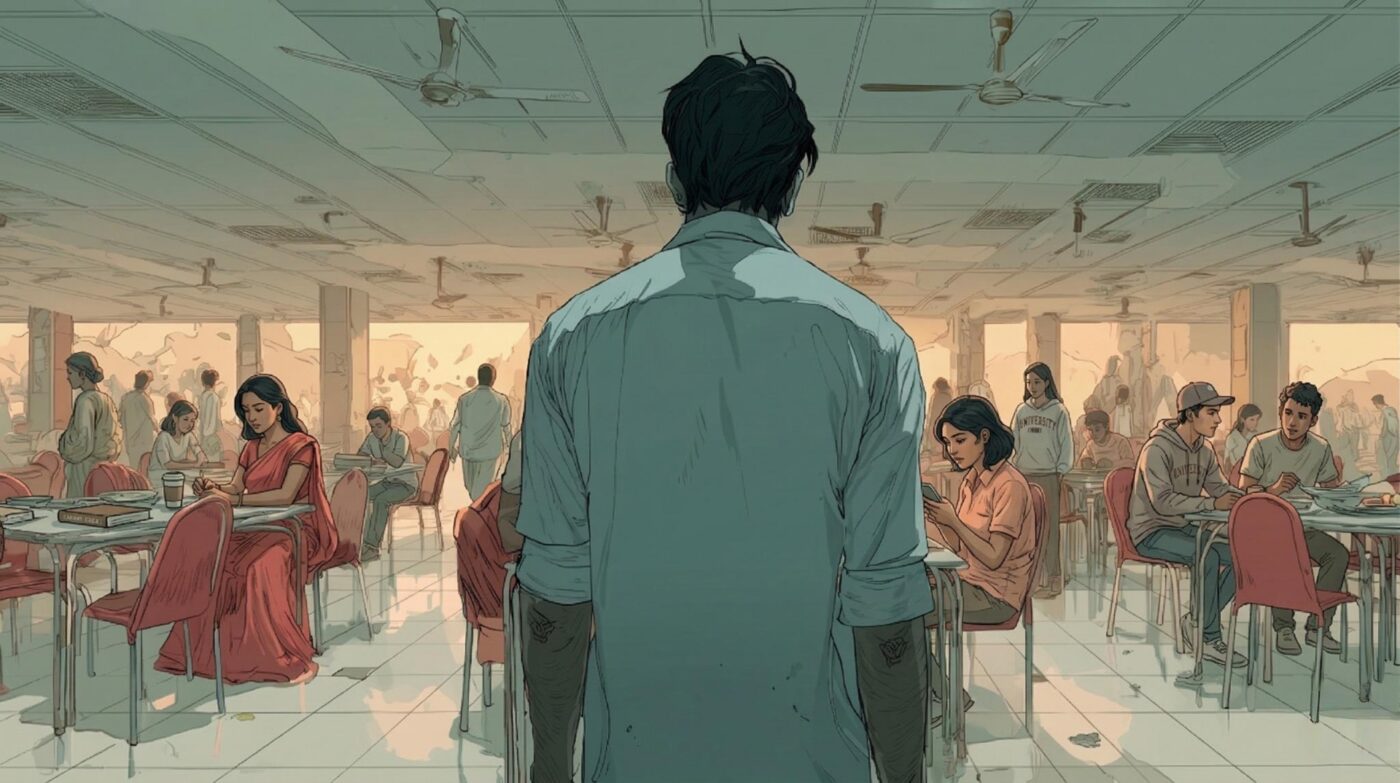
The canteen was a feverish greenhouse—thick with steam, overcooked oil, a hundred arguments in progress. Group 7 claimed a corner table pockmarked by generations of pen doodles, soda rings, etched scars of teenage violence. Nothing neutral about the space. A DMZ where alliances and betrayals were brokered over miso soup and limp fries.
Samara was waiting. Halfway through a lemon-lime Sprite, tapping acrylics against the table with patience that read as threat. Her laptop was open. Glossy sticker on the back: “Girlboss in Beta.” She didn’t look up when the rest arrived, only tilted her chin to acknowledge their existence.
“I’ll be CEO. You guys can be the rest.”
Dhara stopped mid-sit, tray of shingaras and potato chop suspended. “We vote for CEO.”
“That’s not how startups work.” Samara typed as she spoke. “Someone needs to establish the vision. Otherwise, it’s chicken biryani in a blender.”
Beside Akib, Kabbo leaned back until the chair nearly failed him. Chin tilted, watching the slow rotation of ceiling fans. He opened his battered notebook, wrote in block capitals: “PLASTIC CHAIRS / PLASTIC SMILES.”
Arafat was late. His laugh bled through the canteen’s din like a warning shot.
Akib tried to shrink, counting cracks in the faux-marble tabletop. The cracks only refracted his reflection back at him—hundreds of tiny, accusatory Akibs. His shirt stuck to the small of his back. The AC here was decorative.
Dhara locked eyes with Akib. Daring him to challenge Samara’s coup.
He shook his head. Minutely.
No way. He’d already been the face of a losing team once.
Samara finished her sentence with a triumphant clack of the return key, finally faced them. “Okay, so. Local market failures. Thoughts?”
Dhara sipped her cha with steadiness that bordered on aggression. “We already picked Burger Daddy. Unless you want to make a case for Biman?”
Samara’s smile was a mathematical function—calculated, efficient, lacking warmth. “Burger Daddy is fine, but we can’t just say ‘they made bad burgers.’ We need a narrative. Scandal sells. Kabbo, you’re, like, the creative, right?”
Kabbo closed his notebook. Shrugged. “I can make it tragic. Or funny. Both work.”
He looked at Akib. Gaze lingering a shade too long. Started humming under his breath.
Arafat crashed into the scene—cardboard box of Pizza Hut balanced on one hand, half-eaten donut in the other. “Guys! We need carbs for optimal brain function.” He slid the pizza box onto the table, the bottom leaving a glossy, oil-damped trail. “Supreme Beef, no onions. Kabbo’s allergic.”
Samara recoiled. The smell violated her personal code. “Is that even halal?”
“Better question.” Arafat peeled back the lid. “Is that even cheese?”
Akib tried to laugh. It snagged in his throat.
He watched as Arafat offered the first slice to Dhara. She took it with unmistakable defiance, biting off a corner while pinning Samara with a stare. Their rivalry was so intense it left Akib feeling like an intruder in a family feud.
Kabbo took a slice, too. Only to dissect it, lifting off cheese strands one by one to examine their texture.
Samara refused the pizza. She picked up a shingara from Dhara’s plate instead, snapped it in half. “Fine. But if we lose, you’re all in the acknowledgments slide, not me.”
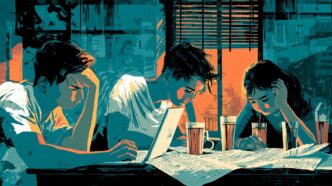
The group bent over laptops and phones. Low drone of debate swelling between them.
Kabbo doodled a Burger Daddy mascot with an executioner’s hood, labeled it “MASCOT AS METAPHOR.”
Arafat scrolled through memes about food poisoning, started building a slideshow peppered with GIFs.
Samara led with a text thread she’d allegedly intercepted from an ex-employee. The kind of thing that would barely pass for journalism. Would kill in a classroom presentation.
Dhara compiled numbers: revenue graphs, Yelp reviews, a heat map of all the branches that had closed in the last eighteen months. She worked with the grim determination of a surgeon suturing a wound.
Akib watched the chaos unfold, fingers hovering over his keyboard. He wanted to be useful. To lead. To prove he was more than the sum of his brother’s scandal and his own inability to make eye contact.
Every time he opened his mouth, the girls were already three moves ahead, Arafat was cracking another joke, or Kabbo was humming a new tune.
Eventually, Akib settled for formatting the slides. His one claim to competence. Fonts consistent, margins precise, transitions subtle. Sharp.
Small. Something.
Pizza down to two slices. Table littered with oil-stained napkins and half-drained cans.
Samara declared, “We’re done. If we don’t get an A, I’ll eat my own laptop.”
Dhara wiped her hands on a napkin, looked at Akib. “Next time, you pick the case. Fair’s fair.”
He nodded. Swallowed the words he wanted to say.
There would be a next time. There always was.
They broke up the meeting, each peeling off into the midday glare.
Akib lingered. Let the chaos dissipate before he stood to leave. He watched the remnants of their project—the pizza box, the scribbled notes, the clash of personalities.
Strange, weightless hope.
He was going to get cancelled for incompetence. Maybe, just maybe, he’d go down in style.