
Summary
Wake Up Dead Man reimagines the mystery genre as a reflective study of faith, doubt, and community. Eschewing flashy twists, Rian Johnson delivers a moody, character-driven film that favors emotional truth over clever spectacle.
Overall
-
Acting
-
Cinematography
-
Plot
Rian Johnson has always been known for turning genre expectations on their heads. His previous Benoit Blanc mysteries—Knives Out and Glass Onion: A Knives Out Mystery—became famous for their layered plots and clever wordplay. With Wake Up Dead Man, Johnson sets aside some of his trademark levity for a different kind of journey. This time, he turns his attention to faith, community, and the ambiguities inside every human heart. What emerges is a film that challenges not just what we expect from a mystery but how we think about the connections in our societies.
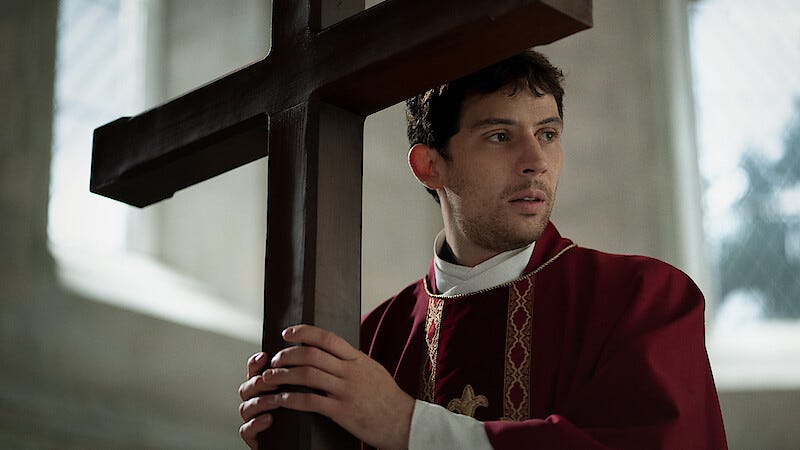
The story centers on Reverend Jud Dupenticy, brought to life with subtle emotion by Josh O’Connor. Dupenticy is an unlikely priest – a former boxer living with the fallout from a tragic accident. His past grounds him, shaping his approach to the world and to those in his parish. Rather than rigid doctrine, Jud’s ministry comprises empathy and an honest attempt to heal a fractured community. But old divisions run deep in this corner of the Northeast. From the moment Jud arrives at Our Lady of Perpetual Fortitude, he faces an unyielding resistance from the traditional members of the parish.

The main antagonist, Monsignor Jefferson Wicks – a role filled with stern intensity by Josh Brolin – serves as a barrier to Jud in every regard. Wicks champions an inflexible brand of orthodoxy, seeing questions as threats and interpreting mercy as weakness. His rule is supported by his right-hand woman, Martha Delacroix, and the unbending groundskeeper Samson Holt. This dynamic plays out in spare offices, echoing sanctuaries, and under the flickering lights of the church.
Wicks champions an inflexible brand of orthodoxy, seeing questions as threats and interpreting mercy as weakness.
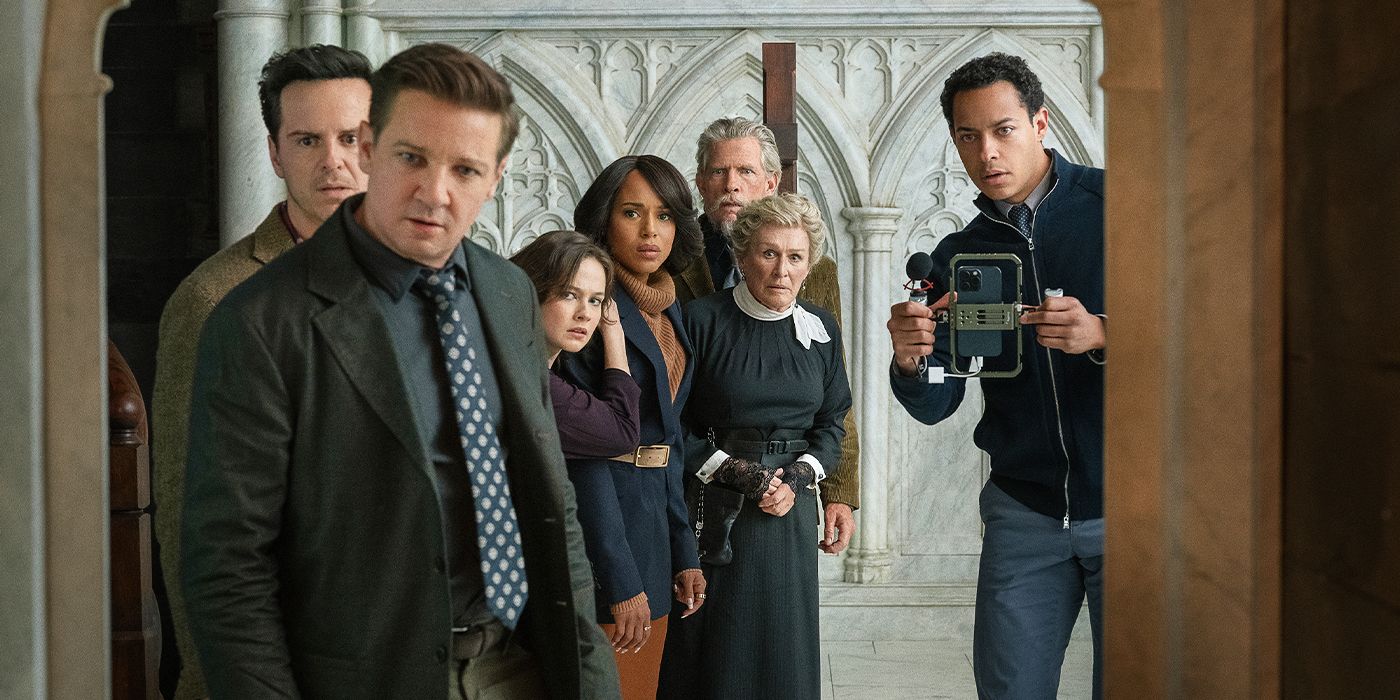
The ensemble cast brings extraordinary life to smaller roles. Glenn Close’s Martha is notable for her sharp exterior and the hints of pain and loyalty that shape her every flinty word. Thomas Haden Church’s Samson clings fiercely to authority. Jeremy Renner’s Dr. Nat finds protection in bluntness, while Andrew Scott’s Lee Ross drifts dangerously into suspicion and conspiracy. Cailee Spaeny stands out as Simone Vivane, whose quiet determination opposes controlling powers. The Draven family, played out with understated force by Kerry Washington and Daryl McCormack, navigates the crosscurrents of ambition and the exhausting realities of politics.
Benoit Blanc, so often the main event in Johnson’s work, plays a different role here. Daniel Craig’s Blanc is present but not central. This opens up space for Jud’s spiritual crisis, shifting the focus from external puzzles to the quieter mysteries of faith and doubt. When Blanc does intervene, his sharp intellect and dry humor punctuate the tension. Yet his skepticism acts less as a tool of ridicule and more as a kind of thoughtful prompting – a reminder that certainty is never easily found.
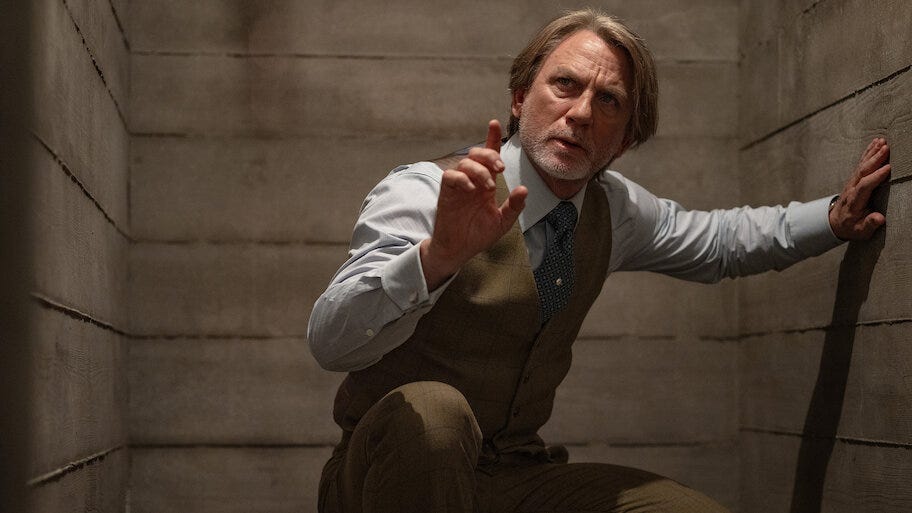
This subtle approach extends to every facet of the film’s craft. Johnson works again with cinematographer Steven Yedlin, and together they create a visual atmosphere that matches the story’s internal drama. The lighting is more than just mood. Cold, blue shadows dominate many scenes, suggesting isolation and uncertainty. Yet, in certain moments, soft light from stained glass or flickering candles hints at resilience. The stone walls and vaulted ceilings of the church become part of the emotional architecture, containing not just prayer and ritual, but all of the pain and hope carried by those who gather inside. Johnson’s decision to frame the film within the bounds of the parish is arguably his boldest narrative choice. Despite the same background being rotated among scenes, the impact is never dull.
Sound design is equally important in this world. Prayers are whispered, the drone of the organ is haunting. Day and night, the church seems alive with reverberant echoes. The creak of wooden pews and footsteps on tile become part of the narrative, marking time by the steady beat of ongoing struggle. This immersive approach draws the audience deeper, making the parish itself almost a living character.
The true intrigue here is not located in corpses or alibis, but in the tangled histories and secret shames that bind these characters together. Johnson’s script lingers in these messy tensions. Instead of rushing to solve a puzzle, the narrative dwells on how pain is passed down, how doubts fester, and how small gestures of kindness can destabilize the most rigid hierarchies. The murder at the parish acts as a turning point, as well as a climax.
For many films, the challenge of depicting religion lies in either reverence or cynicism – falling into stereotype or simple judgment. Johnson sidesteps this entirely. He’s interested in the conflicts and questions that drive real spiritual searching. This honesty, rare in a big-studio mystery, marks one of the film’s greatest strengths.
If there is a weakness to Johnson’s approach, it’s that some characters, especially those played by Renner and Scott, might feel underexplored. But this is natural in a huge ensemble. Critical reactions to Wake Up Dead Man have been mixed, and it’s easy to see why. Those expecting a return to the overtly playful, twist-happy traditions of the previous Knives Out movies may leave unsatisfied. The film doesn’t aim for closure as much as for clarity – a distinction that means it’s more reflective than conclusive. Instead of offering one grand reveal, Johnson encourages us to join in the messiness. The whodunit, when it does come, serves mainly to highlight the wounds and bonds that existed long before murder cast its shadow. The ending feels earned, if not neat. Grace appears after much darkness and uncertainty.
The whodunit, when it does come, serves mainly to highlight the wounds and bonds that existed long before murder cast its shadow.
Ultimately, Wake Up Dead Man is a thoughtful, daring reimagination of what a studio mystery can be. It invites us not only to seek truth or justice, but to look honestly at the fragile threads that hold individuals together. Johnson has set aside showmanship in favor of something riskier: a meditation on what it means to trust, to forgive, and to try again after disappointment. Like the best stories, it doesn’t pretend to offer all the answers. Instead, it invites us to keep watching and hope that even snowbound worlds can thaw with time.
The movie’s slow, careful rhythms and complex emotional palette may not be for everyone. But for those willing to trade puzzles for people and shock for insight, it is a rewarding entry in a genre ready to ask harder questions.