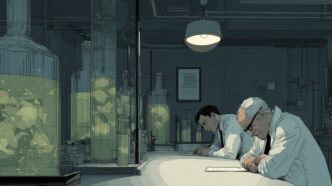
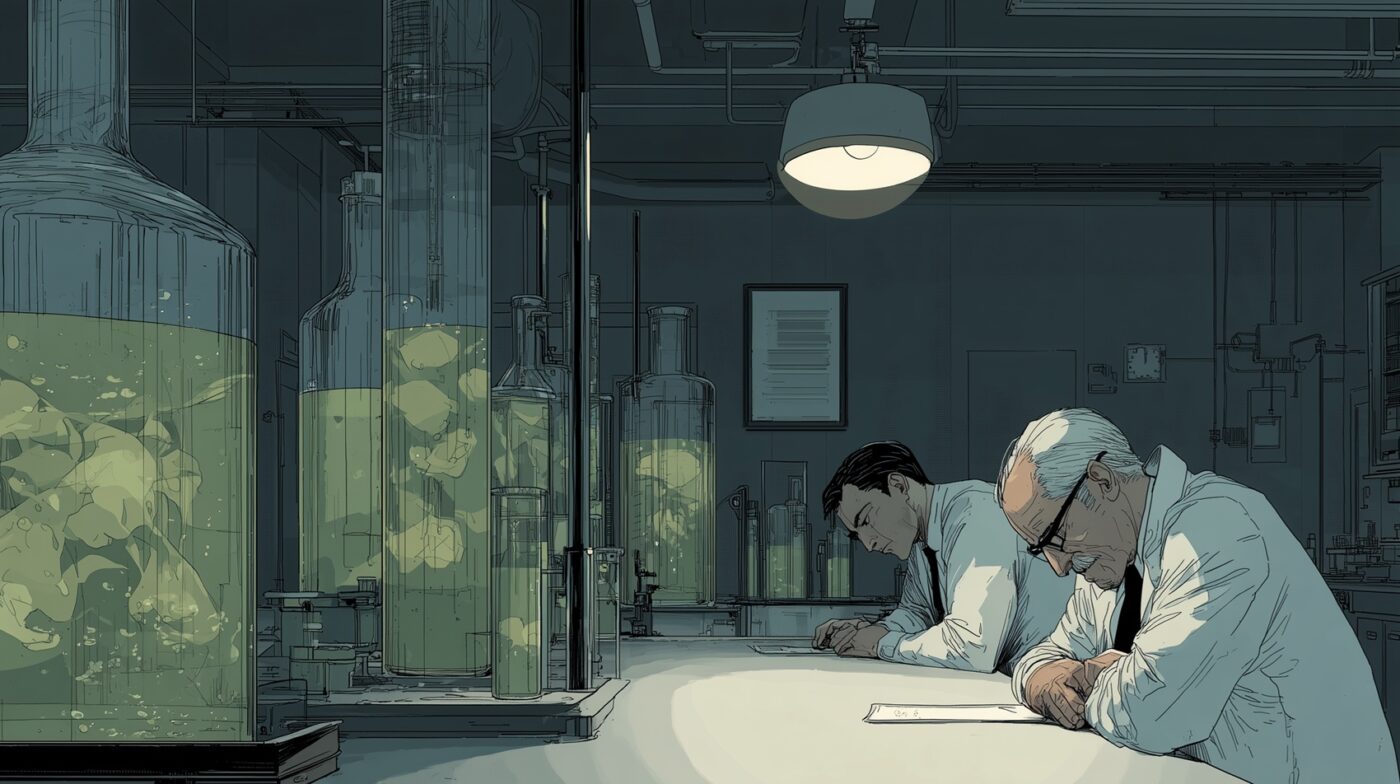

The pipes breathed in the dark. A slow, wet rhythm — lub-dub, lub-dub — that no one in the building seemed to notice anymore. At one corner of the room sat two men, two old friends, across from each other at a white table, their corner lit only by the overhanging light.
“But Khan! You can’t just shut down this project now. I— no, we are this close to a breakthrough! We can’t just back out now.”
“Jones, you’re not getting it. The funding is going to stop. The board considers this project an unnecessary risk, and they’re scared of how the public is going to react to… all of this.” Shehtaz Khan said, gesturing to the large glass vessels behind Dr. Riley Jones. Metal pipes protruded from the top of each vessel, carrying a murky green fluid to and from the containers that housed numerous unusual creatures. Riley sighed in defeat. He was rubbing his temples, his head bowed low, the overhanging light casting his face in shadow. Somewhere in the darkness of the laboratory a clock ticked in time with the pipes — lub-dub, lub-dub.
“How much time do we have to scrap…?” Riley inquired, not looking in Shehtaz’s direction, his voice lower than before. Shehtaz gave his friend a sympathetic look, almost reaching out to hold his shoulder before slowly pulling his hand back.
“Look, Riley,” Shehtaz said, his voice gentle. Riley turned to him. “The higher-ups say they can only allow for a week or so.” Riley groaned at the deadline, but Shehtaz continued: “I tried to negotiate on what can be done with the findings so far, and an agreement was reached — you can publish all the research as a valid attempt at developing synthetic life. It may not be cognitively complex in the ways a human mind is, but it’s a breakthrough in its own right, okay?” He extended his arm across the table and patted Riley’s hand.
“You’re missing the part where I’m still a failu—”
“No, you’re not, Rile—”
“Yes, I am, Khan!” Riley snapped back, his repeated attempts at reassurance futile, slamming his hand down on the table with a thud. He looked straight into Shehtaz’s eyes as he spoke.
“For my students? My team? This was their first chance at doing something big, something worth remembering.” Riley smiled at that — a real one, brief and unguarded. Then it was gone. The softness in his face dissolved into frustration again.
“But for me? This could have been my last chance to do something historic for them.” Riley stood from his seat and took a few deliberate steps, hands moving as he spoke, rationalizing his own perspective — his final attempt at persuading Shehtaz.
“The team can get better chances after this. I believe in them. They’re young and have the intellect to work their way to better things, things I couldn’t give them.” Riley continued to defend his work, pacing slightly, while Shehtaz kept his tired gaze on him.
“But what about me? This was the first time something was actually going right! Sure, they are technically miscarriages—” Shehtaz’s eyes twitched at the word, but no words came to him that could refute what the team had gotten so far: the countless bodies of fully formed synthetic life that refused to live. “—but this is the furthest we had ever gotten. Who knows what we can achieve if—”
“That’s exactly the ‘what’ they don’t want to know, Riley,” Shehtaz said, cutting him off. Riley sat down again, his shoulders dropping.
Shehtaz laced his fingers together and sighed, looking up toward the hanging light as if trying to pray away his friend’s stubbornness. “Riley.” He exhaled. “I’ve been saying this the entire time. The board wants to be careful. One step at a time.” He paused, searching for a way to make it land. “Nobody is trying to ruin you. But if we scare people — the public, the investors — there’s no trust. And without trust?” He gestured at the room around them. “None of this exists.”
Riley looked away from his friend and up at the light that hung above their table. Its blinding, sterile white glow shielded them from the otherwise dark room they had sat in for so long. It swung ever so lightly, as if it were a disapproving adult looking down at a children’s quarrel, shaking its head at them. The guilt settled somewhere beneath his ribs and stayed there. He should have tried harder, done things better — but there was no more room for that. He sighed and hung his head, eyes closed, palms covering his face. He gently rubbed his eyes, hoping they would stay dry, at least in front of Shehtaz. Then he pushed his chair back and stood. Down the hall, his students were still working. They didn’t know yet.