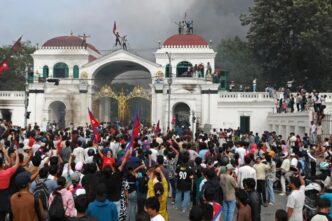


It was a revolution that began not with a bang, but with a scroll. In a dizzying 48-hour whirlwind, the Himalayan nation of Nepal was turned upside down. What started as scattered online anger coalesced into a torrent of youthful defiance that flooded the streets of Kathmandu, leaving government buildings smoldering and a prime minister cast out. The speed with which Nepal’s Gen Z—a generation born into a republic that promised a new dawn—toppled the political establishment is a phenomenon that even its participants are still struggling to process. “It wasn’t planned to be a revolution,” admitted Tanuja Pandey, a 25-year-old lawyer and environmental activist caught in the storm. “I think shocked is the right word to use.” We examine how these Gen Z protests in Nepal represented the latest in a long line of South Asian revolutions.
This seismic event was not a simple protest against a single policy, but a complex eruption born from a potent trinity of forces. First, it was a showcase of the unprecedented power of modern technology, where platforms like TikTok, Discord, and even artificial intelligence were weaponized to mobilize, organize, and overwhelm a state apparatus that fundamentally misunderstood the digital terrain. Second, it was a raw and visceral roar against deep-seated socioeconomic rot—a revolt against the blatant corruption and nepotism of a ruling class that flaunted its wealth while the nation’s youth faced a grim future of unemployment and forced migration.
But most profoundly, the uprising was a historical reckoning. It was the delayed and furious response to a revolution that was aborted nearly two decades ago. The very generation raised under the flag of the 2008 republic, which had promised liberation from monarchy and feudalism, rose up against the bitter reality of its broken promises. This article explores the anatomy of Nepal’s Gen Z revolution: from the viral sparks that ignited the flame and the digital arsenal that fanned it, to the ghosts of a betrayed political past that provided the fuel. It is the story of a nation’s future fighting to escape the failures of its past.
Every great fire begins with a single spark. For Nepal, there were two. One was a clumsy act of state censorship, the other a viral spectacle of elite indulgence. Together, they formed a combustible mix that proved too powerful for the government to contain.
The government of Prime Minister K. P. Sharma Oli lit the initial match. Citing the need to combat fake news and hate speech, his administration announced a ban on 26 social media platforms for failing to comply with a registration deadline. For a generation that communicates, organizes, and exists in the digital sphere, this was not a bureaucratic measure; it was a declaration of war. Young Nepalese, already deeply cynical about their government, viewed the ban as a transparent and authoritarian attempt to silence their voices and stifle dissent. The very tools they used to critique the powerful were being taken away, and they refused to be muted. This act of censorship, intended to impose control, instead became a unifying grievance, a clear and undeniable symbol of the state’s autocratic drift and its fear of its own people. It provided a single, unambiguous target for a generation’s simmering discontent.
If the ban was the match, the kindling was years in the making. A growing sense of outrage had been building online, centered around the hashtag #nepokids. This viral movement served as a digital pillory for the children of Nepal’s political elite, who shamelessly flaunted their inherited privilege on social media. For months, young Nepalese scrolled through feeds filled with images that felt like a personal insult: exotic holidays, mansions, supercars, and designer handbags, all funded by a system perceived as deeply corrupt.
The anger was not born of simple jealousy; it was a righteous fury rooted in a stark and painful contrast. While the children of the powerful posed with their spoils, the reality for the average Nepalese youth was bleak. With a youth unemployment rate hovering above 20 percent, one of the highest in the world, the dream of a prosperous life at home had evaporated. For millions, the only viable path to survival was migration. A vast diaspora of young men and women sustains the country from the Gulf, Malaysia, and India, sending back remittances that account for nearly a quarter of the nation’s GDP. Villages are emptied of their youth, and families survive on wire transfers while the coffins of migrant workers return to Kathmandu airport with grim regularity.
Against this backdrop of sacrifice and struggle, the images of the #nepokids were incendiary. One post, in particular, became a symbol of the movement’s rage. It showed Saugat Thapa, the son of a provincial minister, posing proudly beside an enormous pile of gift-wrapped boxes from Louis Vuitton, Gucci, and Cartier, bizarrely topped with a Santa hat. The photo went viral, encapsulating the grotesque disconnect between the ruling class and the people they were meant to serve. Another incident that fueled the fire was the wedding of a politician’s daughter, where a major road was allegedly blocked for hours to accommodate VIP guests, causing massive traffic jams and reinforcing the narrative that the elite lived by a different set of rules.
For activists like 23-year-old Aditya, seeing these displays of unearned opulence was “really unacceptable.” The #nepokids were no longer just individuals; they were symbols of systemic rot, living proof that the republic had failed to deliver on its promise of equality and had instead entrenched a new aristocracy.
On September 8th, the online fury spilled onto the streets. Galvanized by calls to action that had circulated on the few unbanned platforms, thousands of young protesters, led by figures like Aditya and his friends, descended upon the capital, Kathmandu. The initial protests were a direct response to the social media ban, but the energy was clearly fueled by the deeper anti-corruption message. The demonstrations quickly gathered pace and momentum, far exceeding the expectations of both the organizers and the authorities.
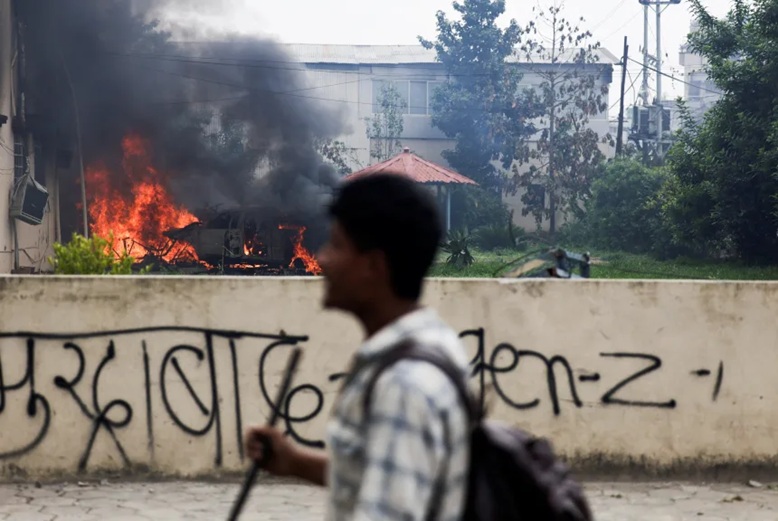
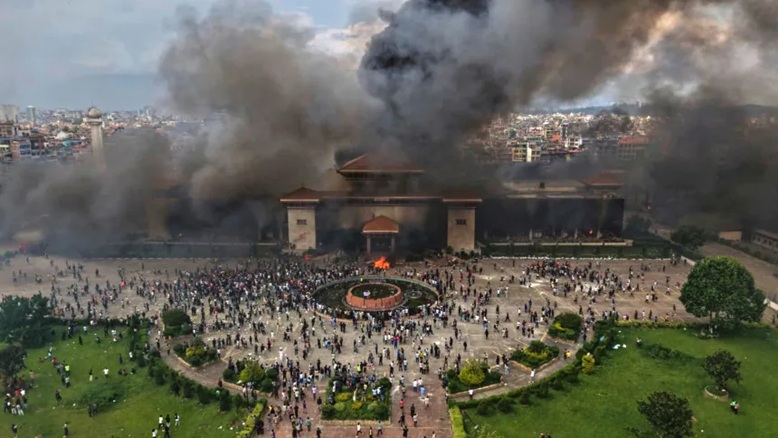
The state’s response was swift and brutal. Security forces met the protesters with rubber bullets, water cannons, and tear gas. But instead of dispersing the crowds, the crackdown only intensified their resolve. The clashes escalated dramatically. By the following day, September 9th, the situation had spiraled out of control. Enraged crowds stormed the parliament building, Singha Durbar, and set government offices ablaze. The prime minister’s residence was engulfed in flames. The capital was a war zone, filled with chants of defiance, the smoke of burning tires, and the sirens of overwhelmed emergency services.
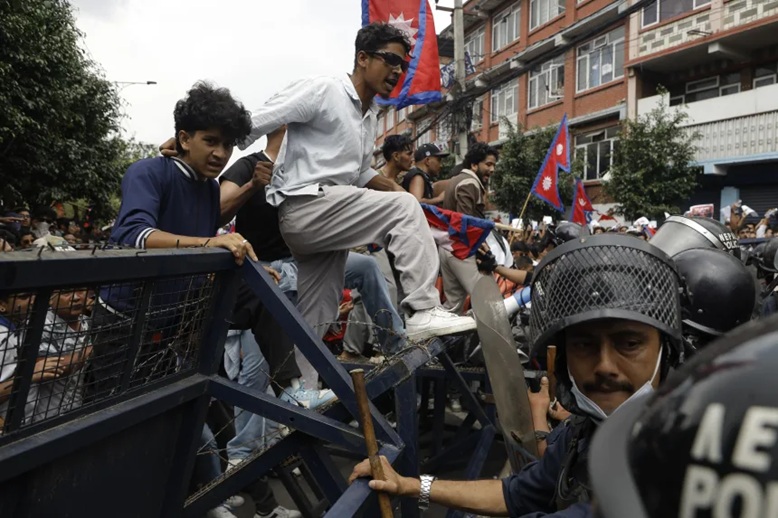
The human cost of this explosive uprising was staggering. In the chaos of those two days, official reports stated that 74 people were killed: 61 demonstrators, three police officers, and 10 inmates who tried to escape during the turmoil. Over 2,100 people were injured. Faced with a city in flames and a government that had lost all control, Prime Minister KP Sharma Oli resigned. The revolution, unplanned and leaderless, had succeeded in its immediate goal. In less than 48 hours, a generation armed with smartphones and a burning sense of injustice had brought the state to its knees.
The Nepalese revolution was a quintessentially 21st-century uprising, defined by the tools that forged it. This was not a movement of pamphlets and clandestine meetings but of viral videos, encrypted chats, and AI-generated propaganda. Gen Z, a generation of digital natives, wielded technology with an intuitive and sophisticated mastery that the state could neither comprehend nor counter, transforming their smartphones into the most potent weapons in their arsenal.
When the government imposed its sweeping social media ban, it inadvertently created a strategic bottleneck. TikTok, one of the few major platforms that had complied with registration and remained unbanned, was suddenly elevated from a hub of entertainment to the central nervous system of the revolution. It became the primary tool for mass mobilization, with calls to action, videos exposing corruption, and clips of protest activity spreading like wildfire through its powerful algorithm.
Recognizing this opportunity, small, agile groups of activists moved quickly. A group calling themselves the “Gen Z Rebels,” which included the activist Aditya, hunkered down in a library in Kathmandu. Armed with little more than mobile phones and laptops, they used AI platforms like ChatGPT, Grok, and Veed to create a barrage of social media content. They produced over 50 clips targeting the #nepokids and government corruption, using multiple accounts and Virtual Private Networks (VPNs) to evade detection. Their first video, a 25-second clip from the wedding that had enraged Aditya, was set to ABBA’s “The Winner Takes It All” and ended with a simple, powerful call to action: “I will join. I will fight… Will you?” Within a day, it had over 135,000 views, its reach amplified by online influencers who recirculated it to their own vast networks.
As the protests turned violent and the army imposed a curfew, the movement’s strategic hub shifted from the public square of TikTok to the more secure, semi-private rooms of Discord. The gaming chat platform became the revolution’s de facto digital parliament. In thousands of servers and channels, protesters from across Nepal and the diaspora debated their next moves, shared information, and, most remarkably, held an online vote to nominate an interim leader for the country. Their choice was Sushila Karki, a 73-year-old former chief justice of the Supreme Court with a formidable reputation for fighting corruption. When Karki was sworn in, the popular Instagram account gen.znepal posted a celebratory message that perfectly captured the generation’s voice: “Honorable PM Sushila Karki… SLAYYY 💅🏾.” It was a fusion of deadly serious political action and irreverent internet culture, a language the old guard could not speak.
The digital nature of the movement meant that it was never confined by Nepal’s borders. The country’s youth were keenly aware that their struggle was part of a larger regional wave of revolt. They drew direct inspiration and tactical knowledge from recent youth-led uprisings that had toppled governments across South and Southeast Asia. They studied the 2022 Aragalaya movement in Sri Lanka that drove a president from power, the student-led revolution in Bangladesh that ousted Sheikh Hasina in 2024, and the ongoing demonstrations against corruption in Indonesia and the Philippines. “We learnt that there is nothing that we – this generation of students and youths – cannot do,” Aditya affirmed.
Technology brokered a powerful sense of solidarity among these disparate movements. A cartoon skull logo, originating from the popular Japanese anime One Piece where it is used by a crew of pirates fighting for freedom, was first popularized by Indonesian demonstrators. It was quickly adopted by protesters in Nepal and the Philippines, appearing on flags, in video clips, and as social media profile pictures—a shared symbol of rebellion. The hashtag #SEAblings (a play on siblings in Southeast Asia) trended online, as young people from different nations expressed support for one another’s anti-corruption fights. As historian Jeff Wasserstrom noted, while political solidarity in Asia is not new, the speed and saturation of modern technology are different. “The images [of protests] go further and faster than before,” creating an immediate and visceral connection. For a young activist in Kathmandu, seeing images of a mansion owned by a corrupt official in Manila on their phone made the fight feel universal and deeply personal.
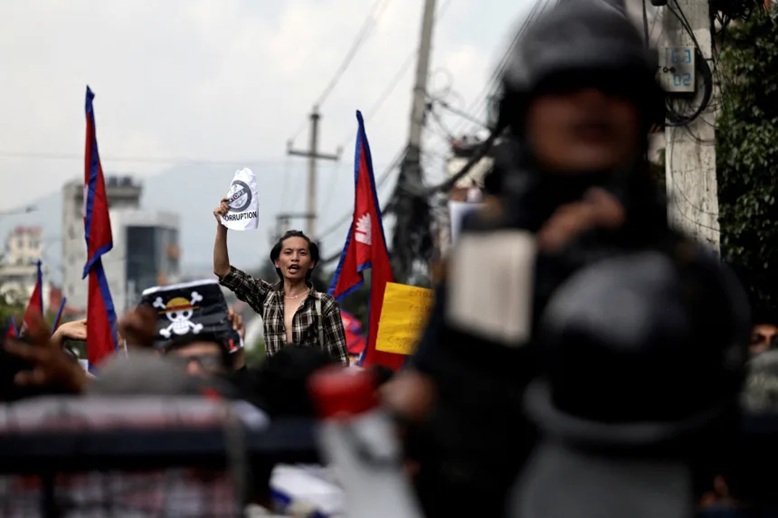
Yet, for all its power, the reliance on social media came with inherent dangers. The same digital platforms that enabled rapid mobilization also proved to be fertile ground for division, misinformation, and targeted harassment. The leaderless, decentralized nature of the movement, while a strength in evading clampdowns, made it vulnerable to manipulation and internal friction.
Activists who rose to prominence, like Tanuja Pandey, found themselves the targets of vicious online hate campaigns. “The things that keep us awake at night are the divisions [in the public discourse],” she shared, expressing worry that the core anti-corruption message was being misinterpreted or deliberately twisted by bad actors. The digital town square was chaotic and often toxic, and the very tools that empowered the protesters could be turned against them to spread lies, sow discord, and delegitimize their efforts. This digital backlash highlighted a central challenge for the movement moving forward: how to harness the democratizing power of the internet while mitigating its capacity for chaos and destruction. The revolution was born online, but its long-term survival would depend on navigating the treacherous currents of the digital world it inhabited.
To understand why thousands of Nepalese teenagers and twenty-somethings were willing to risk their lives on the streets of Kathmandu in 2025, one must look back to a revolution that occurred before many of them were old enough to remember. The Gen Z uprising was not simply a reaction to a social media ban or offensive Instagram posts; it was a delayed reckoning with the profound betrayals of the past, a revolt against a republic born from a revolution that was aborted almost as soon as it began.
For centuries, Nepal was a Hindu kingdom ruled by monarchs who presided over a rigidly hierarchical and unequal society. This ancient order began to crumble in the early 2000s, culminating in the 2006 “People’s Movement II” (Jan Andolan II). Millions of workers, peasants, students, and women poured into the streets, defying curfews and bullets to force the authoritarian King Gyanendra to relinquish power. It was a moment of immense hope. Two years later, in May 2008, the 240-year-old monarchy was formally abolished, and Nepal was declared a federal democratic republic.
The air was thick with heady expectations. The country’s Maoists, emerging from a decade-long insurgency in the countryside, became the largest party in the new constituent assembly. For a global left grappling with neoliberal triumphalism, Nepal was a rare beacon of optimism, proof that revolutionary struggle could still achieve victory. The new leaders promised a radical transformation: land reform for the peasantry, equality for marginalized Dalits and women, and recognition for oppressed nationalities. A new constitution was supposed to be built on the principles of social justice and democratic participation. This was the republic the Gen Z protesters were born into—a state founded on the promise of liberation.
Almost immediately, however, the revolution stalled. The Maoist leadership, along with other major communist parties like the CPN-UML, made a fateful strategic pivot. They abandoned the path of mass mobilization that had brought them to power and instead dove headfirst into the murky waters of parliamentary maneuvering. The radical energy of the streets was channeled into the corridors of the state, where it dissipated into backroom deals, patronage politics, and factional infighting. The drafting of a new constitution dragged on for years while party leaders traded ministries and contracts.
The ideological justification for this retreat was the orthodox Stalinist-Maoist doctrine of a “two-stage revolution.” According to this theory, Nepal’s first task was to complete a “bourgeois-democratic” transformation by dismantling feudalism and establishing a republic. The socialist transition could only begin at some undefined point in the future. In practice, this theory provided the perfect political and moral cover for compromise and co-option. It allowed the leadership to present their embrace of constitutionalism, neoliberal development policies, and alliances with reactionary forces not as a betrayal, but as a “necessary stage.” By deferring socialism to an abstract horizon, they legitimized their own integration into the very capitalist system they had once vowed to overthrow.
The consequences were disastrous. Insurgents who had once mobilized millions became bureaucrats defending privileges. The same parties that promised liberation became administrators of neoliberal reforms and brokers of foreign loans. By 2018, the Maoists and their rival CPN-UML had merged, commanding a decisive parliamentary majority. Yet instead of transformation, there was only paralysis and power grabs. The Left became fractured and discredited, seen by the populace not as agents of change but as just another part of the corrupt political establishment.
For the generation born after 2008, the political infighting was abstract, but its consequences were painfully real. The republic failed to deliver on its most basic economic promises. Agriculture, once the backbone of the economy, declined sharply, causing farming incomes to collapse. The state proved incapable of generating decent jobs at home. This drove millions of young Nepalese to emigrate, not as a choice, but as a necessity.
A remittance economy took hold. Today, money sent home by Nepali workers abroad accounts for nearly a quarter of the nation’s GDP—one of the highest rates in the world. While this influx of cash has reduced absolute poverty, it has entrenched a dangerous cycle of dependency and inequality. The nation’s survival was effectively outsourced to its migrants, who are often treated as disposable labor in the Gulf states and Malaysia. For the youth left behind, the reality was stagnant wages, soaring inflation, and a near-total lack of opportunity. The 2015 constitution enshrined an impressive list of rights—to education, health care, and housing—but in practice, they were hollow promises in a state riddled with corruption and incapable of providing basic public services. The republic that had promised dignity and prosperity had instead delivered precarity and exile.
The profound disillusionment with the republic and the failure of the Left created a dangerous political vacuum. In the streets and online, royalist forces, once marginalized, have become more prominent. Brandishing the old royal flags, they tap into a nostalgia for a past that, for all its faults, is now remembered by some as a time of stability. Their appeal gains credibility with every new corruption scandal and every broken promise of the republican elites.
While a full rollback to monarchist rule seems unlikely—the class alliances and international interests that supported the republic’s formation are still largely in place—the specter of the monarchy serves a crucial purpose. It functions as a potent protest vocabulary, a way for a disillusioned populace to express its total rejection of the current system. The rise of royalist symbolism is not so much a coherent political project as it is a symptom of the republic’s profound legitimacy crisis. It is a stark warning that when a revolution fails to deliver, people will begin to search for alternatives, even in the ghosts of the authoritarian past they once fought to overthrow. The Gen Z movement, in this sense, is fighting a war on two fronts: against the corrupt present and against a reactionary nostalgia born from the failures of the revolutionary past.
In the aftermath of the fiery 48 hours that shook Nepal to its core, the smoke has cleared to reveal a landscape fraught with both peril and fragile hope. The immediate victory of forcing a prime minister’s resignation has given way to the far more complex and uncertain task of building something new from the ashes. The Gen Z movement has disrupted the political landscape, but whether this disruption can be channeled into lasting transformation remains the nation’s most pressing question.
The immediate aftermath brought a flurry of activity aimed at calming the streets and creating a semblance of order. With K. P. Sharma Oli’s resignation, an interim government was quickly established, headed by Sushila Karki, the former chief justice nominated by the protesters on Discord. Her appointment was a significant symbolic victory, a nod to the movement’s demand for an anti-corruption figurehead at the helm. Elections were scheduled for early March of the following year, offering a constitutional path forward.
Furthermore, in a direct concession to the protesters’ core demands, the new administration announced the formation of a judicial commission to investigate the violence and the deaths that occurred during the clashes. In other countries in the region facing similar protests, such as the Philippines, independent commissions were also set up to investigate corruption, with presidents promising “no sacred cows.” Similarly, in Indonesia, some financial incentives and controversial perks for lawmakers were scrapped. These moves in Nepal were designed to signal accountability and a break from the past. However, for a generation deeply cynical about state institutions, these are merely first steps. The real test will be whether these commissions have the power and political will to prosecute powerful figures and dismantle the entrenched networks of patronage.
Despite these initial victories, significant challenges loom. The very nature of the movement—decentralized, digitally-driven, and largely leaderless—presents a fundamental dilemma. While this structure made it resilient and difficult for the state to decapitate, it also impedes the long-term strategic planning necessary for fundamental social change. As Steven Feldstein of the Carnegie Endowment for International Peace points out, social media is “inherently not designed for long-term change… you are relying on algorithms and outrage and hashtags to sustain it.”
History provides a cautionary tale from within Nepal itself. The 2006 revolution, led by the millennials of their day, successfully ousted the monarchy but ultimately failed to achieve its transformative goals. The country then cycled through 17 governments as the economy stagnated. The previous generation of protest leaders, argues Narayan Adhikari of the Accountability Lab, “ended up becoming part of the system and lost their moral ground.” The challenge for Gen Z is to avoid this fate. To succeed where their predecessors failed, they must find a way to transition from a disparate online movement to a cohesive political force with a long-term vision. This requires building bonds that are physical as well as digital and developing viable political strategies that go beyond a “zero-sum, burn-it-all-down” approach.
What may distinguish this generation, however, is its acute awareness of this history. The young activists on the streets today are not naive idealists; they are the children of a broken revolution, and they carry its lessons with them. Aditya, the 23-year-old activist, vows that this time will be different, drawing a sharp contrast with the past. “We are continuously learning from the mistakes of our previous generation,” he states firmly. “They were worshipping their leaders like a god. Now in this generation, we do not follow anyone like a god.”
This rejection of charismatic, deified leadership in favor of a more horizontal, issue-based movement could be their greatest strength. It reflects a deep-seated distrust of the traditional political structures that co-opted the last revolution. Their demands go beyond simply replacing one set of leaders with another; they are denouncing the entire system of corruption, inequality, and elite compromise. They are fighting not just for free speech, but against the very socioeconomic conditions that make their lives untenable. This focus on systemic change, rather than on personalities, offers a glimmer of hope that they may yet avoid the pitfalls of the past.
The Gen Z revolution in Nepal is far more than a flash in the pan. It is a complex, multi-layered historical event that stands as a stark warning to ruling elites everywhere about the potent combination of technological empowerment and political betrayal. It is a testament to the power of a globally connected youth movement that shares symbols, tactics, and a profound sense of solidarity in its fight against injustice. But most of all, it is a new chapter in Nepal’s unfinished revolution. The republic promised equality but delivered instability. It promised justice but delivered corruption. The crowds that filled Kathmandu’s squares were a powerful reminder that the struggle which began in 2006 is not over. The republic was never the conclusion; it was only the beginning. Whether this new, defiant generation can build a future that finally fulfills that radical promise, or whether they too will be consumed by the system they seek to overthrow, is the unwritten question that now hangs over the Himalayas.