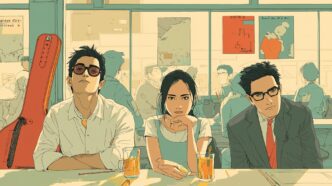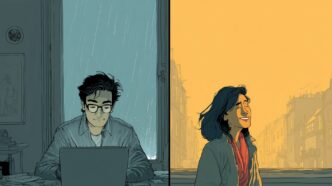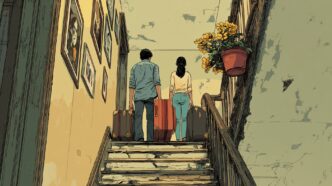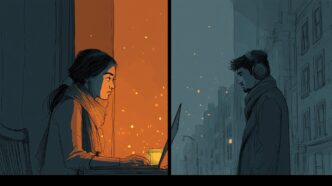
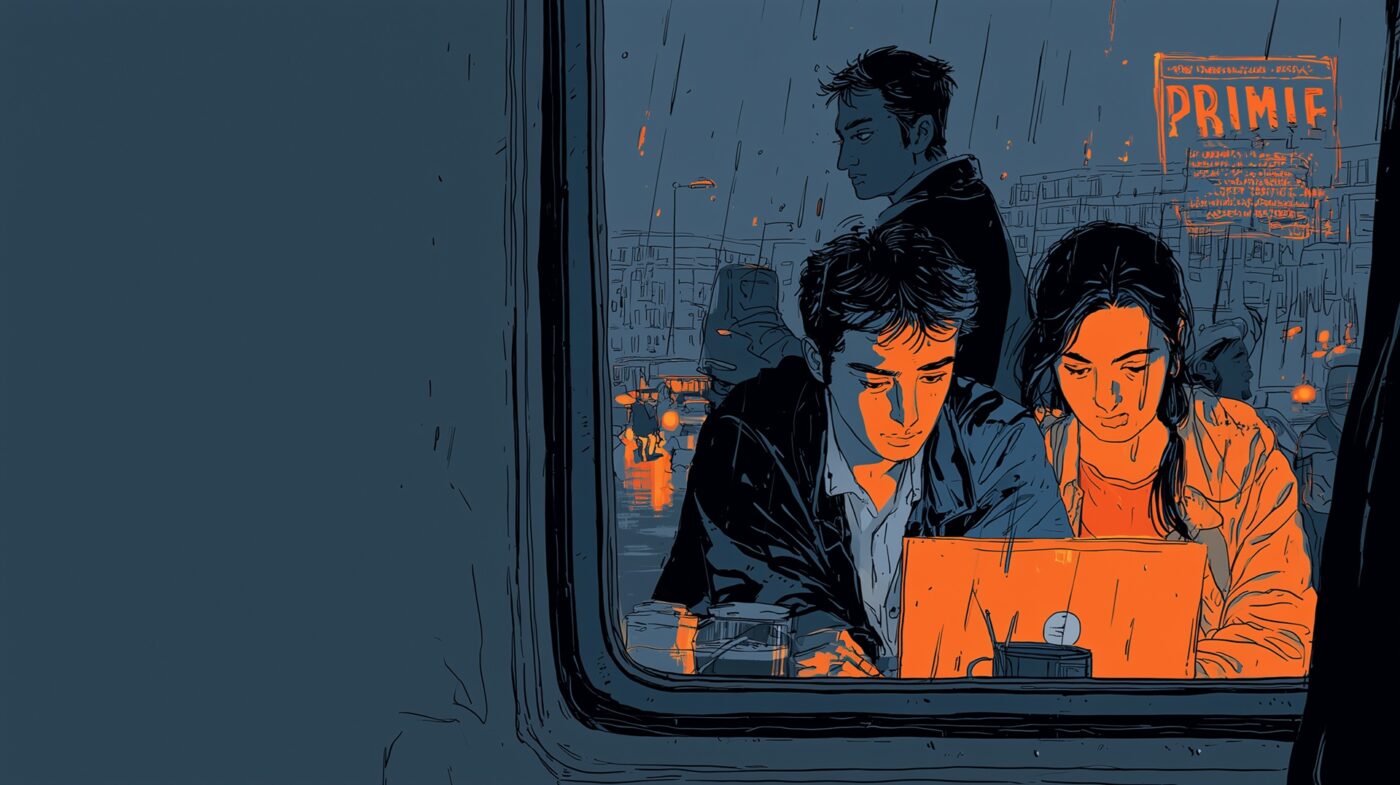

Banani café interiors were always variations on the same fever dream: imported fake-wood tables, pendant lamps like upturned colanders, crowds so curated someone should check your shoes at the door. Akib slid into the booth facing the window. The AC burned the inside of his nose. Dhara hunched over her phone, breath fogging in the meat-locker chill. She wore a cardigan the color of pistachio ice cream.
Samara swept in ten minutes late. No walking—gliding, her trench coat trailing behind like an exclamation mark. No laptop bag. Just a pale beige MacBook clamped under her arm like a clutch purse. She dropped it on the tabletop and sat, arranging herself in a perfect right angle, one knee over the other, both hands folded like origami.
Kabbo arrived last. Garments Protest tee. Iced Americano. He looked like he’d slept in the shirt. Probably had. He slouched, letting the cold air hit his face, tried to order a cheese toastie from a passing waiter who ignored him completely.
“So.” Samara barely waited for anyone to breathe. “Here’s the deck. Don’t touch the formatting.”
She AirDropped it to the group. A moment later, four identical beiges glared from four screens. Akib scrolled. First slide: the Burger Daddy logo rewritten as BD PRIME in a font so thin it would snap in a stiff breeze. The color was pale, noncommittal sand. Next slide: a timeline, also beige, with milestones in a slightly darker beige. No images of burgers, daddies, or even a hint of grease.
Dhara’s thumbs hovered over her phone. “Samara, is this… the actual template?”
Samara didn’t look up. “Yes. Minimalist. Clean.”
“It’s like a funeral for flavor,” Kabbo said, his voice half-swallowed by the AC. He zoomed in on the mission statement: To Revolutionize the QSR Experience in Post-Modern Urban Bangladesh. “You killed the entire concept of food.”
Samara gave him a withering look. “We’re rebranding. That’s the whole point. Put a pepperoni slice on the cover, people expect Pizza Hut. This is a lifestyle play.”
Dhara pinched the bridge of her nose. “But Burger Daddy’s entire identity is being cheap and trashy. You’re making it look like a Swedish dental supply company.”
“Aspirational,” Samara said. “People don’t want to be who they are. They want to be who they see on Instagram.”
Kabbo, bored, opened the font menu and started scrolling. “What if we used something with energy? Something that says ‘Daddy’ in a fun way?”
Samara’s eyes flicked up. Kabbo previewed Bleeding Cowboys. Akib could almost hear her teeth grinding.
“Absolutely not.” Sharp. “Do you want us to look like a Texas BBQ joint?”
Dhara smothered a laugh. “At least then someone would know what we’re selling.”
Akib hovered his cursor over the slide master, finger itching. He could see a better version in his mind’s eye. Last semester, he’d spent four sleepless nights reformatting a group project only for the others to upload an outdated draft on presentation day. He’d sworn never to care again. His eye twitched at the off-center alignment in the third slide.
“Honestly,” Dhara said, “if you want to sell the story, start with the sauce. That’s the only reason anyone goes to Burger Daddy. Even after the food poisoning thing, people still line up for the Naga Lava.”
“Tabloid angle,” Kabbo said, perking up. “Make the scandal part of the story. Embrace the chaos.”
Samara’s mouth thinned. “I don’t do tabloid.”
“But you do beige?” Dhara shot back.
Dhara’s voice splintered the table’s tension. “Why are we even here? We’re supposed to analyze supply chain collapse during the Eid rush, not pick out a Pantone wedding palette.” She snapped her notebook shut. The click echoed off the condensation-streaked window.
The air changed. Kabbo glanced at Akib. Akib stared at a crack in the tabletop. Samara didn’t flinch, only placed her palms flat against the marble with the poise of someone about to push away from the negotiating table. “Excuse me, but the entire project lives or dies on the pitch. If you want to win, you need to look like you deserve to.”
“I want to pass, not start a lifestyle cult,” Dhara said. “If you care so much about the pitch, just do it alone.”
Samara’s eyes lingered on Dhara for a full second. Then she stood. Fluid. Deliberate. Years of Instagrammable brunches condensed into one movement. “People without vision always blame the presentation.” She scooped her MacBook, the vein of her wrist pale against the sleeve of her trench. “Arafat, we’re leaving. Come on, my driver’s waiting.”
Arafat, who’d just arrived mid-scene and was halfway through a cheese croissant, looked between Dhara and Samara, then at the untouched iced Americano sweating on the table. He stood, mumbled something that was probably “catch you later,” and trailed Samara out. Burnt milk and Axe lingered in his wake.
Nobody spoke. Kabbo flicked through the deck, deleting three slides with a single, performative gesture, then shut his laptop. “Guess we’re the new Group 7. Do we even have a plan?”
Akib watched the blurred traffic beyond the glass. A courier on a battered Honda idled at the curb, helmet bobbing as he scrolled on his phone. Across the road, schoolgirls took selfies with a waffle cone, each frame capturing a single, perfect second. No one would ever bother to print.
He remembered the first time he’d tasted Naga Lava sauce. A dare. Plastic tray balanced on his knees in the food court at Jamuna Future Park. The burn crept up the back of his throat and stayed there. Sometimes the experience was the point, not the flavor.
“We have forty-seven hours,” he said. Condensation trickled down his glass. “We scrape the data. We build the model. We make it loud.”
Dhara opened her notebook again. Lines of neat handwriting already crowding the first page. Her shoulders had relaxed, a tiny shift. Akib noticed. “I’ll tag my cousin at Chawkbazar for the supplier info,” she said. “And Kabbo, if you memeify the mascot, keep the executioner’s hood. At least then the joke lands.”
Kabbo grinned. Canines yellowed from instant coffee and too many late nights. “I’ll give him a selfie ring light, too.”
***
Three hours later, they squatted on the curb outside the café. Humidity draped over their heads like a hot towel. The pavement sweated through their jeans. Dhara had peeled off her cardigan and knotted it around her waist; goosebumps dusted her arms—the aftermath of Samara’s exit more than the clammy air. Akib’s laptop sat on his knees, barely holding a charge, its fan wheezing like a dying mosquito.
Dhara jabbed her finger at the spreadsheet. Nails bitten to the quick. “It’s the supply chain, obviously. No one is paying bribes at the port anymore, so the sauce shipments get held up for weeks. Two weeks before Eid, they ran out, doubled the water to stretch the batch, and messed up the ratios.”
Kabbo scrolled through Instagram reels on his phone, letting the words pool around him. He’d already folded a napkin into a makeshift origami swan and balanced it on Akib’s shoulder, where it wobbled like a tiny, indecisive general. “We can meme this. A sad Burger Daddy, chained to the customs office, weeping tears of diluted Naga Lava.”
Akib tried to picture it. His brain kept rendering the PowerPoint in the same boxy Arial font he’d used since tenth grade. “That’s funny, but have you seen Samara’s decks? Everything is so…” He trailed off, gesturing helplessly into the thick air. “It doesn’t matter if the content is good. If it looks cheap, it is cheap. No one takes it seriously.”
Dhara grunted. “Then make it look expensive. You’re the slide guy.”
Akib felt the old, familiar itch on his right wrist—the urge to snap his laptop shut and run. “I design like a government clerk from the 90s. My best template is blue gradient with white bullet points.”
Kabbo shrugged, unbothered. Eyes never leaving his phone. “I’ll draw the burgers by hand, if you want. Stick figures only.” He glanced at Akib. “Or we could find someone who actually knows how to do this.”
Akib watched a rickshaw crawl by. The driver’s vest soaked translucent with sweat. Assembly line of group projects he’d survived. Some teams had an in-house slide god. Others just faked it with Google Images and desperation. He remembered a rumor, whispered by the Senior Bhaiyas who still smoked at the edge of the parking lot: there was a legend on campus—a super-senior who hadn’t attended class in three years but still roamed the halls, trading slick decks for cold, hard cash.
His name was Siraj.
Akib had never met Siraj. But he’d seen the output. Rumor had it one of Siraj’s decks had gotten a team to the semifinals of an international case comp, despite the fact that their proposed startup was an app to deliver live goats for Qurbani Eid. The slides had so much polish, no one noticed the business plan was a joke.
He hesitated. “You heard of Siraj?”
Dhara squinted at him. “The Ghost? Isn’t he a myth?”
Kabbo looked up from his phone, for once interested. “I heard he lives in the library basement. Only accepts payment in foreign energy drinks.”
Akib shrugged. “We’re doomed anyway. May as well try.”
***
They spent the next hour in reconnaissance. A small band of exiles, ranging the campus in search of a legend. Library, no dice—just first-years hunched over exam preps and a librarian who looked like she would commit murder for a working air conditioner. They checked the ground floor of the admin building, where Kabbo swore he’d once seen Siraj carrying a tupperware of biryani. Only found the accounting clerk eating lunch with his mouth full and his desktop screensaver on fire.
Past the perimeter of campus, behind the library’s rain-stained outer wall, there was a tea stall with no signboard and no official tables—just a collection of plastic stools and scavenged cable-reel spools. It was known exclusively as The Batcave. Source of the worst instant coffee in Banani but also the only place you could smoke out of sight of the admin. The light came in slantwise through a hacked-together patchwork of blue tarp and rusted sheet metal, filling the air with a chemical morning glow even at dusk.
Siraj was there, exactly as Kabbo had predicted. Hunched over a war-scarred Thinkpad that sounded like it was running nuclear physics simulations. The man wore a t-shirt that simply read Lorem Ipsum, the fictional text in 48-point Impact font; beneath it, his skin had a faint, yellowish pallor, as though illuminated from the inside by fluorescent light and regret. Eyes bloodshot. Hair uncombed and unusually dense. Next to him, a brown paper bag of samosas sweated translucent oil onto a stack of numbered index cards.
He didn’t look up when they approached. Didn’t flinch when Kabbo dropped heavily onto the stool beside him. Akib lingered at the edge. Dry mouth. The odor of sweat and molasses-sugar chai stuck to his skin.
Kabbo opened with a flourish. “Siraj Bhai, you still running the Slide Syndicate?”
Siraj tapped something on the laptop, then leveled a stare at them. Pupils dilated perfectly round. “Depends. Are you willing to pay?”
Dhara, who’d followed at a deliberate five-meter distance, set her notebook down like she was placing evidence into a court record. “We just need a little design. For an assignment. Please.”
Siraj tilted his head, studying her. “I don’t work for free.”
Akib swallowed. Every failed group project clung to him like cheap cologne. “We have data. We just don’t have… polish.”
Siraj’s attention flicked briefly to the spreadsheet printout Akib held in his fist, then to Akib’s face. Lingered an uncomfortable second. “Cash is meaningless. This country will be underwater by 2040. I trade in vices.”
Kabbo perked up. Possibly the first time he’d heard anything resembling a challenge all day. “Name it.”
Siraj held up three fingers. “Benson & Hedges, gold, three packs. Monster Energy, original, not the sugar-free shit. And—” he paused for effect— “unfiltered gossip about the new Dean of Student Life. The dirtier the better.”
Dhara let out a sound that was almost a laugh. “You want bribes and rumors?”
“Correct,” Siraj said, turning the laptop so they could see the screen. “Do you want Helvetica or Futura for the headline?”
Akib didn’t know the difference. Kabbo leaned in, scrutinizing. “Helvetica. It’s what Burger Daddy would have wanted. Classic but a bit trashy.”
Siraj opened their draft. His nostrils flared so wide the pockmarks on his cheeks went concave. He scrolled. Then he howled—a long, unbroken yowl, as if someone had pried his thumbnail off with a spoon.
“Who did this?” His pointer finger jabbed at the screen, which now glowed a sickly, sepia beige.
No one answered. Or everyone answered, all at once, by shrinking back a centimeter. Even the chai-wallah paused mid-pour.
Siraj slammed the spacebar. “This is an abomination. This is a crime against typography. What is this font? Whose idea was this?” He flicked to the next slide, then again, each time more agitated. “Look at the kerning! ‘Burger’—the ‘B’ and the ‘u’ are social distancing. ‘Prime’ isn’t even aligned to the baseline. There is a river of negative space in your bullets. Are you trying to bore the audience to death? Is that your strategy?”
He spun the laptop around so they could witness their shame in high-res.
Akib tried to swallow. His throat clicked. “It’s the standard template—”
Siraj cut him off with a palm-up spasm. “No. No standards. Only vision. You must seduce the eyes before you can penetrate the mind.”
Kabbo’s whole face went red from holding in a laugh. Siraj didn’t notice. He was already dragging files onto the desktop, opening them in rapid-fire succession: a folder labeled “CaseComp_MurderDekho,” a PNG of a glistening burger with a knife stabbed through it, a rainbow palette with colors so lurid Akib’s retinas recoiled.
“We do not beige,” Siraj said. His voice now deep and ceremonial. “We go full flavor.” He replaced the first slide’s sand with a radioactive orange. “You see? Already the appetite is ignited. Look at the negative space—it wants to be filled, not left empty!”
Dhara leaned forward. Pencil poised. Siraj caught her in the corner of his vision. “And you—what is this?” He held up her printout. “This is a wall of numbers. You think anyone reads the footnotes? You cut eighty percent. Only keep the numbers that punch.”
He began to narrate his process. Not for their benefit—as though the laptop required a running commentary. “Now we switch to a bold, slab-serif—see how the letters hug each other? Intimacy creates hunger. Good. Next, we add a photo of the actual burger, unfiltered, dripping. We want them to crave it. If anyone sees a sanitized burger, they go to McDonald’s. If they see the grease, they remember Burger Daddy is for the brave, not the weak.”
Kabbo clapped, softly. Siraj ignored him. “And these transitions—no more fade-ins. We do jump cuts, smash cuts. Keep them awake. Keep them on edge.”
He worked for twenty straight minutes. Fingers gliding, deleting, rearranging. When he finished, he loaded the deck onto a battered USB drive, then turned to face them. He was sweating. Not clear whether from exertion or from the caffeine and nicotine cocktail he’d mainlined since noon.
“This is how you win,” he said, handing the drive to Akib. “You don’t read from the slides. You become the slides. If you read off the slide, I will kill you myself.”
He said it so flat, so matter-of-fact, Akib believed him.
***
The next thirty-six hours passed in a kind of time-lapse fever. They met in the canteen, the library, even the mosque courtyard once, rehearsing lines, cutting text, adding GIFs of burger disasters and viral tweets about food poisoning. Dhara distilled her research into five brutal bullet points, each one more savage than the last. Kabbo hand-drew a set of meme-mascots—Burger Daddy with a hangman’s noose, with a black eye, with an IV drip of Naga Lava sauce. Akib rewrote the opening pitch seven times, each version shorter and sharper, until the first sentence hit like a slap.
The morning of the presentation, the group huddled outside the auditorium. Clutching their notes. Dhara’s hands shook, but her voice was steady. She’d practiced in the mirror, in two languages, for hours. Kabbo had transformed his nerves into kinetic energy, pacing the corridor in tight, staccato circles. Akib felt the hum of adrenaline everywhere: in his ears, in his teeth, behind his eyes, where the colors of the new deck still vibrated, pulsing neon.
Inside, the other groups were already presenting. He watched through the open door as Samara delivered her pitch: flawless, sleek, every move choreographed. Her team’s deck was a monument to beige. The professors nodded, impressed. Akib glimpsed the other teams—Biman Airlines, a failed tea startup, a social enterprise for stray cats—each one more polished than the last.
Their turn. The auditorium lights stung. Akib’s vision narrowed to the stage, then the laptop, then the first slide—a wall of hot orange and indigo. He could feel the audience tense, recoiling, then leaning in.
He didn’t read the slides. He performed them. He told the story of Burger Daddy as a tragedy, then a crime, then a strange, heroic underdog tale. He let the grease seep into the pitch, made them cringe, then laugh, then want to try the Naga Lava challenge for themselves. Dhara delivered the numbers like a series of punches. Kabbo ran the memes, timing each GIF to land just as the room was about to tip from laughter to discomfort.
It was over in five minutes. Akib felt his heart still sprinting a half hour later.
After, Siraj texted a single line: “You have weaponized cholesterol. Well done.”
The team didn’t win first place. Didn’t even get runner-up—Samara’s team took that, of course. But when the class voted for “Most Viral Pitch,” Group 7 won by a margin so wide the professor accused them of ballot stuffing.
Akib saved the final deck on his desktop. He stared at the filename—Project_Grease_God_Final_v3.pptx—then at his reflection in the black monitor.
He let himself smile. Just a little. Just enough to feel the burn, like the afterglow of too much Naga Lava.