




The stage at Coachella smells of dust and warm air, the kind that settles on skin and clothes and stays there. In April 2026, under the familiar palms of Indio, Katseye made their debut at the festival—five figures instead of six, the geometry of the group quietly rearranged. The crowd filled the gap with noise. Onstage, the remaining members moved with the trained precision of a unit that has rehearsed these formations hundreds of times. But the math was still off, and everyone in the tent knew it.
For a group built to represent a new kind of global pop—a seamless fusion of K-pop discipline and American commercial instinct—the image of five members navigating a stage designed for six said something no press release had. Katseye arrived at its biggest moment to date carrying unresolved questions about its future, its identity, and what kind of enterprise it was always meant to be.
The Experiment
HYBE, the South Korean entertainment conglomerate that built its empire on BTS and the industrial logic of K-pop, launched its American ambition in partnership with Geffen Records in the early 2020s. The goal was direct: take the machinery that had industrialized global pop from Seoul and apply it to a Western market. Build a girl group from scratch, on camera, and make the process part of the product.
The result was Pop Star Academy: KATSEYE, a Netflix docuseries that drew over 120,000 applicants from around the world. The show positioned itself as a modern evolution of the “making the band” format—familiar in its structure, radical in its ambitions. TIME called it the most deliberate attempt yet to transplant K-pop’s industrial process into American soil. Slate noted that the show “brings K-pop to the classic ‘Making the Band’ reality show format.” Fast Company asked the sharper question: could HYBE actually copy K-pop’s success in the US, or was the formula untranslatable?
What emerged was a group unlike any other in contemporary pop. Lara is Tamil-American. Sophia is Filipina-American. Daniela is Latina. Yoonchae is Korean. Megan is American. And Manon is Black and Swiss-American—the first Black artist to be signed to HYBE. The diversity was intentional and documented. Grammy.com described them as “the global girl group styled after K-pop superstars.”
In interviews, Daniela offered the most economical summary: “the first American girl group to make American pop music but trained to do the crazy choreography of K-pop.” The group was both a cultural statement and a commercial product. Those two things are not always easy to hold together.
The Numbers Say Yes
On paper, Katseye entered 2026 as a success story. Their second EP, Beautiful Chaos, released June 27, 2025, debuted at number four on the Billboard 200—their highest chart position to date. By year’s end, the record had sold 186,000 units in the US, making Katseye one of the ten best-selling American artists of the year. TikTok named them Global Artist of the Year, citing over thirty billion views on the platform.
In early 2026, the group placed three songs simultaneously on the Billboard Hot 100—a milestone that few K-pop-adjacent acts had reached on the Hot 100. The 68th Grammy Awards brought nominations for Best New Artist and Best Pop Duo/Group Performance for “Gabriela.” Coachella followed in April—a first for the group, and a genuine cultural marker. Their Coachella set was met with strong reviews, with Billboard noting their joint performance with HUNTR/X as one of the festival’s standout moments. The pop press had the receipts to argue that the experiment was working.
The Crack in the Frame
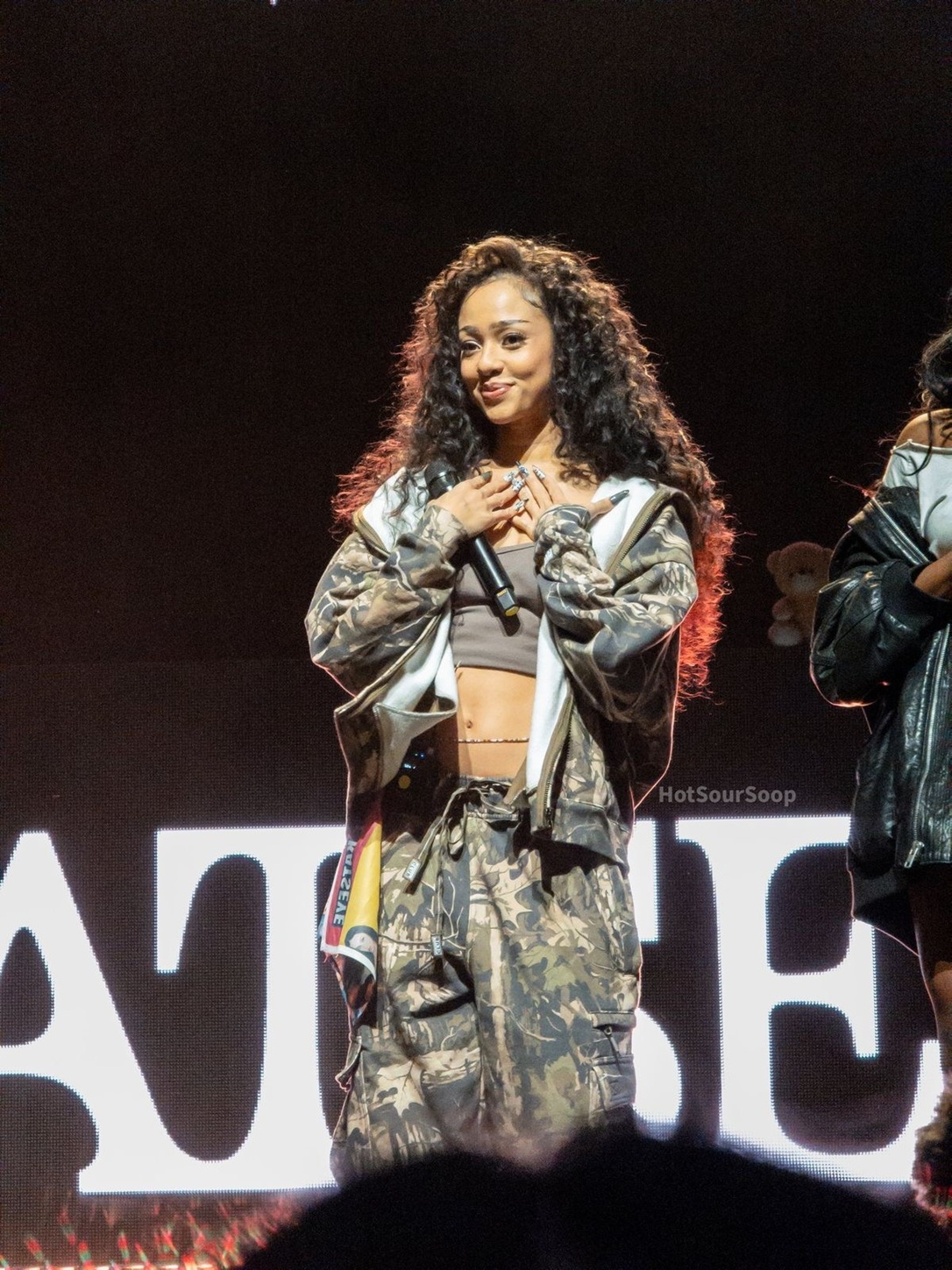
Then came February 20, 2026.
HYBE and Geffen announced that Manon Bannerman would take a “temporary hiatus” from Katseye to focus on her “health and wellbeing.” The language was careful and corporate. The timing—just as the group was ramping up for Grammy season and Coachella—was not.
Variety reported the news first. Deadline followed. E! Online noted that Manon would not be present at the group’s Coachella debut, which she ultimately was not. The announcement was framed as temporary, but the subsequent weeks complicated that framing considerably.
Manon spoke to fans on Weverse shortly after, writing: “I’m healthy, I’m okay, and I’m taking care of myself.” But she added something the official statement had not: the situation, she said, was “out of her control.”
The phrase traveled fast. SheKnows published a detailed timeline of her hiatus, noting that fans had observed she removed “Katseye” from her Instagram bio shortly after the announcement. Distractify documented the mounting fan concern. A Foothill Dragon Press piece captured the anxiety inside the fandom: her hiatus was not behaving like a health hiatus.
Then came the L’Officiel report on a new single called “Pinky Up”—promoted as a five-member project—and the Yahoo Entertainment timeline that assembled what many fans had already concluded: Manon was likely not coming back. According to Philstar, she would not appear at Coachella. By April, that had proven true. The group’s upcoming EP, WILD, scheduled for August 14, 2026, does not appear to include her.
The racial dimension of her departure was never far from the surface. During Pop Star Academy: KATSEYE, Manon had been singled out for missing practices. She addressed it plainly: “Being called lazy, especially as a Black girl, is not fair.” As the only Black member of Katseye, her treatment during the show generated discussion that lingered well past the debut. SheKnows and other outlets noted that some fans believed her exit carried a weight no official statement had acknowledged. Whether her departure was primarily about health, creative friction, or something else entirely, the symbolism of losing the group’s sole Black member—under circumstances framed as being “out of her control”—was not lost on the audience that had watched her fight for her place in the group from the beginning.
The Artistic Question
Success metrics are one thing. What the music actually does is another.
Critical reception of Beautiful Chaos was more mixed than the charts suggested. Album of the Year aggregated a range of responses. In his review, Pitchfork’s Joshua Minsoo Kim gave the EP a 5.5 out of ten and called it “awfully ordinary,” “disappointing,” and “inoffensive music for the incurious listener.” AllMusic awarded two out of five stars, identifying “Gnarly” and “M.I.A.” as the only tracks that distinguished themselves. Other reviewers were warmer: Rolling Stone Philippines praised the EP’s versatility, Tastemakers Magazine noted the group leaning into a bold new sound, the Daily Californian called it “boisterous and scintillating, brilliantly bright,” and The Dartmouth landed on “unapologetically bold, dynamic and creative.”
The split says something true. Katseye makes music that lands for its audience—the chart numbers are proof—but it does not yet make music that consistently lands for critics invested in pop as an art form.
That tension is not unique to them: plenty of commercially successful groups navigate it without crisis. But for a project framed as the next evolution of global pop, the critical ceiling matters more than it might for a group with different ambitions.
There is also the question of identity. CNN noted in May 2026 that K-pop was “becoming more popular than ever—and less Korean.” Katseye sits precisely at that fault line. NPR placed them alongside Tiffany Day and Slayyyter in a piece about “pop burnout,” suggesting that even sympathetic observers were beginning to ask what, exactly, Katseye was for. The Korea Herald covered the group’s arrival with industry interest: Katseye is a proof of concept for what HYBE can do outside Korea, not just for the group itself. That framing is clarifying but also limiting. A proof of concept can be declared successful and retired. A group with its own irreplaceable identity cannot.
The Second Group Question
In August 2025, before Beautiful Chaos had even finished its chart run, Music Business Worldwide reported that HYBE and Geffen were already developing a second global girl group. Three former Pop Star Academy: KATSEYE contestants—people who did not make the final cut for Katseye—were confirmed for the new project. NME covered the announcement. KED Global reported that auditions had opened in Japan for a fourth member.
The timeline is striking. Katseye had not yet released Beautiful Chaos when their creators were already engineering a successor. This does not necessarily mean Katseye is being abandoned—HYBE manages multiple active groups simultaneously, and the K-pop model is built on portfolio thinking. But it does suggest that Katseye may have been conceived as the opening move in a larger strategy rather than as an end in itself.
That framing changes how the current turbulence reads. A group mid-crisis is a liability. A group mid-expansion—one iteration in a planned sequence—is something different. The question of whether Katseye is “in crisis” may depend entirely on whose perspective you apply: the fans invested in these six specific people as an irreplaceable unit, or the labels that built the group as a scalable model.
The Landing

In their Billboard Coachella interview, the five members who performed—Daniela, Lara, Megan, Sophia, Yoonchae—spoke warmly about the show and each other, and said nothing about Manon. A Medium essay published earlier in the year had noted that the group had a long road ahead of it if it wanted to become, in any durable sense, Katseye rather than a HYBE product with Katseye’s name on it. The Dragon Chronicle had praised Beautiful Chaos for its “ambition and range.” On Netflix Tudum, the original promotional materials still feature Manon among the founding trainees. The image of six, preserved in documentation, set against the image of five, performing live.
Is Katseye facing a crisis? The answer depends on what you think a crisis looks like.
By commercial metrics, 2025 was their best year. By cultural visibility, 2026 has brought Grammy nominations, a Coachella debut, and three simultaneous Billboard Hot 100 entries. But the departure—ongoing or permanent—of their sole Black member under circumstances that feel unresolved, the mixed critical reception of their music, and the imminent arrival of a successor group all press against the celebratory narrative.
A crisis is not always a collapse. Sometimes it is a moment when the questions a project was always carrying become impossible to defer. Katseye arrived with enormous ambitions and genuine talent. What it has not yet settled is whether it can become its own thing—not a proof of concept, not a portfolio asset, not a category between K-pop and Western pop—but a group with a sound and a story that holds.
That answer is still being written. The stage, for now, has five members on it. Backstage, a stylist lays out the costumes for five. In the dressing room mirror, a group marks through its formations and counts the beats, and the geometry of what was six and is now five hangs in the room the way unspoken things always do—present, unnamed, waiting. The next move belongs to the group, the labels, and whoever decides what the sixth chair means.







Leave a Reply