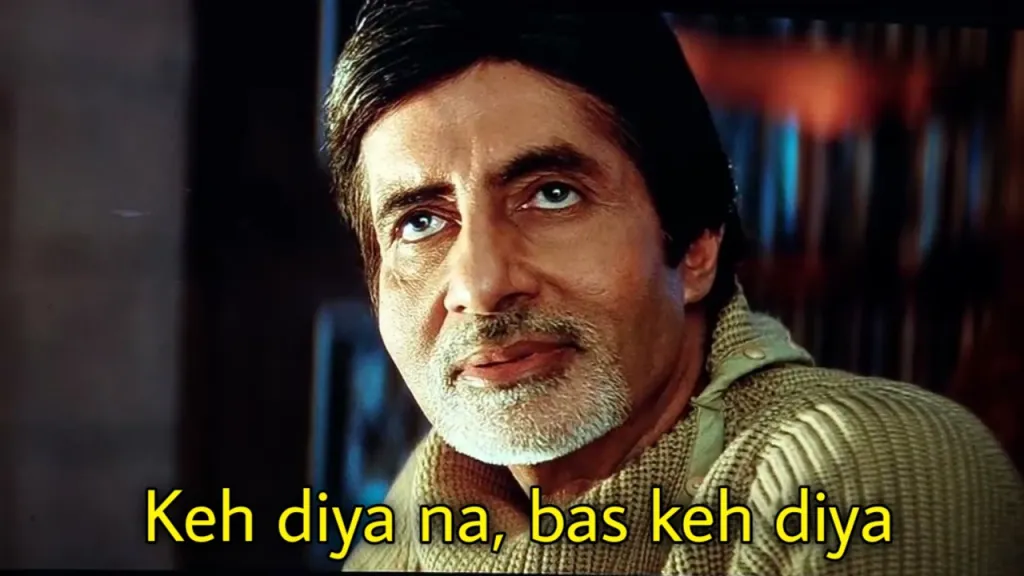

If you’ve watched Kabhi Khushi Kabhie Gham (2001) closely, you’ll realise it’s not just a film about love, family, chiffon sharees or aggressively well-moisturised people crying in mansions, it’s actually about what happens when a South Asian family collectively decides that open communication is simply not part of the syllabus. Yes, I did bawl my eyes out several times (no shame, please), but have we ever actually paid attention to what the film is really showing beyond the dramatic hugs and background music? Beneath all the grandeur, the entire plot quietly runs on what happens when no one says what needs to be said.
Okay so let’s talk about it a bit. Yash Raichand, of course, is the unquestioned authority, firm, proud, and always right (or at least, no one dares to suggest otherwise). But what’s more interesting is how comfortably that authority exists. No one really challenges it. Not even Nandini- the wife, who clearly sees everything, understands everything, and yet chooses silence almost like it’s part of the role. Her quietness doesn’t just sit beside his control… it supports it, smooths it over, keeps it functioning. And slowly, almost politely, that silence does what loud conflict couldn’t: it breaks the family apart.
Rahul, by default, does what any emotionally well-trained South Asian eldest son would do, he simply doesn’t question anything in his house. He falls in love with someone who clearly doesn’t fit the family’s expectations, and instead of convincing his father (well, he did try once though- bold move, honestly), he chooses to give up after the first try. Because, let’s be real, when has “I’m in love with someone you won’t approve of” ever been received with calm discussion and emotional maturity? We don’t talk about these things in front of our parents, right (!)?
Rahul, by default, does what any emotionally well-trained South Asian eldest son would do, he simply doesn’t question anything in his house.
There is no safe space for that kind of honesty actually in South Asian families. Love, especially the inconvenient, socially misaligned kind quietly becomes taboo. So instead of taking the time to “convince”, Rahul in the film, acts. He marries her without warning, without preparation, without the dramatic family meeting that would’ve ended in either emotional breakdown or polite denial. And, unsurprisingly, that silence doesn’t protect anyone either way– it detonates everything. He gets disowned. Just like that. A relationship collapses, not only because of difference, but because there was never a system where that difference could even be spoken about.

It plays out like high drama on screen, the music, the tears, the slow-motion heartbreak. But take all that away, and what’s left is… uncomfortably familiar. Because if you grew up in a South Asian household, you probably have faced this already: there are things you just don’t talk about. Not because they don’t exist (oh, they absolutely do) but because no one really knows how to hold those conversations without everything else starting to crack.
So while we’re on this topic, let’s take gender roles for instance, which are rarely explained, yet deeply practiced. You see it in everything. Sons are given a longer leash, more freedom to explore, or the unquestioned decision maker of the house. Daughters, on the other hand, are taught to be careful, to be aware and silent, to represent the family in how they speak, dress, and behave. Even in Bollywood films like Dangal (2016), where daughters are pushed to break barriers, their strength still exists within a framework shaped by a father’s vision. It’s empowering, but it also reminds you, even empowerment is often guided, not freely formed. Another unspoken thing in Asian households.
And then, of course, there’s the issue of periods:, one of the most normal biological functions on earth, yet somehow still treated in many South Asian households as something to be whispered about. An entire generation of girls has perfected the art of being non-chatty about carrying pads hidden inside sleeves, pockets, books or anything except openly in their hands. The vocabulary around it is equally fascinating. Nobody says “period.” It becomes “that time of the month,” “problem,” “issue,” or a vague facial expression from across the room that everyone somehow understands instantly. What’s even more impressive is how society expects women to quietly manage cramps, exhaustion, hormonal changes, pregnancy, childbirth, and motherhood. But discussing the actual body responsible for all of this still makes people deeply uncomfortable.
An entire generation of girls has perfected the art of being non-chatty about carrying pads hidden inside sleeves, pockets, books or anything except openly in their hands.
Then come the toxic relatives, arguably the longest-running side characters in the South Asian family cinematic universe. Every family has at least one. The aunt who treats personal boundaries like a fun little suggestion. The uncle who asks deeply invasive questions at weddings as if he’s conducting a government census. The relative who casually body-shames children, compares siblings, creates drama in every gathering, and somehow still gets invited to every single event because “they’re family.” That phrase alone has probably protected more emotionally exhausting people than any legal system ever could. What’s interesting is that everyone usually knows who the problematic relative is. Entire car rides home are spent discussing what they said. Parents warn children beforehand. Cousins exchange knowing looks across dinner tables. And yet, nobody directly addresses the behavior itself. Instead, the family collectively develops coping mechanisms-polite laughter, forced tolerance, strategic avoidance-all while pretending this is perfectly normal social interaction.
Because we don’t talk about toxic relatives in this house.

Remember Kabir’s crashout in Dil Dhadakne Do (2015), where he had a breakdown in front of his family because nobody in his family ever had a real conversation? In many South Asian families, parents carry entire biographies that are never fully narrated. You don’t hear the stories in clear, complete form. Because many of our parents were never taught how to have these conversations either. Emotional expression was not a priority in their upbringing. Survival was. Did they ever care about your mental health? Or their own?
In brown households, mental health exists only theoretically, that too if one is lucky. In reality, it has been subsumed under broader terms such as stress, “overthinking,” and the perennial catch-all phrase: “be tough.” Mentioning anxiety or feeling overwhelmed? You can expect a smirk at best and a condescending “everyone is stressed, don’t make a fuss” at worst. Counseling, too, enters the dialogue with the dramatic flair of an unforeseen plot twist. In my own family, for example, when my cousin expressed her intention to seek therapy due to her excessive stress in medical studies, she received an instant response of “why don’t you sleep more” from my aunt; case closed. Talking and seeking help from a professional for emotional issues is still considered as a taboo. So we resort to our tried-and-tested method: normalization, avoidance of labelling, and hope that somehow the problem will work itself out amid duty and resilience.
But perhaps the change cannot be loud or forceful, even. Perhaps, it starts in small gestures. In posing a question instead of making assumptions. In describing a feeling instead of repressing it. For the reality was that these conversations had never been impossible. They had merely never been practised. In South Asian households, there are some topics that are never discussed, not because they are insignificant, but simply because no room has ever been made for discussion.
Silence is not forever. It’s just where the conversation paused.