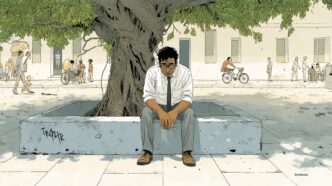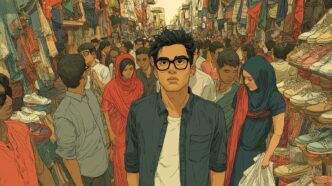

The building leaned into the alley, a failed origami pressed between exhaust clouds and cigarette smoke. The Corolla shuddered to a stop. Police whistle. Rashed cursing in low Bengali, wrestling the trunk latch. Ahsan swung his legs out and the air grabbed him—tighter now, as if the city had been waiting.
He braced himself. The sidewalk: sleeping dogs, SIM card wrappers, men with nowhere else to be. Above, every balcony extruded a different life. Bedsheets strung for privacy. Half-dead banana plants. Fairy lights blinking in code. Between him and the foyer, an old man in a lungi washed the curb with a plastic bucket. The water traveled a foot before surrendering to muck.
Nusrat was already out, phone tucked between cheek and shoulder, barking at an invisible operator. She regarded Ahsan and Sadia with a tight, evaluative stare. He could almost hear her tallying: bags, wife, sweat stains, the ratio of American affect to native obedience.
He hauled the suitcases up the first step. Ancient spit stained the concrete, fossilized into warning. The entrance was a squeezed rectangle, half-blocked by a potato sack full of mangoes and a sleeping delivery boy. Ahsan inhaled—no, recoiled. Sweet. Ripe. Decisive rot.
Their building had always been grimy, but he’d forgotten the density of things. On the ground floor, a tailor’s shop had annexed half the stairwell with a rack of stitched kurtas and a sewing machine chained to the railing. The tailor himself: just a pair of legs visible beneath layered fabric. A fan oscillated next to a shrine of plastic flowers and a calendar from 2017.
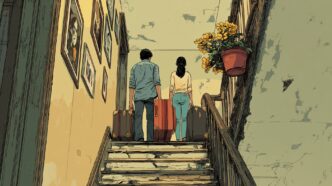
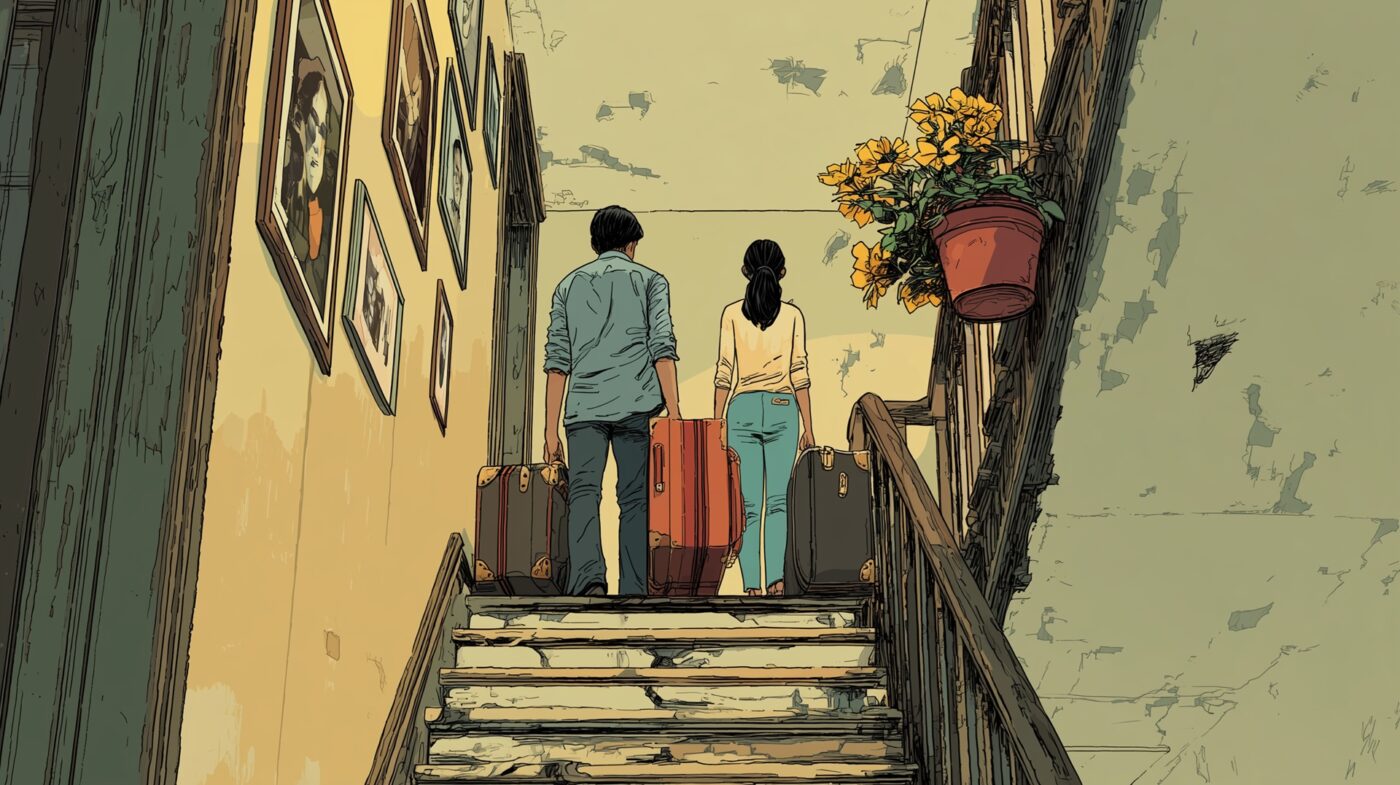
The climb began. Ahsan’s hands burned with bag handles. The stairs were steep, the risers slick with whatever lives had passed through earlier. On the second landing, family photos lined the wall, every frame layered in dust. His own face at age twelve—grinning, unknowing, fossil of optimism. Next to it: Nusrat at her college graduation, jaw set like a challenge.
He was sweating rivers before the third floor. Sadia, unburdened but for her green knapsack, floated ahead, the hem of her leggings bright against the gloom. She paused at every landing, taking in the graffiti, the ornamental mold, the way light fractured through cobwebbed glass blocks. At the fourth floor, she stopped to admire a hanging basket of marigolds, their yellow furious against the city’s gray. “They’re beautiful.”
Honest awe in her voice.
He saw only the rusted nail that held them. The plastic twine cutting into half-dead stem. Had his mother done this, or had a neighbor decided the building needed brightening? He wanted to say something bitter, but Sadia was already pointing her phone, lowering her voice to a whisper of reverence.
Nusrat waited at their door. She punched in the code—2, 4, 7, 9, soft beep—and swung the gate open. Practiced violence. The hallway beyond was exactly as Ahsan remembered: patterned tile, a faded painting of the Sundarbans, and the unmistakable base note of old ghee and incense.
He waited a second, letting Sadia step inside first. The suitcases thunked against the tile. He braced for the first words, his mother’s voice—half accusation, half welcome—but the flat was silent. No clatter of pots. No TV cricket commentary. Just the tick of the ancient wall clock and the psychic pressure of a thousand memories compressing at the threshold.
He set his bag down. The weight of the last six years, the flight, the job, marriage, America—it pooled in his shoulders, the small of his back. He’d always hated this hallway, this forced pause before the greeting. Stage cue before the curtain.
“Here, here,” Nusrat said, shepherding them through the narrow living room, past the crocheted antimacassars and the drooping spider plant. She paused at a door Ahsan recognized, but the nameplate was new: “Guest Suite” in English, gold decal peeling at the corners. Nusrat opened it with a flourish, revealing what used to be his childhood bedroom.
It had been sterilized in anticipation. The air was thick with lemon-scented polish and the powdery plume of Raid. The twin beds—he and Nusrat’s, never upgraded—were now pushed together beneath a canopy of ancient mosquito net, edges tucked military-tight. A ceiling fan whirred in lazy, uneven circles. Someone had lined the dresser with a paper doily, and on top: a pyramid of bottled water, a plastic tray of imported Ferrero Rocher, and a handwritten Welcome Card in cursive that was unmistakably his mother’s.
Ahsan blinked. Same bookshelf, but his collection of Star Wars figurines—once arranged in battle on the top shelf—had been replaced with Sadia’s wedding portrait, blown up and framed. His diploma, once proudly tacked above the desk: gone. The walls themselves looked newly scrubbed, the posters of cricket heroes replaced with a garish print of the New York skyline.
He stood in the entryway, suitcase still in hand. Sadia whirled in a slow circle, face lit with delight. “It’s like a movie set. I feel like a princess.” She ran her finger along the edge of the net. “Oh my god, is this for us?”
Nusrat beamed, satisfied. “Special arrangements for the guests. Abbu wanted everything perfect.” She reached for the air conditioner remote, then paused. Theater. “We have AC now. ‘Split unit,’ high efficiency. But it’s not necessary in this weather. The fan is more than enough.”
Ahsan’s mother appeared behind him, sari rustling. She was smaller than he remembered. Or compressed. Her eyes stung with pride and accusation. “You are sweating already?” Clucking tongue, but she gripped his elbow for a heartbeat, thumb bruising his skin, before letting go. “We cleaned everything. Sadia, you must be thirsty. You like Rooh Afza? Or Fanta? We have both.”
Sadia smiled, undaunted. “Rooh Afza please, Ammoo.” She dropped the “aunty” with fluidity that made his mother melt. They disappeared down the hallway together, giggling over the right ratio of syrup to water. Nusrat lingered in the doorway, arms crossed, gaze fixed on Ahsan.
“Your wife is modern. But polite.” She almost smiled. “I like her.” Then, softer: “You’ll get used to the heat. Just pretend you’re at the gym.” She closed the door with an exaggerated sigh.
He sat on the quilted bed. The mattress was hard as concrete, but it yielded in the right places. Old memory. He leaned back, stared at the ceiling. The whir of the fan. The floral netting above. The smell of Mortein and lemon Pledge—all exactly as it had always been, except the edges had been sanded down, made safe for inspection.
A knock. Sadia entered, balancing two tall glasses, condensation streaking the sides. She handed him one. “Your mom says you used to drink this by the bucket.”
He took a sip. The sugar syrup clamped onto his teeth, familiar and almost revolting. “I did. Until Abbu switched us to Tang because it was ‘more scientific.'”
Sadia perched beside him, knees up, toes flexed as if testing the room for booby traps. “It’s sweet, but not as sweet as she wanted me to say.” She leaned her head against his shoulder. “It’s good, though.”
He couldn’t remember the last time he’d felt this tired. The kind that made every surface a potential bed. He tilted his head, listening to the sounds of the flat: his mother’s laugh, the tinkle of glass, the jostle of slippers on tile. Out in the living room, someone was adjusting the TV volume, a news anchor barking rapid Bengali. He looked at Sadia, at the way she had already claimed a corner of the bed with her phone and notebook, her shoes neatly paired at the edge of the rug.
“I thought it would be worse,” she said. “Your mom’s a softie.”
He barked a laugh, short and sharp. “She’s a python. You just haven’t seen her squeeze yet.”
The sun dipped behind the smog, the room goldening then graying. Sadia stretched out, feet dangling off the bed, and scrolled through their arrival photos.
He watched her—foreign, at ease, already sifting the place for details worth remembering. The netting as a romantic relic, maybe. The fan a quaint testament to thrift. The imported chocolates a gesture of trembling hospitality. Did she see the ghosts? The old fights? The years of wanting out?
Ahsan stretched, careful not to jostle her. The quilted coverlet was scratchy on his bare arms. The lemon polish masked everything under bright, clean citrus. He closed his eyes, let his body sink into the bunker of his youth.
Out in the hall, his mother called his name. Voice thinner now but still sharp as glass. Dinner in ten minutes.
He exhaled. Two weeks, maybe less, of this. He could do it.
Sadia’s fingers on his wrist. Gentle squeeze, anchoring him.
“You good?”
He nodded, eyes still closed. “Just dehydrated.”
She laughed. “Drink your Rooh Afza, American boy.”
He did. It tasted like history. Like home. Like surrender.
***
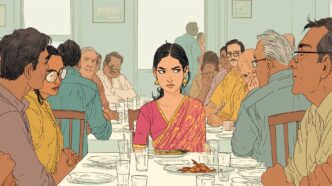
Dinner was a battalion of familiar guilt: rice mounded on chipped porcelain, lentils glistening with ghee, a parade of pickled things and fried treats arranged with the precision of a military salute. The family sat at the dining table—his mother at the head, back ramrod straight despite the give of her spine; Abbu to her right, hands folded, head bowed not in prayer but in the small defeat of exhaustion. The fluorescent tube above buzzed with a migraine-inducing whine, flickering every few seconds as if reluctant to illuminate the proceedings.
Sadia perched to Ahsan’s left, plate untouched, eyes wide as she took in the choreography: his mother dispensing ladlefuls of dal, Abbu’s hand trembling as he reached for the stack of lukewarm rotis, Nusrat cutting a fried eggplant into mathematically perfect squares before passing it down. The only thing louder than the electrical hum: the silence.
He watched his father’s hands. They shook with a Morse code of fatigue, a visible tremor that made small tasks a hazard. Every time a spoonful neared his mouth, a few grains of rice would tumble back to the plate. White against brown sauce. Abbu didn’t acknowledge the spills, only redoubled focus, jaw flexed. Nusrat rolled a piece of roti and set it in front of him, her movements brisk and practiced. He wondered how many times she had done this while he’d been gone.
Memory: Abbu was a monolith. The man who hoisted him onto his shoulders at Eid, who terrified rickshaw drivers with a single glare, who once bent rebar bare-handed to patch the broken gate. This man was no less himself, but diminished. A statue turned soft at the edges by too many rainy seasons. Punchy regret for every call he’d dodged, every time he’d ended a chat with “work meeting, sorry, gotta run.”
His mother’s sari was stiff with newness, but her face was looser, creased, as if the skin had finally given up resisting the pull of time. She smiled at Sadia—showy welcome—but her cheeks sagged when she forgot to hold the pose. She sprinkled black salt over Ahsan’s salad, the way she had when he was a child, and for a second her hands hovered in midair, unsure of why they were there. She coughed, a thin, papery sound, and set the salt down with a clatter.
“You like the food?” Her accent suddenly more pronounced. “Sadia, it’s nothing compared to your mother’s cooking, of course.”
Sadia grinned. “This is the best eggplant I’ve ever had. And I don’t usually like eggplant.” She made a show of scooping up a piece, chewing thoughtfully, nodding in approval. “So good.”
A smile cracked his mother’s face. “You are so polite. Not like him.” She gestured to Ahsan, who was eating mechanically, the flavors loud but indistinct. “Always complaining in America—calls it ‘oily’ and ‘too spicy.’ Now look how thin he is.”
His father grunted. A noise that might have been agreement or just the effort of swallowing. “How is your work?” Abbu asked, turning to Ahsan. The question came out slow, deliberate, as if he was uncertain of the English words.
Ahsan set his fork down, wiped his hands. “It’s good, Abbu. Busy. They just promoted me to lead engineer. I’m running a team now.”
Abbu nodded, lips pressed tight. Approval, but rationed. “In my day, supervisor means responsibility. You must watch all the people, not just your work.”
Nusrat snorted lightly. “He supervises from a computer. Says he never leaves his house.”
“Remote work,” Ahsan corrected. Old urge to defend, to clarify. “It’s normal now. All the offices are closed anyway.”
His mother leaned in, eyes sharp again. “But you will go back to office? Or you want to stay home forever?” She glanced at Sadia, looking for alliance. “Men should not be lazy.”
Sadia shrugged, a tiny tilt of her head. “He’s always working. Even on the plane he was answering emails.”
“Ayyo, baba, you should rest when you can,” his mother said, squeezing Sadia’s hand with sudden tenderness. “Don’t let them make you a machine.”
The conversation drifted, awkwardness cresting. He inserted something lighter. “How is your health, Ammoo? You look… healthy.”
She shook her head. Subtle, practiced motion. “We are old, my son. Old people have small problems. Blood pressure, sugar, all the usual. Nothing serious.” Her eyes darted to Nusrat.
Nusrat put down her fork, leaned back in her chair. “Abbu can’t walk more than three flights now. His knees are finished. Doctor says he needs surgery but he won’t listen. Amma keeps forgetting her medicine, so I have to set alarms for her like a schoolchild.” Her tone was flat, the words tossed out like soiled laundry.
His mother made a clicking sound. “Drama queen. We are fine, Alhamdulillah.”
Ahsan looked at his sister. Tightness in her jaw. A line between her eyebrows that deepened every year. She caught him looking, shrugged as if to say: she never tells the truth, not unless you make her.
Heat rose under his collar. Shame that made him want to apologize without knowing for what. He reached for the water jug, poured himself a glass. Hand unsteady.
“So,” his mother said, voice bright again, “tomorrow we go shopping for your cousin’s wedding. You must buy new kurta, handsome. Sadia, we have to get you proper sari. American jeans not allowed in the wedding hall.” She chuckled, pleased with herself.
Sadia beamed. “I’ve always wanted to try one. Maybe yellow? Or something loud?”
“We’ll get the brightest one,” his mother promised. They shared a look—brief, conspiratorial warmth.
It stung, how easy it was for Sadia to fit in, to draw out the sweetness his mother had never shown him without a fight. He stabbed at the last piece of eggplant, chewed it to mulch.
His father caught his eye, and for a second Ahsan thought he might say something—anything—about the last six years. The words didn’t come. Instead, Abbu’s hand trembled again, rice scattering on the tabletop, and he looked away. Ahsan swallowed hard, the food turning to paste in his mouth.
***
Ahsan excused himself before dessert, his tongue still grainy from the eggplant, the conversations clotted in his head. He told Sadia he needed to shower, but really he just wanted to be alone, even if only for the length of a cold rinse and a few minutes with the bathroom door locked from the inside.
The guest bathroom was exactly where he remembered. A tiled crypt wedged between the service balcony and the box room where they kept broken appliances and old suitcases. He flipped the switch—one bare LED, flickering like a dying satellite—and peeled off his shirt, which stuck to his back with the tenacity of a spent cigarette filter.
The showerhead was a relic. The knob for “Hot” had always been decorative, and the “Cold” was barely more than a suggestion. He twisted both out of habit, but the water was a mean, treacly trickle, barely enough to rinse the sweat from his chest let alone the city’s whole day from his skin.
He stood under the drip, counting the seconds between each lukewarm droplet. Memory: loitering in this same space as a teenager, using the silence to script imaginary arguments with his parents, or to practice the American accent he’d imported from television. The year he’d spent secretly growing out his hair, hoping to pass as some generic brown version of Kurt Cobain, only to have his mother shear it off in a fit of pre-exam anxiety. The first time he’d smoked a cigarette here, the window wide and the fan on full blast, the guilt sticking to him for days after.
He lathered up with an off-brand soap, the shape already warped from communal use, and rinsed as best he could. The water pressure was a joke. He could almost hear Nusrat in the next room, peeling onions and muttering about the “fancy Americans and their fancy plumbing.”
He toweled off with the only clean towel—a faded souvenir from a Malaysian airline—and rummaged in his bag for deodorant. His phone buzzed. American number blinking on the screen. He ignored it.
He opened the door a crack, listening. Sadia’s voice carried from the kitchen, warm and bright, as if she’d always belonged here. His mother’s laughter rose in response, trailed by the clatter of dishes. He could picture them: Sadia perched on a stool, elbows on the counter, watching his mother dice okra with surgical precision. His father’s news channel a dull roar from the living room. Nusrat somewhere in the background, detached but never not listening.
He retreated to the bedroom, spread out on the brittle mattress, and dialed his sister. She picked up immediately, voice half-submerged in wind and static.
“You survived dinner.”
“Barely,” he said, curling his toes under the edge of the bedspread. “You know the shower doesn’t work, right? I had to use, like, two liters of water to even get the sweat off.”
“Welcome home. We’re on a water ration.” She didn’t sound sorry. “Try not to use more than you need.”
He looked at the ceiling fan, spinning in slow, arthritic arcs. “Also, the fan’s useless. I think it’s actually making the room hotter. Is this a prank?”
Rashed’s voice, faint and amused, broke in behind her. “You want five-star, go to Westin.”
Ahsan rolled his eyes. “I just want not to die of heatstroke. Or fungus.”
“Your wife seems fine,” Nusrat said, the smile audible in her voice. “She’s in the kitchen teaching Ammoo to make avocado toast.”
He winced. “God.”
“You’ll live. You’re soft. You got soft.”
He pressed his hand to his chest. Afterburn of the shower. Pulse in his temples. “I’m not soft. I just have standards.”
“You’ll adjust. Wait till the first night of load-shedding. Then you’ll see.”
He heard the echo in her voice. Hint of the old dare. He almost wanted to tell her how it actually felt, the way the walls pressed in, the way every muscle in his neck refused to unclench. How even the ceiling fan, with its lazy indifference, made him want to punch holes in things just to hear the sound.
Instead: “I’m going to take a nap. Wake me up if Ammoo starts grilling Sadia about her parents.”
“She already did. She approves. Your wife is a survivor.”
He hung up. The room felt smaller. He closed his eyes and let the mosquito net drape over his arm, the way he had as a child, making a tent out of the thin white mesh. He imagined the hum of the city outside. The motorcycles and rickshaws and the distant, unceasing complaints of old men in tea stalls. Living here again, day after day, year after year.
He must have drifted, because when he opened his eyes, the room was dusk-blue, and Sadia was nowhere in sight. The TV in the living room was going full volume—some game show punctuated with canned applause and belligerent laughter—and his mother’s voice, lighter now, a rising lilt, carried down the hallway like a thread. He rolled to the edge of the mattress and just listened: footsteps, laughter, the distinct snap of a lighter, and Sadia’s own voice climbing the scale, bright and uncertain.
He walked out, the tile sharp and cool under foot. At the living room’s edge, he caught a slow-motion tableau: Sadia, perched on a stool, wrapped in a cyclone of turquoise and magenta, her arms outstretched while his mother looped a border of sari fabric around her like a flag. The sight stopped him. He’d seen her in every Western permutation—jeans, business-casual, one-piece swimsuits in Cancun—but never like this. Never so visibly, so joyfully out of her element.
Nusrat lounged on the sofa, feet up, half-watching the TV and half-watching the scene in front of her, phone propped on her lap to record the moment for future blackmail. Sadia wobbled as his mother cinched the sari at her waist, laughing at her own reflection in the darkened window. “Wait, you have to teach me the step again.” Her words spliced with broken Bangla: “Ektu help korun, please, khub shundor hoye jay.” His mother beamed, eyes crinkling, hands moving with a muscle memory that made the whole thing look less like dressing and more like spell-casting.
He stood frozen. Something inside him wanted to interrupt, to claim Sadia back into his familiar territory, where she wouldn’t look so natural in borrowed silk, wouldn’t so easily fold herself into his mother’s delight. Instead, he leaned on the doorframe and watched as Sadia imitated his mother’s hip-sway, the two women orbiting the coffee table, twin satellites of awkward grace.
“You see?” his mother called out, not looking at him. “Not hard! Just needs practice. When you wear this, everyone will say you are real Bangali girl.” She adjusted a bindi on Sadia’s forehead, thumb rough but gentle. “Ahsan!” she snapped. “Why you standing like ghost? Come and see.”
He shuffled forward, one hand on the back of a chair. Sadia turned and did a little spin, the sari fanning out in a way that was both ridiculous and—he had to admit—beautiful. Her grin, wide and unguarded, made her look five years younger. “How do I look?”
“Like a Bollywood backup dancer,” he wanted to say, but her happiness hit him with a force he couldn’t name. “You look good. It suits you.”
Nusrat snorted, mouth full of potato chips. “She wears it better than you ever did on Pohela Boishakh.”
Sadia fingertipped the edge of the sari, holding it up with exaggerated elegance. “Will this survive the wedding buffet? I feel like a single jalebi could ruin this whole operation.”
His mother tsked, insulted on behalf of the garment. “Nothing can ruin this sari. I wore it for my own sister’s engagement, you know. Special. Not for eating buffet.”
Sadia wriggled out of the layers with his mother’s help, then folded the fabric with an earnestness that made him ache. She handled the sari like a sacred object, smoothing the creases, matching the edges, and when she handed it back to his mother, she did so with both hands and a tiny curtsy. For a moment, the room glowed.
Sadia’s phone pinged. She scooped it from the table, thumbed a reply, then looked up at Ahsan. “I took a picture. You want to see?”
He nodded, and she swiped open the screen, turning it toward him. There she was: lips parted in surprise, sari a whorl of blues and pinks, bindi slightly off-center. The background—his mother’s earthenware pots, the aging lace doilies, the fluorescent glow—looked so much like an old cousin’s wedding photo that he half expected to see his own twelve-year-old face grinning in the margin.
He wanted to laugh, to point out how Sadia’s hair was frizzing in the humidity, how the sari hung at an angle, how she’d already stained the edge with some errant chutney. But all he said was, “It’s good.”
She blinked, uncertain. “Just good?”
He shrugged. “You look happy.”
His mother snatched the phone from Sadia and studied the photo with a jeweler’s scrutiny. “Nice. I’m sending to all my sisters. They will be jealous.” She scrolled through, squinting, then handed the phone back. “Tomorrow, we will go to New Market. Buy matching bangles. You must wear everything proper. Whole family will see.”
Sadia nodded, solemn as a bride. She set the phone down and, after a moment, reached for his hand. Her fingers were cool and steady, and she squeezed once—a signal that, for now, she was on his side.
Nusrat muted the TV, uncoiled from the sofa, and padded into the kitchen. Click of lighter. Metallic rasp of the fridge door. Faint pop of a soda bottle opening. His mother, sari still slung over her shoulder, drifted behind her, narrating tomorrow’s shopping trip in a monologue of prices, traffic shortcuts, and the relative merits of cotton versus georgette. Sadia watched them go, her smile fading to something deeper—reverence, maybe, or simply relief.
Ahsan let himself flop onto the sofa, the old springs protesting under his weight. Sadia curled up next to him, her voice low and private. “Thank you for not making fun of me.”
He shook his head. “I was going to. But you looked… I don’t know. Like you belonged.”
She traced a circle on his knee, silent for a beat. “It’s weird, isn’t it? I always thought I’d be the one to mess up. But your family’s kind of amazing.”
He looked away, toward the window, where the night outside was thick and close, the lights of the city smeared like wet paint. “They’re good at pretending. So am I.”
Sadia leaned her head on his shoulder, her hair still scented with the lemon polish. “You don’t have to.”
He wanted to argue. Instead, he just closed his eyes, let the smells and sounds and heat soak through him. The din of the TV and the clatter in the kitchen. The faint pulse of the city outside. He’d been braced for impact since landing—waiting for the old shames and resentments to come crashing down—but here, now, there was only this: the weight of Sadia’s head, the memory of her spinning in borrowed silk, the promise of morning and bangles and whatever came after.
He let himself breathe. Just for now, he let himself be.