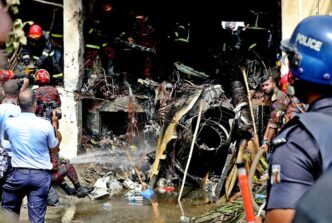
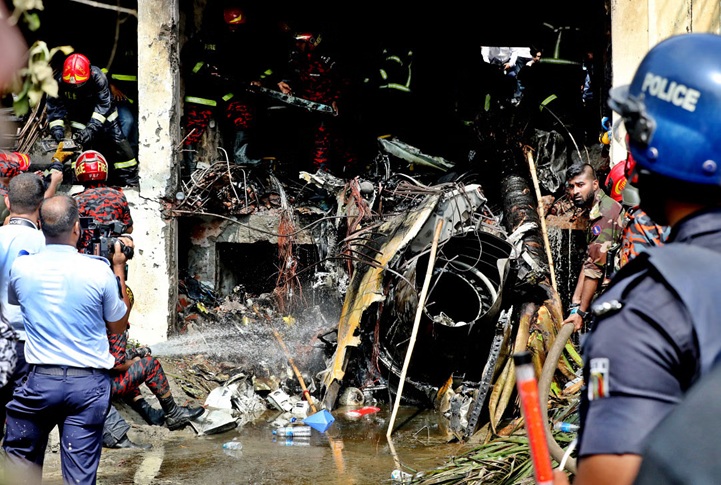

Disasters have a peculiar way of lingering in the collective memory. Reading about a tragedy in the news is one thing, but witnessing a jet fall from the sky above your own city is entirely different. The crash at Milestone College in Uttara, Dhaka, left Bangladesh reeling. A military jet lost control; the pilot managed to eject, but the plane crashed into a school. Images of burnt classrooms and mourning families quickly circulated everywhere. It felt as if something irreversible had happened. Yet, for many in Bangladesh, this was not just an isolated event. It served as another reminder of the risks woven into daily life, and of the institutions that continue to let those risks persist. The Milestone tragedy in Dhaka is a watershed moment for Bangladeshis, making us ask: do things ever change?
A fighter jet, older than most of the students in Milestone College, should never have been flying over a city, let alone a school. Nevertheless, that is exactly what occurred. The FT-7 BGI jet, based on a Soviet-era design, has been a familiar presence in the city’s skies for years. These planes are used to train pilots and frequently fly over densely packed neighborhoods, schools, and markets—areas teeming with life. This time, the ever-present risk became a devastating reality.
The government and the Bangladesh Air Force have yet to provide real answers to the basic questions raised by the crash. Why are these outdated jets still in service? Why do training flights continue above a crowded city? There has been no press conference taking responsibility, nor any clear promise of meaningful change. The official explanation cited “engine failure,” as if the crash were simply an unfortunate accident. But the underlying issue is much deeper. This disaster was not the result of chance; it was the outcome of years of decisions and inaction. Experts and city planners have warned about the dangers of such flights for years, but those warnings were consistently ignored.
Accountability remains rare. No one in a position of power has resigned or admitted failure. There is no public roadmap for making training flights safer or for modernizing the air fleet. Instead, what lingers is silence—a silence that feels deeply familiar. Time and again, Bangladesh has witnessed tragedy followed by explanations, but not by genuine reform. Each time, hopes for substantial change fade a little more.
This habit of inertia is pervasive. State agencies continue with business as usual, even when new risks emerge. The idea of moving training flights outside Dhaka has been discussed for years, yet nothing has changed. The FT-7 keeps flying, and the city keeps expanding around the air base. People have learned to live with the dangers looming overhead. Some accept it as the price of progress, while others recognize it as the price of neglect.
During the crisis, ordinary people stepped up. Medical staff worked long hours, and volunteers donated blood and aided the injured. But the country’s hospitals were never equipped for a disaster of this scale. Bangladesh, with nearly 170 million residents, has only a handful of burn centers and far too few specialized doctors. There were not enough beds, not enough nurses, and not enough supplies. These shortages are nothing new. Every major disaster—factory fires, ferry accidents, building collapses—reveals the same gaps in the health system. Each time, officials promise improvements, and each time, the system remains unchanged.
Some victims died instantly, but many passed away later. Their wounds could have been survivable with better resources. Instead, families waited and hoped while doctors did all they could in crowded, underfunded wards. In a robust health system, heroism would not be necessary for basic care. In Bangladesh, it often is.
The tragedy at Milestone College exposed the fragility of these systems. No amount of dedication can make up for a lack of resources. Doctors and nurses did their best, but they were working in a system stretched beyond its limits long before the crash.
As the nation mourned, another familiar pattern emerged. Public grief was mixed with self-promotion. Politicians arrived with cameras, eager to be seen, but contributed little to the response. Some activists and influencers used the tragedy as a backdrop for their own images and posts. For some, the disaster became an opportunity for attention rather than a call to action. Rumors spread quickly. Blame was cast, sometimes more loudly than efforts to help.
This kind of response is not unique to Bangladesh, but it seems increasingly common. In moments that should prompt unity and focus, the most visible voices are often the least helpful. Those with the power to create real change often remain silent or simply offer condolences, while others try to use the tragedy for personal gain.
Ordinary citizens, however, showed up where it mattered. They donated, helped, and comforted the grieving. Their actions made a tangible difference, even as officials seemed distant or distracted. It’s a reminder that, despite everything, the resilience of the community remains strong.
Still, the larger question lingers: will anything actually change? Some countries learn from disaster, making reforms—however slow or incomplete—that prevent future tragedies. Others mourn, debate, and then move on, waiting for the next crisis to restart the cycle.
In Bangladesh, cycles of outrage and forgetting are all too familiar. After a factory collapse or fire, promises are made and sometimes new laws are passed. But without effective follow-through, these reforms fade away. The Milestone tragedy risks being yet another example—a catastrophic event that changes nothing.
Institutional memory in Bangladesh often seems short. Every disaster is followed by an investigation, but these rarely go far enough. The most important questions are often left unasked. Why did anyone believe it was acceptable to fly training jets over a school? Who benefits from maintaining the status quo? Who would lose out if reforms were finally enacted?
The location of Kurmitola Air Base tells its own story. When it was built, Dhaka was a much smaller city. Now, the air base sits at the heart of a sprawling, crowded metropolis, right next to an international airport, surrounded by homes, shops, and schools. Every takeoff and every training maneuver puts thousands of people at risk. Urban planners and safety experts have argued for years that the air base should be relocated, but the planes still fly.
Why does nothing change? The answers are frustratingly clear. Moving a base is expensive and disruptive. There are always more urgent problems to address. Institutions develop habits, and change is slow—especially when it is not forced by outside pressure. The public sometimes accepts these risks as unavoidable, not questioning what could be different.
The military reputation creates another barrier. It is respected and, at times, shielded from criticism. Its internal decisions are rarely subject to public scrutiny. After the crash, official statements focused on technical details and tributes to the pilot’s skills, not on the underlying question of why these flights occur over the city in the first place.
This kind of risk is not inevitable. It is a choice, made repeatedly, to maintain the status quo. The same attitudes that allow outdated jets to remain in the air also explain why hospitals stay underfunded and why reforms are so slow to materialize. When it is easier to explain away a failure than to prevent one, the cycle is doomed to repeat itself.
Bangladesh has demonstrated its ability to change before. Sometimes, after a disaster, enough voices demand action and things shift. But this is the exception, not the norm. Most often, the routines of politics and government overshadow the need for reform.
If anything positive is to come from the Milestone tragedy, it must begin with uncomfortable questions. Why does a country with so much potential settle for so little from its leaders? What will it take to ensure that training flights never again endanger children? Why do the simplest reforms take years to implement, if they happen at all?
The answers are complex but not impossible to find. They require accepting that some institutions resist change because they are insulated from accountability. Leaders may prioritize good publicity over good policy. Public outrage fades as new problems arise and old tragedies become mere statistics.
Despite these challenges, there is still hope. In the days following the crash, ordinary people stepped up. They helped one another and demanded answers. This collective spirit, more than any speech or official promise, offers a way forward.
Building a safer future will take more than mourning or assigning blame. Statues and ceremonies will not protect classrooms or strengthen hospitals. True respect for the victims requires real change—stronger oversight, better equipment, improved medical facilities, and leaders willing to answer for their decisions.
The jet that crashed at Milestone stands for more than one accident. It represents the cost of delay and the consequences of failing to learn from the past. If memory lasts longer than public outrage—if leaders are moved by what happened, instead of hoping it will be forgotten—then perhaps this tragedy will finally mark a turning point.
A nation’s greatness is measured not only by how it celebrates its successes, but also by how it responds to its failures. Bangladesh now stands at a crossroads. The country must choose between accepting more of the same or demanding something better.
For those who lost loved ones, and for everyone who wants safer schools and stronger institutions, the hope is that this time, things will be different—not just in words, but in action.