

Summary
Silent Hill f marks a haunting rebirth for Konami’s legendary horror series, trading Western surrealism for a distinctly Japanese psychological landscape. Set in 1960s rural Japan, the game intertwines folklore, repression, and social decay into a slow, suffocating dread. Through Hinako Shimizu’s fragile yet defiant journey, it explores the horror of conformity and the quiet violence of control. With Akira Yamaoka’s melancholy score, precise art direction, and a focus on observation over action, Silent Hill f redefines fear as something intimate and cultural — a meditation on endurance, memory, and the unspoken darkness beneath everyday life.
Overall
-
Plot
-
Narrative
-
Replayability
-
Visuals
The return of the Silent Hill franchise marks a deliberate reconstruction of psychological horror. With Silent Hill f, developer Neobards Entertainment and publisher Konami expand the series into new cultural and emotional territory. The story relocates the familiar unease of Silent Hill to the transitional and restrained rural Japan of the 1960s. Horror emerges through atmosphere and implication, turning daily life into a slow unraveling. The opening captures this precisely: quiet rituals, domestic rhythms, and a tension that spreads across the village like fog.
Spring in Ebisugaoka unfolds as a study of ordinary beauty. Rice paddies reflect the sky, students linger by the road, and Shinto shrines stand still at the edge of town. This calm is the framework for fear. As the story deepens, each detail — cracked tiles, a drifting petal, a faint hum — acquires weight. Ebisugaoka operates as a living architecture of anxiety rather than mere scenery. Japanese folklore and postwar Japan social pressures thread through the supernatural, creating a precise, claustrophobic, and unforgettable world.

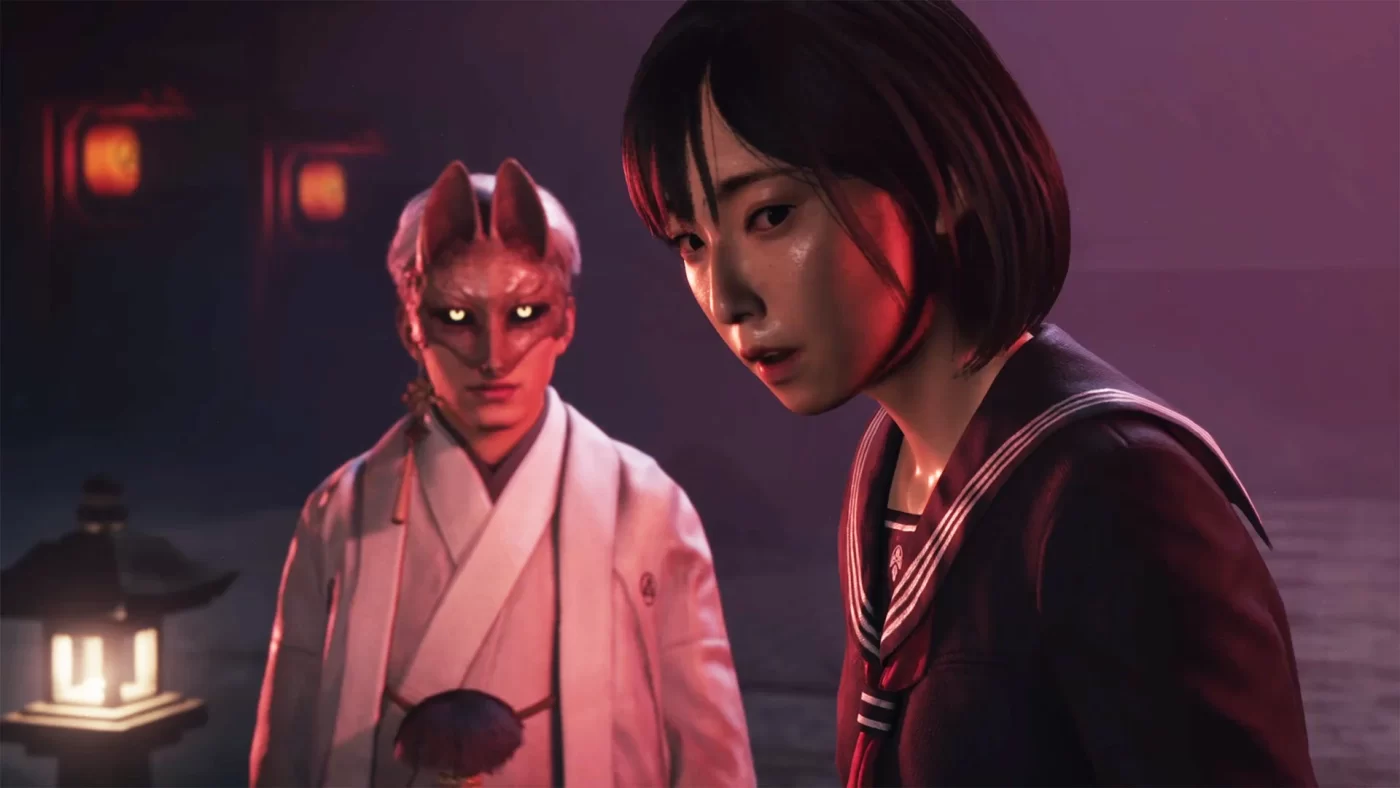
Every Silent Hill story centers on its protagonist, and here that role belongs to Hinako Shimizu. She is a young woman caught between adolescence and adulthood, surrounded by a household defined by silence and control. Her father is severe, her mother resigned, her older sister already gone. Hinako’s life unfolds in narrow routines that hide growing unrest. The story observes her not as a hero or victim, but as a person learning the limits of endurance.
Her small circle of friends — Shu, Rinko, and Sakuko — anchors her in the fragile comfort of youth. Their laughter, secrets, and shared frustrations build a portrait of connection under pressure. The fog’s arrival fractures that normalcy, replacing it with dread that seeps into every familiar space. Hinako’s struggles mirror the anxieties that surround her: expectations, family constraint, and the quiet cruelty of conformity. The horror gains power because it grows from what she already knows.
Horror in Silent Hill f unfolds through steady observation. The supernatural grows within the ordinary, transforming daily life into a space of distortion and fear. When fog descends on Ebisugaoka, the village becomes a mirror of memory and repression. Each change in its landscape reflects social tension: expectations placed on women, the weight of domestic violence, and the quiet despair of isolation. The story builds its unease from these structures, showing how fear thrives in control, silence, and ritual.
The supernatural grows within the ordinary, transforming daily life into a space of distortion and fear.
The environment evolves into a psychological map of belief and consequence. The more the village decays, the more clearly its social order is exposed. Monsters appear as expressions of its history, shaped by guilt, restraint, and superstition. Through this transformation, Silent Hill f defines its horror through systems that sustain suffering. The game studies endurance and conformity with precision, using atmosphere and detail to show how dread can grow from what a community chooses to preserve.
Puzzles and environmental design shape the rhythm of Silent Hill f. Each interaction is deliberate, reinforcing the connection between observation and consequence. Shrines, school corridors, and narrow village lanes form a network of spaces that demand close attention. Symbols drawn from Japanese mythology and local ritual guide the player through mechanisms that test patience and logic alike. Every object carries intention: a mask, a charm, a folded note. The world behaves like a riddle written in the language of superstition.
Gameplay reflects this restraint. Weapons are fragile, resources limited, and every decision has weight. Players learn to act with precision, avoiding confrontation, conserving strength, and moving through spaces that seem to breathe around them. The scarcity of tools and the unpredictability of enemies create constant unease. Progress depends on awareness rather than aggression. This design sustains tension without exaggeration, aligning the player’s vulnerability with the protagonist’s own uncertainty.
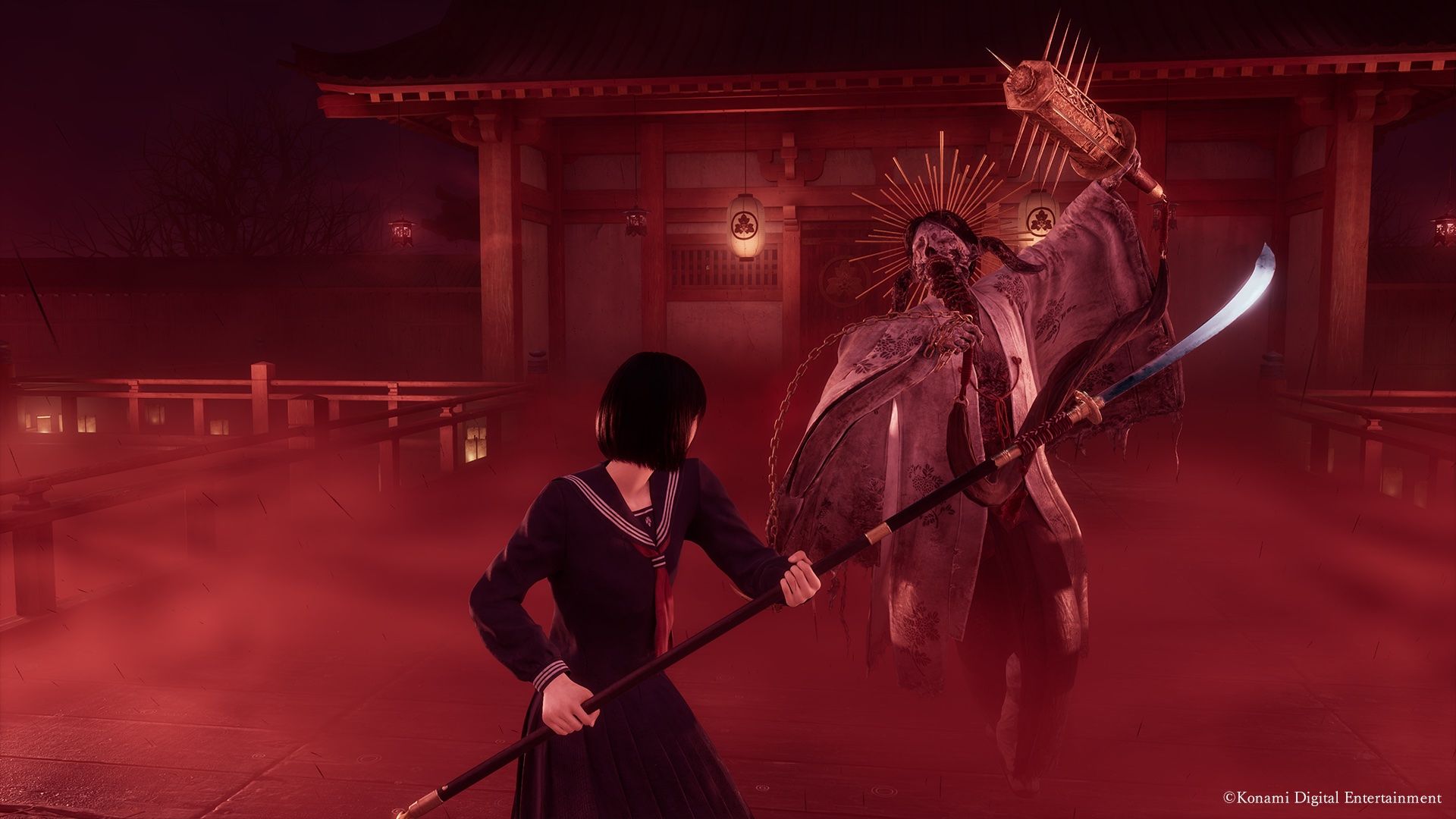
The shrine realm sequences mark a shift in tone and visual intensity. Within these spaces, the laws of the village dissolve and the supernatural takes full form. Red light saturates every surface, roots and flowers pulse through walls, and sacred motifs repeat in patterns that feel both ritualistic and invasive. The environments move with an organic rhythm, turning each corridor and courtyard into an extension of the protagonist’s mind.
Boss encounters emerge naturally from these settings. They are constructed as tests of timing, endurance, and spatial understanding. Each adversary represents a fragment of the story’s underlying tension — figures bound to guilt, secrecy, or punishment. Dodging, navigating, and managing limited resources become expressions of survival rather than mechanical challenges. The sense of control remains fragile, and the victories are quiet. These moments expand the scale of the experience without breaking its coherence, merging symbolism, gameplay, and emotion into a single progression.
Art and sound design define the atmosphere of Silent Hill f with precision. Every visual detail contributes to the slow corrosion of beauty. The village of Ebisugaoka appears luminous at first, filled with pale sunlight and color that feels almost fragile. As the story progresses, those same tones deepen into decay. Walls bloom with mold, petals stain the ground, and light turns metallic. The visual style conveys deterioration as a natural process rather than an intrusion, giving the horror a quiet inevitability. The score by Akira Yamaoka returns to the series’ tradition of melancholy minimalism, using sparse melodies and dissonant echoes to sustain tension. Music arrives in fragments, often vanishing before resolution.
The visual style conveys deterioration as a natural process rather than an intrusion, giving the horror a quiet inevitability.
However, story remains the defining element of Silent Hill f. The narrative examines control, trauma, and identity with precision. The events in Ebisugaoka reflect the weight of social structure and the quiet violence it sustains. Each revelation ties the supernatural to patterns of neglect and obedience. The game avoids excess explanation, letting memory, rumor, and environment speak for themselves. This approach builds a sense of intimacy between player and protagonist; every discovery feels personal, every piece of the past carries emotional residue.
Hinako’s journey follows the slow emergence of self-awareness. Her defiance begins in hesitation, growing through small acts of courage. She learns the cost of resistance in a community that demands silence. The fragments of her history form a portrait of endurance that remains unresolved. The story treats her vulnerability as a form of strength, presenting survival as persistence.

Mechanically, this focus on restraint defines the experience. Encounters favor avoidance, and resources demand careful management. Each choice reinforces a theme of limited agency. The player’s exhaustion mirrors Hinako’s. Fear arises from attrition, not surprise. Puzzles, exploration, and confrontation operate as variations of the same question: how much can one endure before breaking?
Art and performance sustain that question through the final act. The decaying village becomes a reflection of memory collapsing into dream. Sound continues to blur distance and proximity, creating the illusion that the player is never far from threat. The final sequence returns to stillness, closing the loop between life and legend without comfort or resolution.
Silent Hill f redefines what psychological horror can express. The game transforms setting, character, and design into a unified study of endurance. Its power lies in observation, in the slow recognition of what cannot be escaped. Every scene, every sound, every fragment of story adds to a portrait of fear that feels human and immediate. It is a strong continuation of the series’ most essential question: how much truth can a person bear before they disappear into it?