




Summary
Now You See Me: Now You Don’t delivers a breezy, high-energy heist, trading complex conspiracies for charming showmanship. Directed by Ruben Fleischer, this third chapter reunites the original cast with a standout Rosamund Pike. While leaning on digital effects, it’s a stylish, nostalgic caper that prioritizes pure, magical entertainment.
Overall
-
Plot
-
Cinematography
-
Acting
When a familiar franchise steps back into the spotlight, there’s always a question—will it chase its earlier mysteries, or carve out a new path? At this crossroads, Now You See Me: Now You Don’t begins with easy confidence. It knows what its audience wants, but also isn’t afraid to ask what comes next. Instead of overloading the screen with constant twists, this third chapter slows the pace, favoring clarity and energetic charm over puzzle-box storytelling. There’s a sense that showmanship and camaraderie are pulling the strings this time, not plot alone.
Ruben Fleischer’s direction is clear and brisk, picking up the baton with a buoyant energy. The camera is often in motion, swirling around lavish party sets and giving the cast room to fill scenes with sly humor. Gone are the layers of triple-crosses and shadowy conspiracies that defined the series’ beginnings in Now You See Me and Now You See Me 2. In their place is a more direct presentation that feels meant for sharing.


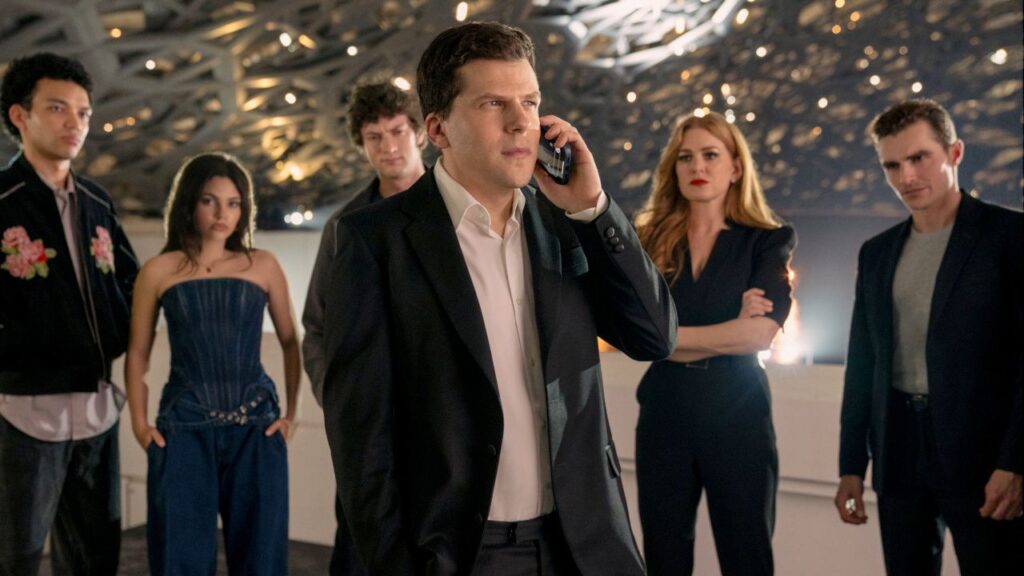
At heart, the film’s plot is simple: the original Horsemen find themselves scattered, their group broken by loss and circumstance. Isla Fisher’s Henley and Dave Franco’s Jack reunite with Jesse Eisenberg’s J. Daniel Atlas and Woody Harrelson’s Merritt, drawn back together by the imprisonment of one of their own in Russia and the lure of one last big score. Their target is the Heart Diamond, a legendary gem locked in the private troves of Veronika van der Berg. Rosamund Pike, in a flamboyant, chilling performance, owns the role with a mix of theatrical glee and icy control. She is less your typical villain than a welcome burst of over-the-top genre fun.
The underlying conflict is as old as the stage—good versus evil, showmen against the greedy. Yet the script, shaped by Michael Lesslie, Paul Wernick, Rhett Reese, and Seth Grahame-Smith, creates a premise bustling with effervescence. Dialogue shimmers with banter, and the ensemble cast is encouraged to trade quips and winks as if in a private joke. There are moments when plot takes a back seat to pure entertainment, and the effect is often like watching a magic act: we know it isn’t real, but delight in the attempt.
Dialogue shimmers with banter, and the ensemble cast is encouraged to trade quips and winks as if in a private joke.
Where the film finds new territory is in the introduction of a younger trio of illusionists—Bosco, June, and Charlie—played by Dominic Sessa, Ariana Greenblatt, and Justice Smith. These newcomers bring their own ideas, focused on exposing corruption and righting social wrongs. The generational conflict this creates is not window-dressing; it’s woven deeply into the story, creating at times a sense of rivalry and mentorship together. The film uses this tension to spark new energy.
One of the standout sequences unfolds at a real magic castle, evoking the legacy of the Magic Castle, where the cast gathers for a birthday party. Here, the stakes are low but the fun is high. Beneath it all there’s an easy warmth that speaks to the series’ enduring appeal. Fleischer’s camera leans into the spectacle, letting visual effects serve the story without overwhelming it. Real magic is married to digital finesse, offering a unique immersive experience. Not every illusion astounds, and sometimes the spectacle feels more digital than practical, but the commitment to showmanship is never in doubt.


Jesse Eisenberg’s performance is a clear evolution from earlier films. His portrayal of Atlas now carries less of the rapid-fire sarcasm that once defined the character. Instead, there’s an edge of authority and self-possession, a subtle nod to the actor’s own maturation. Eisenberg’s chemistry with Harrelson remains one of the film’s pleasures, resulting in scenes spruced up with both friction and affection.
However, it’s Rosamund Pike who steals the spotlight in her scenes as Veronika van der Berg. Her performance is nearly operatic in tone, with just enough sly humor to keep things unpredictable. There are moments where her accent teeters on caricature, but Pike’s sheer charisma lifts even the most implausible dialogue. She is the spiritual center of the film: visibly enjoying the game, and in turn, giving the audience permission to do the same.


The screenplay deliberately foregrounds showmanship over narrative precision. Authorities are bumbling, and the heist’s logistics are as breezy as the dialogue. This approach borrows from the logic of magic itself: the illusion must dazzle even if, upon close examination, some corners are cut.
For all its fun, the film is not without missteps. At times, the younger trio’s earnestness feels forced, and their dialogue can stall the film’s rhythm. The script, in its eagerness to ground these newcomers, frequently falls back on speechifying rather than letting their ideals show through action. Moreover, with so many faces on screen, not every character finds space to deepen. Morgan Freeman, for instance, is mostly background, trading on gravitas rather than character arc.
Despite these stumbles, Now You See Me: Now You Don’t remains easy to root for. Rather than striving for reinvention, the film settles for celebration: a spirited homage to the pleasures of teamwork, clever illusion, and the enduring appeal of a caper well-played. There’s a humble, self-aware joy at work that softens any disappointment in the lack of deeper artistic ambition.
Rather than striving for reinvention, the film settles for celebration: a spirited homage to the pleasures of teamwork, clever illusion, and the enduring appeal of a caper well-played.
While there’s little here to redefine the genre or shatter expectations, Now You See Me: Now You Don’t offers what it promises: gleaming entertainment, heartfelt nostalgia, and a few surprises tucked up its sleeve. For anyone craving a breezy heist, a familiar ensemble, and a chance to watch the impossible unfold just out of reach, the film more than delivers. Sometimes, cinematic magic is less about changing the rules than playing them with new energy.
In the end, the film asks for little and gives plenty – a place to spend a couple of hours charmed by showmanship, buoyed by ensemble spirit, and reminded that tricks, like stories, can always be retold with style. In a world that too often craves darker reinvention and moody revisionism, Now You See Me: Now You Don’t stands as a kind of bright, shared spectacle—a reminder that, sometimes, the greatest trick is a simple, well-timed smile and a flourish of the hand.