





Summary
Param Sundari held potential as a modern take on the overused Bollywood inter-regional romance, but ultimately fails due to its plot holes and simplistic storytelling.
Overall
-
Plot
-
Cinematography
-
Soundtrack
-
Acting
Bollywood’s romcom universe is ever-expanding, racing to keep up with notions of modern love, shifting family expectations, and the all‑consuming presence of technology. Into this crowded landscape, Param Sundari (2025) emerges with an ambitious vision: unify North and South India through the lens of modern dating apps, set against a backdrop of Kerala’s stunning waterways. With Sidharth Malhotra and Janhvi Kapoor in the lead roles, the film aspires to blend digital-age innovation with age-old tradition, adorned in vibrant colors and lively music. Yet as the story unfolds, the film reveals its old-fashioned priorities: style over substance. It ultimately leans on familiar tropes and surface-level charm that undermine its novelty. Much like a dazzling store display that catches the eye but holds nothing new inside, Param Sundari is pleasant to behold but leaves a hollow aftertaste once the credits roll.
The premise of the film is constructed around contemporary matchmaking, a nod to the current swipe-and-scroll era. Param Sachdev, played by Malhotra, is the archetype of privileged urban youth: charming, yet directionless, and nudged towards maturity by his family’s expectations. His father challenges him to validate the effectiveness of a new dating app he hopes to fund, insisting that Param personally “test” the platform before any investment is approved. This whimsical experiment, paired with the app’s algorithmic logic, whisks Param away from his world of weighted gym bags, protein shakes, parathas and designer kurtas, and drops him into a quiet Kerala village near Alappuzha.

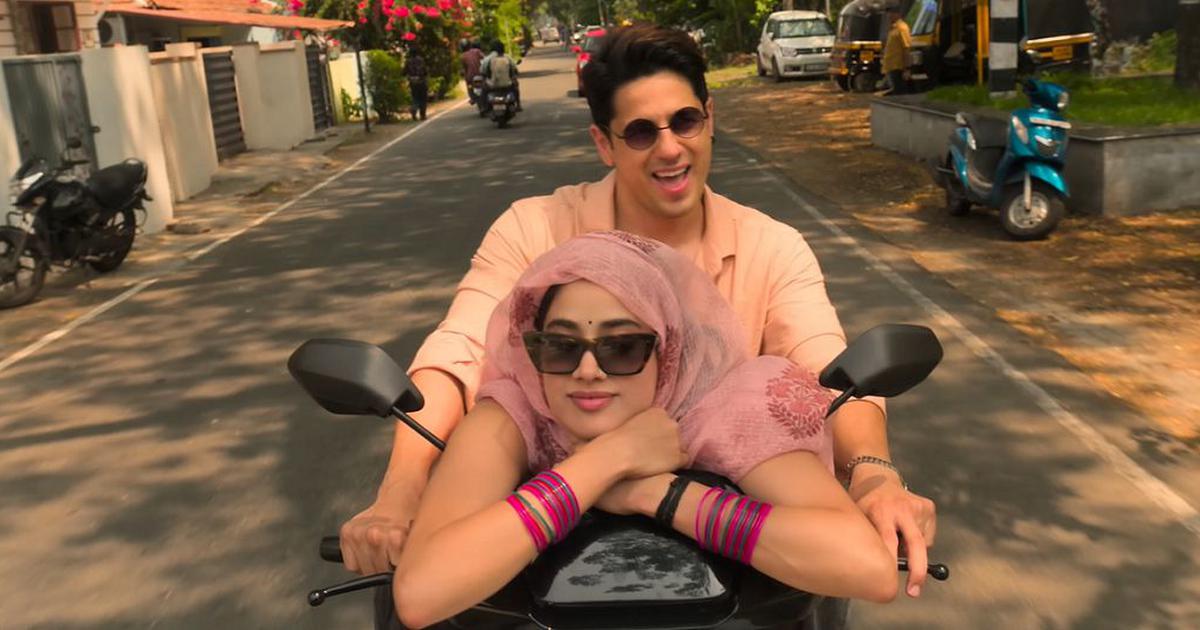
It’s here that we meet Sundari Pillai, portrayed by Janhvi Kapoor, a graceful Mohiniyattam dancer who runs a warm, inviting homestay. Her life revolves around her art, her younger sister, and the customs of her community. From their first meeting, the narrative teases the classic North-South romance, mingling the brashness and bling of Param with Sundari’s composed, culturally-rooted sensibility. Yet, the interplay between these two worlds, instead of sparking fresh insight or organic friction, leans on cultural stereotypes and forced tension. The romance between Param and Sundari feels less like a fusion of worlds and more like a mosaic of familiar Bollywood clichés with its string of predictable jokes and recycled romantic shortcuts.
Most so-called inter-regional love stories in Bollywood use the same old overused trope. The extroverted, over the top Punjabi guy paired with a traditional, demure Bengali or South Indian girl—marketed as a fresh cultural fusion. In reality, it’s just the same old predictable storyline repackaged with concepts from Chennai Express, 2 States, Rocky Aur Rani Kii Prem Kahaani, Namastey London, Dilwale Dulhania Le Jayenge, Humpty Sharma Ki Dulhania, etc.

/filters:format(webp)/movietalkies/media/media_files/2025/06/17/param-sundari-still-1-996406.jpg)
The film Param Sundari may have wanted to bridge the gap between tradition and modernity where the app “Soul Mate” is beyond just a plot device and instead symbolizes the tension between algorithmic, data-driven matchmaking and the messier, unpredictable way love often works in real life. But following that one scene of “using data analysis to find your soulmate” Param Sundari promptly forgets the very concept it markets itself on. The dating app, the supposed backbone of the entire plot, vanishes from the narrative. There is no swiping, no DMs, no algorithmic compatibility, no real exploration of how online dating shapes modern relationships. The story abandons its own premise like a half-charged phone left behind at a café.
Param Sundari promptly forgets the very concept it markets itself on. The dating app, the supposed backbone of the entire plot, vanishes from the narrative.
Perhaps the narrative wanted to ask: Can a set of profile preferences and arbitrary swipes translate into real-life human bonds? But instead of further exploring this, Param Sundari uses the app mostly to justify farcical coincidences and in the next shot, moves the entire cast out of network coverage. The result is a movie that could have been a sharp, charming, modern love story but ends up feeling like déjà vu. The visuals are beautiful, the music is catchy, but breaking into loud dancing and singing to show attraction feels increasingly out of touch with contemporary audiences that were promised a nuanced cross-cultural romance grounded in modern dating.
A glaring example of the film’s confused writing appears when the dating app conveniently directs Param straight to Sundari’s homestay without Sundari having the slightest idea that they’ve been “matched.” As a Gen‑Z viewer, I couldn’t help asking: “Do the creators even know how a dating app works?” In the real world, you cannot stalk (!!!) someone to their home or workplace based on an algorithmic suggestion, let alone try to charm them under false pretenses. Mutual interest, informed consent, and transparent communication are the bare minimum for GenZ dating pools. Yet, here, Bollywood falls victim to its own outdated fantasy of “fated meetings” engineered through questionable behavior. When will the industry finally retire this problematic trope? Instead of feeling organic or even playful, the film clings to the same outdated bollywood formula: the hero falls for the (already betrothed) heroine, then proceeds to interfere with her wedding until destiny somehow justifies his persistence.
Mutual interest, informed consent, and transparent communication are the bare minimum for GenZ dating pools. Yet, here, Bollywood falls victim to its own outdated fantasy of “fated meetings” engineered through questionable behavior.
As the story unfolds, we notice that the film’s humor frequently banks on culture clash: Param’s struggle with Malayalam pronunciation, his awkward sartorial choices, Juggy’s garbling Malayalam-Tamil-Telegu and their stilted attempts at fitting in with local customs. This is not new for Bollywood, but since Param Sundari was hyped as a cross-culture romcom the cultural caricatures feel exaggerated and rather patronizing from both ends. The writing lacks depth and fails to connect the audience to the character’s personal struggles. The love triangle subplot and Sundari’s family conflicts are introduced and thrown aside before the audience can even process what’s happening.
The humor, heavily stereotyping Punjabi and Malayali cultures, was often cringy and borderline offensive. The North Indian characters, Param and his friend Juggy, play the gym-bro archetype to almost cartoonish effect. Juggy, in particular, is little more than a running gag, defined by his lack of subtlety and over-the-top energy. This kind of humor and characterization reduce characters and communities to labels instead of exploring their differences with thought or empathy. As an audience I’d often think: if you cannot respect/educate yourself on your love interest’s culture are you really cut for cross-cultural romance?


The script, in its bid for laughs and aesthetics, sometimes turns Kerala’s rich culture into props, as if shooting for a travel brochure checklist: coconut palms, flashy mundus, vibrant dancers, and a few forced references to Ayurveda and local martial arts. Despite the tokenism, this did effectively surge the film’s visual appeal. With renowned cinematographer Santosh Sivan behind the camera, nearly every frame gleams with golden light, catching the sparkle of Kanjeevaram sarees and the reflection of water lilies on tranquil backwaters.
The film’s musical choices add to this richness. Composers Sachin-Jigar curate a soundtrack that adapts to the shifting moods of the narrative, moving from breezy, upbeat numbers like “Sundari Ke Pyaar Mein” to melodious love songs like “Pardesiya”. Paired with Sharanya Menon’s choreography and strong vocal work from seasoned singers like Sonu Nigam, Shreya Ghoshal, and Adnan Sami, these often stand apart from the plot that ties them together. Sachin-Jigar’s compositions are infectious and imaginative, providing the film with its most memorable moments, even when the narrative falters. Songs like “Pardesiya” carry the emotional weight the story itself can’t deliver. The blend of northern and southern musical styles feels effortless, and the fact that the tracks thrive as commercial success independently, widely enjoyed outside the context of the film, only show how much deeper the music goes.
Supporting characters are a mixed batch; some shine, others fade quickly into cliché. Renji Panicker, as Uncle Bhargavan, provides a rare moment of emotional depth; he is the anchor, calming the chaos around him with subtlety and warmth. In contrast, Gopika Manjusha’s portrayal of Jincy, the nurse, is built on jokes about lust and desirability, leaving little room for complexity or redemption. Janhvi Kapoor is luminous in her dance scenes but struggles in dialogue; her Malayalam sometimes feels forced, and poor dubbing chips away at the authenticity of her performance, creating an emotional distance that the script never bridges. I kept wondering why they didn’t cast a Malayalam or South Indian actress.

The film’s pacing? Despite running for over two hours, the story sometimes sags, especially during extended Kerala sequences where beautiful scenery tries (unsuccessfully) to compensate for sparse plotting. The film gestures toward bigger themes (passionate love versus familiarity, peace and comfort; tradition against technology) in certain monologues, but these are never adequately developed. Instead, we are dragged back to the antiquated formulas: love conquers all, intuition is mightier than any algorithm, and families ultimately come together for a well-choreographed finale. This is perhaps the most frustrating part: how the film treated its own premise. Param Sundari flirts with the concepts but keeps hurrying back to safer territory, exchanging serious engagement for easy gags and musical numbers.
If Param Sundari is remembered for anything, it may well be its fashion and set-pieces. Neha Gurbuxani’s costume design transforms Janhvi Kapoor into a striking tableau of South Indian fashion, the detail and lush textures are a feast for the eyes. Even Malhotra’s flashy, hybrid wardrobe provides a visual cue to the larger North-versus-South theme. Scenes of Sundari dancing, working, or simply moving through her world are choreographed and filmed with care, often suggesting a fashion photoshoot more than lived-in reality.
Moreover, there’s something irresistible about the bright festival costumes and intimate wedding sequences. These scenes capture the energy and emotion often missing in dialogue or plot, making the most of color, light, and pattern to deliver cinematic pleasure. But again, this ultimately signals the film’s limitations. The beauty is undeniable, yet it rarely connects to something deeper; the romance remains decorative, not transformative.
Upon introspection, Param Sundari reflects Bollywood’s current struggle: how to stay relevant with new realities while still delivering what typical theatre-going audiences expect. The film’s answer is to blend the old and the new in the most visually striking way possible: attractive, but ultimately disharmonious. The chemistry between Malhotra and Kapoor is present but never powerful enough to override the narrative’s formulaic structure. Their partnership, despite expert choreography and sharp visuals, feels more constructed than spontaneous.
The chemistry between Malhotra and Kapoor is present but never powerful enough to override the narrative’s formulaic structure.
The film’s ending, striving for resolution, feels more like the closing of a loop than a genuine emotional climax. The victory of “real” love over digital convenience(??), technically a whirlwind romance over a long-term one is celebrated in classic Bollywood fashion, with hugs and music. Yet by this point, the audience may feel left with the sense of having watched a beautiful film that unfortunately told nothing new. The desire to experience how love and tradition meet in the digital era remains unfulfilled.
In the end, Param Sundari has its heart in the right place, but the execution leaves the mind and heart wanting more.