




Summary
Predator: Badlands reinvents the long-running franchise by shifting the spotlight from human survivors to the Yautja themselves, following an outcast named Dek on a harsh journey of identity, survival, and unlikely companionship.
Overall
-
Plot
-
Acting
-
Cinematography
Predator: Badlands enters the scene at a time when science fiction and action film franchises often lean into nostalgia or spectacle. Rather than returning to old formulae, it establishes its own footprint, quietly daring to turn inward and examine what it really means to be “the hunter.” Director Dan Trachtenberg and writer screenwriting lead this shift, taking the intimidating Yautja and revealing an unexpectedly fragile side. Through the eyes of Dek—a Yautja outcast—viewers are asked to leave behind the familiar comfort of human-centric menace.
Right from the film’s opening, the focus is clear: this is not another round of humans being picked off one by one, nor is it about skull trophies and invisible stalkers. Instead, Predator: Badlands gives its attention to the Yautja themselves – harsh customs, and the messy business of growing up in a world where value is measured by strength. Dek, our flawed protagonist, is introduced as smaller and weaker than his clan. His failure is not an act of cowardice, but a function of genetics, for which he suffers deeply. Cast out and challenged to survive alone, Dek’s mission to prove himself by hunting the formidable Kalisk is more than a necessary trial. It’s a quest for identity, raising the stakes far beyond physical survival.
For longtime fans of the franchise, this narrative pivot might initially feel disorienting. Previous films placed the audience firmly alongside human survivors, watching as advanced alien hunters exposed the primal limits of human grit. That familiar pulse of terror is largely absent here, replaced by curiosity and vulnerability. Dek is far from the mythos of an invincible hunter; he stumbles, hesitates, and questions himself. This thoughtfully measured approach, at times slow, signals a franchise that reconsiders what thrills and tension are about.
Dek is far from the mythos of an invincible hunter; he stumbles, hesitates, and questions himself.
The world Dek enters, the planet Genna, is rendered in vivid detail. Its landscape, teeming with carnivorous plants and razor-edged flora, becomes a second antagonist, challenging Dek’s ingenuity at every turn. Here, the filmmakers trade familiar military gadgets for more organic threats: grasses that slice with a whisper, beasts that emerge from shifting sands, and strange, venomous lifeforms. Trachtenberg’s approach feels almost documentary-like, at times reminiscent of classic wilderness survival films. Genna’s ecosystem provides a running reminder that brute force alone won’t be enough to see Dek through; it’s the power of observation, and a willingness to learn that will determine his fate.
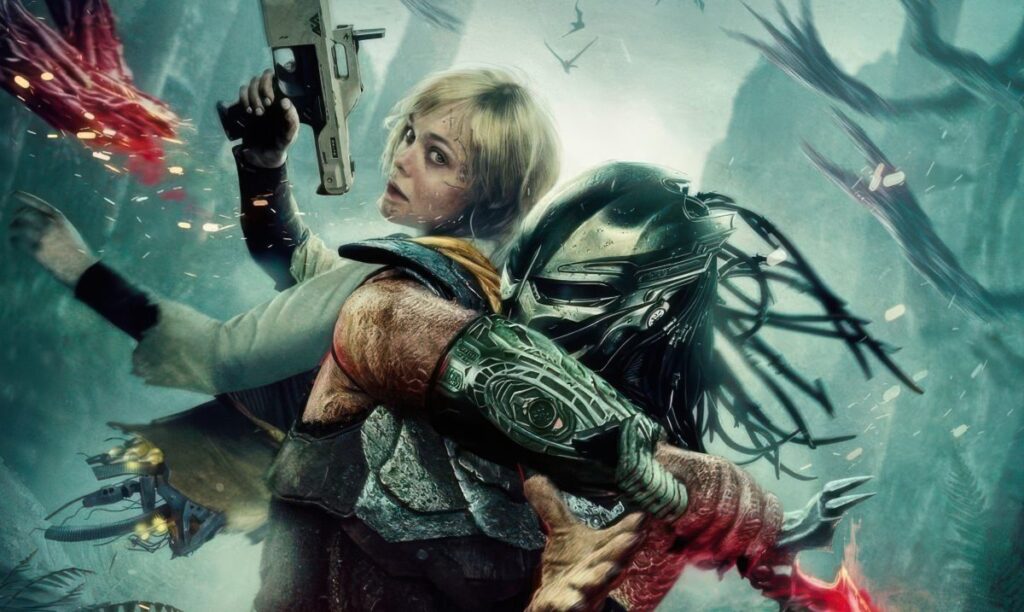
If Dek embodies the spirit of survival against the odds, Thia—the stranded android, performed with a quietly bright presence by Elle Fanning—brings a different kind of complexity. Damaged and half-constructed, Thia voices a longing for meaning that mirrors Dek’s own. She is limited by her synthetic body but not by her curiosity or her humor. Her interactions with Dek—sometimes awkward, sometimes profound—peel back the stereotypes of both alien and machine until only a universal desire for belonging remains. The film relies on her warmth and gentle wit to soothe some of its rougher edges, producing moments of levity and depth. Thia’s role is to illuminate the interior journeys of both herself and the young Predator, showing how even artificial beings can struggle with questions of what it means to be real, to be whole, and to be wanted.


The narrative does not proceed with relentless urgency. As Dek and Thia face Genna’s dangers together, the plot grows less about overcoming external monsters and more about finding courage in connection. Yautja society, as depicted in Predator: Badlands, is strict to the point of brutality. It is a world that teaches its young that compassion is weakness, that trust is a liability. This expanded look at Yautja life is more than a backdrop; it’s central to the tension. For Dek, Thia’s presence is at first a liability, but the relationship that develops between them refuses to follow tradition. They bicker, share uncertain jokes, and ultimately rely on each other in ways forbidden by Dek’s cultural code. These shifts form the core of the film’s emotional argument: empathy and collaboration might be a deep source of strength in a hostile universe.
The film’s physical and emotional landscape is rounded out by the presence of Bud, a dog-faced simian creature who quickly becomes part of Dek’s makeshift family. Bud is a source of unpredictable mischief and brief, much-needed comic relief. His antics will likely divide audiences: some will appreciate the break in tension, others may find the mood jarring. Yet, Bud’s existence speaks to the central theme: the possibility of kinship found not in shared struggle and perseverance.
Visually, Predator: Badlands excels in world-building, making Genna a world of danger both beautiful and terrifying. The resulting action scenes are gripping – every threat carries consequences, and every victory leaves scars. Like a well-built thriller, the film saves its most explosive moments for carefully chosen climaxes, making each pulse of action land with greater impact.


The movie also makes nods at its cinematic roots. Subtle references to in-universe lore, including hints at the Weyland-Yutani corporation, anchor it within the broader myths of sci-fi. Instead of rehashing predictable monster-hunt formulas, it presents the franchise as a vehicle for reflection and self-discovery. This marks a willingness to evolve – to honor the past while challenging what comes next.
Perhaps the most daring choice shown by Trachtenberg and screenwriter Patrick Aison is the complete lack of human characters. In a franchise built on watching people run and die at the hands of unseen hunters, this reversal is radical. The removal of humans from the equation alters the tone in several key ways. First, the violence, while still present and often brutal, feels less personal – synthetic beings meet their ends in intense ways, but they don’t seem to “suffer.” Second, the narrative is freed from certain expectations around language and explicit gore. The PG-13 rating is therefore appropriate, thanks to the absence of human blood and the focus on non-human peril. What results is a film that remains tense and raw but now speaks to a broader age range.
In a franchise built on watching people run and die at the hands of unseen hunters, this reversal is radical.
Occasionally, the blended tone struggles to unify every element. While Dek’s vulnerability and Thia’s human-like warmth bring freshness to the franchise, some viewers may find the mood uneven. But for every moment of discord, there is a sequence where emotional honesty and danger align. In the film’s most memorable confrontations, Dek’s hard-won adaptability and willingness to protect his unlikely allies serve as testaments to his heroism.
In its quieter, more introspective ending, Predator: Badlands invites viewers to consider what survival actually means. Is it about conquering every threat alone, or about understanding the value of unconventional alliances? In its refusal to simply retread old ground, Predator: Badlands carves a new path, expanding old myths into the territory of hope and shared survival. It trades brute repetition for complexity, balancing danger with intimacy, and raw spectacle with genuine heart. The Yautja are no longer just predators; in Trachtenberg and Aison’s vision, they are mirrors—reflecting both the darkness and the promise within us all.