


Summary
Call of Duty: Black Ops 7 reinvents the franchise with a bold, co-op-focused campaign and fluid “omnimovement” multiplayer. While the always-online requirement and surreal plot may polarize solo players, Treyarch’s polished gunplay and innovative maps deliver a top-tier competitive experience. It’s a daring, high-energy evolution for FPS fans.
Overall
-
Visuals
-
Gameplay
-
Soundtrack
Call of Duty: Black Ops 7 marks a turning point in one of gaming’s most enduring shooter series. Arriving with the weight of history and high expectations, this entry chooses not to play it safe. It attempts to reinvent core experiences while doubling down on the competitive multiplayer polish that has long defined the franchise. The result is a game marked by ambition, contradiction, and moments of brilliance alongside frustration.
The new game’s campaign discards the classic formula in favor of a bold, co-op-focused approach. Where players once embarked on solo missions accompanied by AI allies, the new model is always online, built around teamwork. Gone are the scripted squad banter and robust companionship that gave previous stories their cinematic depth. Players are now grouped via matchmaking or left to brave sprawling missions alone. They can choose between skill-based matchmaking (SBMM) for fair, competitive pairings, or more traditional lobbies that throw all comers together without consideration for rank. The result is flexibility, but not always predictability. Non-SBMM lobbies might drop new players into the deep end, facing seasoned rivals with hard-earned reflexes. The shift is immediate and dramatically changes the atmosphere, turning what were once tightly choreographed action sequences into something more isolated.
If the campaign marks a bold, sometimes uneven, departure from tradition, multiplayer stands as Black Ops 7’s backbone and perhaps its saving grace. Here, Treyarch’s experience is evident, delivering the franchise’s most fluid, finely tuned suite of competitive options yet. The new omnimovement system—allowing wall running and wall jumping up to three times in quick succession—changes the tempo of matches in subtle but vital ways. Vertical play is no longer a novelty. Players use multi-leveled maps filled with flanking routes, quick escapes, and sudden vantage points. Spatial strategy becomes second nature, rewarding those who adapt to the pace and energy of the game.

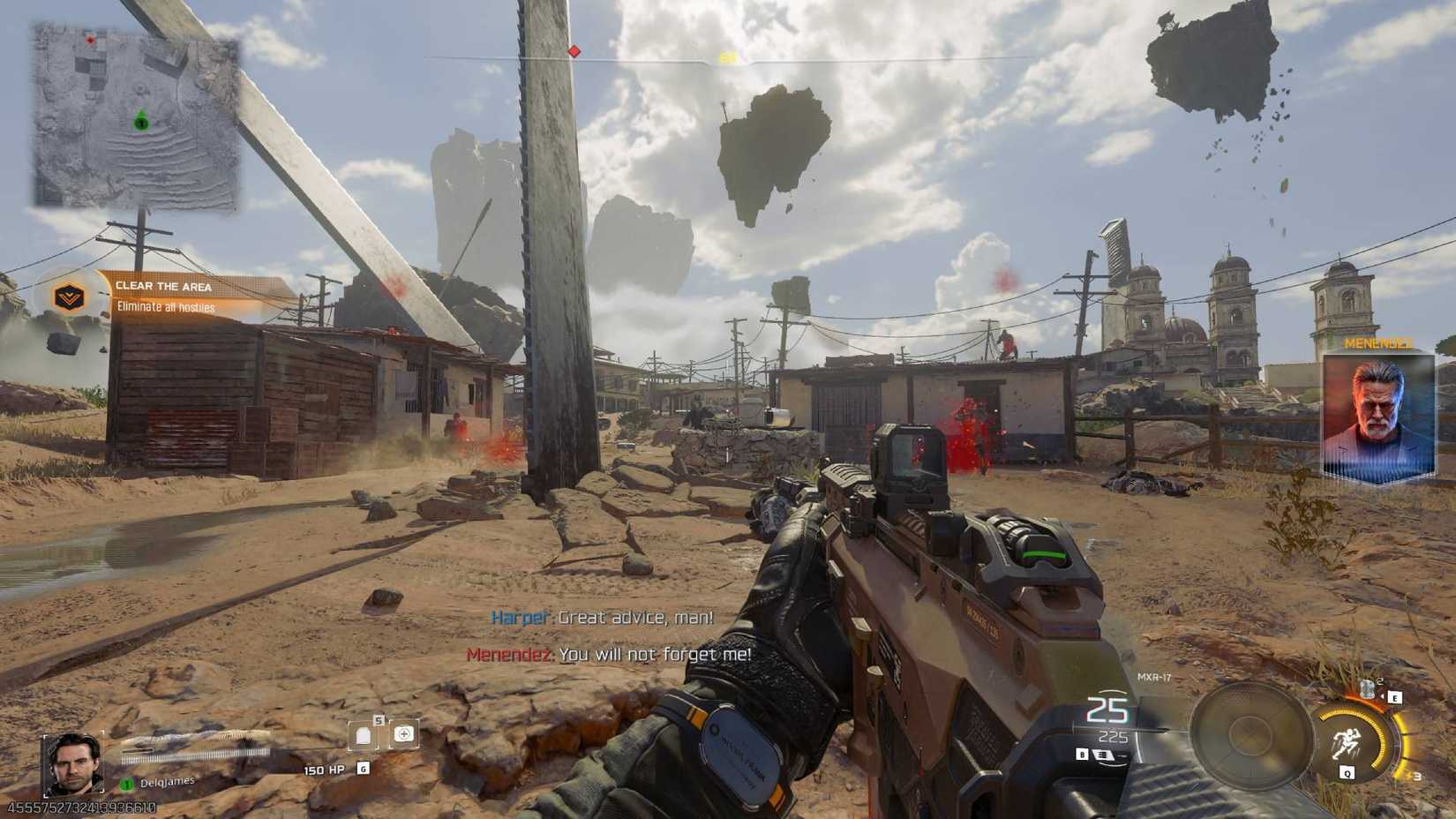
It’s not just a matter of mood. The structure itself demands adaptation. Players need a steady internet connection at all times. For those with unstable connections, the immersive flow is constantly threatened. If a drop occurs, progress is lost. Resuming a mission isn’t a matter of simply restarting at a convenient checkpoint. Instead, the game asks you to redo entire segments, making every disconnection sting all the more. This technical demand sits at odds with the franchise’s reputation for accessible blockbuster experiences, where players were free to lose themselves at their own pace.
Mission design under this new structure compounds the challenge. Objectives seem conceived primarily with cooperative play in mind, as if the designers expected a full squad for every encounter. Enemy numbers are dialed up to meet the assumed strength of groups, which makes solo attempts become tedious wars of attrition. Environmental puzzles and tasks, once quick diversions or shared teamwork, now stretch out, sometimes feeling like chores when tackled alone. And without AI support, there’s no safety net. Tactical variety diminishes the freedom of choice that made previous stories malleable. For those entering the campaign alone, the intent is clear: this is no longer the singular, curated ride that once defined Black Ops. The solo route is possible, technically, but rarely rewarding.
Objectives seem conceived primarily with cooperative play in mind, as if the designers expected a full squad for every encounter. Enemy numbers are dialed up to meet the assumed strength of groups, which makes solo attempts become tedious wars of attrition.
Weapon progression in the campaign offers additional complexity. Players invest in one weapon—encouraged to upgrade it tier by tier—but the system’s limitations can create imbalances. At times, standard rifles can outclass specialized tools meant for unique situations. In the thick of combat, this means the tactical gallery of Black Ops condenses into a handful of favorites, with the rest gathering dust. It is a small shift, but its accumulation chips away at the sense of experimentation that once encouraged players to adapt on the go.
Narratively, Black Ops 7 retains the franchise’s signature interest in psychological complexity, but steers into uncharted territory. The plot again centers on David Mason, a protagonist familiar to series veterans, now swept up in a war against a shadowy collective called “the Guild.” The weapon at the heart of this conflict is The Cradle—a mysterious chemical compound that turns the ground of reality to quicksand, pushing Mason and his team through hallucinatory dreamscapes and scenes of shifting, surreal menace. For fans attentive to franchise lore, there are threads of connection. But for newcomers or even those less steeped in the finer details, the story risks becoming a delirious, fragmented journey. Its ambitions are clear but the emotional anchor fails to hold. Character arcs bleed together, and narrative momentum gets interrupted by the campaign’s psychedelic tone and lack of narrative intimacy. Rather than heightening tension, it often leaves the player at arm’s length, more puzzled than emotionally invested.


Critics like Kotaku’s Zack Zwiezen point to these issues, framing the campaign as a “montage” of wild ideas that rarely coalesce into coherent storytelling. The campaign’s voice performances are strong, and its visuals are engaging, but the plot’s structural experimentation undermines its ability to generate staggering stakes. It is a daring shift, yet one that struggles to marry nostalgia with innovation seamlessly. Technical issues persist in some places, with platforms like the PS5 Pro reporting occasional frame drops. Yet once in the heat of multiplayer, the strengths are impossible to miss: brisk movement, measured gunplay, and maps fun to traverse. On balance, the legacy of Black Ops is well-served on these fronts, even if not every risk pays off.
For all its high-minded narrative ambition and structural novelty, the core gameplay still preserves what has always worked. Gunplay maintains its snap and punch—every firefight feels responsive, every bullet lands with tactile satisfaction. Movement is just as precise, offering flexibility for different playstyles. The campaign threads classic corridor designs with expanded, open segments and vertical traversal tools like the Squirrel Suit. Special powers and arcade-like abilities add layers of spectacle reminiscent of other shooters. These elements stand as a reassuring reminder: even amid reinvention, certain fundamentals are carefully maintained.
The campaign threads classic corridor designs with expanded, open segments and vertical traversal tools like the Squirrel Suit.
Finishing the campaign introduces Endgame—a PvE, extraction-style mode set in the open world of Avalon. Here, players or up to four-person squads dive into hostile zones, scavenging for loot and battling AI adversaries before attempting to escape. It is a change of pace and a breath of fresh air compared to the main storyline. The mode brings tension through objective-driven survival, rewarding teamwork and map awareness. However, it is conservative in scope, more structured than innovative. Fans of extraction shooters may find the mode accessible but restrained, considering it is available only after the campaign.
Variety isn’t limited to guns and gadgets. Black Ops 7’s multiplayer resurrects fan-favorite game modes while pushing into new, untested territory. The Overload mode, an inventive capture-the-flag variant focused on EMP objectives, prioritizes team coordination and tactical maneuvering. Skirmish, a chaotic 20v20 battlefield, comes loaded with gadgets, vehicles, and destructible cover, making matches feel both grand and unpredictable. Yet the scale sometimes comes at the cost of teamwork, as battles devolve into frenzied chaos.
Zombies mode, a staple for the community, delivers on its legacy even as it shows some age. Players are offered both round-based, classic survival and directed progression, weaving nostalgia with new mechanics. Different difficulty paths make the mode accessible to all, and Dead Ops Arcade returns for bite-sized chaos. Yet there’s a feeling that the peak of Zombies has passed. Systems like Gobblegums, once rare and coveted, become easier. Still, the mode’s sense of challenge and camaraderie remains strong.


Map design remains a series strength, with new locales and resurrected classics sharing the rotation. Retrieval features winding underground passages wrapped in icy landscapes, offering opportunities for stealth. Old favorite Hijacked, set on a multi-deck yacht, epitomizes the franchise’s ideal of kinetic, close-quarters action. Across the pool, maps are built to encourage movement. Cover is plentiful, sniping lines rarely overpowered, and every space designed for rapid, unpredictable exchanges.
Beyond raw gameplay, presentation and audio uphold the Black Ops aesthetic. The setting projects slick interfaces and sharp digital overlays. Explosions rumble and guns report with drama, but never drown out the layered soundtrack. Environmental art stands out, with campaign hubs, multiplayer maps, and the perennial Zombies playground all rendered with energy and nuance. There’s a sense that every visual decision is meant to complement the gameplay.
So where does Black Ops 7 leave the franchise? At its core, it is a game in search of its next chapter. The boldness of its choices signals a desire to be more than just another installment. Yet the outcome is divided: the new campaign is as likely to perplex as to captivate. Multiplayer, meanwhile, remains what it has always been—the foundation on which fans will continue to build their memories and rivalries.
So where does Black Ops 7 leave the franchise? At its core, it is a game in search of its next chapter.
For those who come to Black Ops for the camaraderie of competitive play, the thrill of fast rounds and creative maps, Black Ops 7 is as good as the series has been in years. It polishes old strengths, introduces new wrinkles, and refrains from cluttering the experience with pointless grinds or overbearing balance shifts. But for players seeking the narrative immersion—the blockbuster spectacle and intimate storytelling that once differentiated Call of Duty campaigns—this entry leaves much to be desired.