




Summary
The Paper is a quiet, heartfelt workplace comedy that blends dry humor with genuine melancholy. Anchored by strong performances and thoughtful writing, it explores the fading world of local journalism with warmth and honesty. While some arcs feel rushed, the show’s subtle emotion and grounded storytelling make it unexpectedly moving and memorable.
Overall
-
Plot
-
Acting
-
Cinematography
In today’s crowded streaming world, it is easy to overlook a new workplace comedy, especially one set in a fading local newsroom. Yet The Paper on Peacock manages to stand out: not by reinventing the wheel, but by taking the best parts of the genre and infusing them with subtle heart and honesty. Like some of Greg Daniels’ previous comedies, it uses the mockumentary style as a lens for both humor and gentle reflection. But The Paper also dares to drift away from the bigger, broader laughs of its predecessors, finding unique value in honoring tradition while facing the realities of a changing world.
The first thing viewers notice is how much the show respects the daily work at its core. Unlike many office shows, where workplace antics overshadow the business itself, The Paper puts the act of journalism front and center. Here, the Toledo Truth-Teller is not just a backdrop but a living organism fighting for relevance. Its struggles feel real, not just in jokes but in the scraping, desperate moments so familiar to anyone who has watched an old tradition try not to vanish.
From the first scene, there is a quiet melancholy underneath the humor. Details stand out: desks buried under newspapers, computers on the verge of dying, faded posters half-peeling off the break room wall. The staff cut and fold old papers into hats or use them as makeshift notepads, little signs that nothing lasts forever, yet people try to keep meaning alive any way they can. These choices create a feeling that is both funny and sad, an honest portrait of a place and a group of people trying, stubbornly, to matter.
The spirit of Greg Daniels lingers in the corridors, but the series is not simply The Office with different desks. Instead, it is a patient study of working lives. Domhnall Gleeson’s Ned Sampson steps into the story. He is no Michael Scott, but something steadier. His combination of optimism and hard practicality anchors the newsroom through constant economic pressure, tightening budgets, and the endless tides of online disruption. Scenes don’t just play for laughs; they pause, often, to breathe and let us see Ned’s frustration and hope flicker side by side. The jobs may be thankless, the paychecks thin, but the need to protect something sacred gives every moment a sense of purpose.


When the story needs a link to Daniels’ wider TV universe, it arrives with Oscar Martinez, now a reporter after his days of crunching numbers at Dunder Mifflin in Scranton. Oscar’s tone has always been dry and reserved, and here that voice brings a welcome calm to the newsroom chaos. He is a character grown by time—not just a clever observer, but an active part of a failing institution’s last stand. His transformation mirrors the paper’s own efforts to remain valuable even as the world shrugs and moves on.
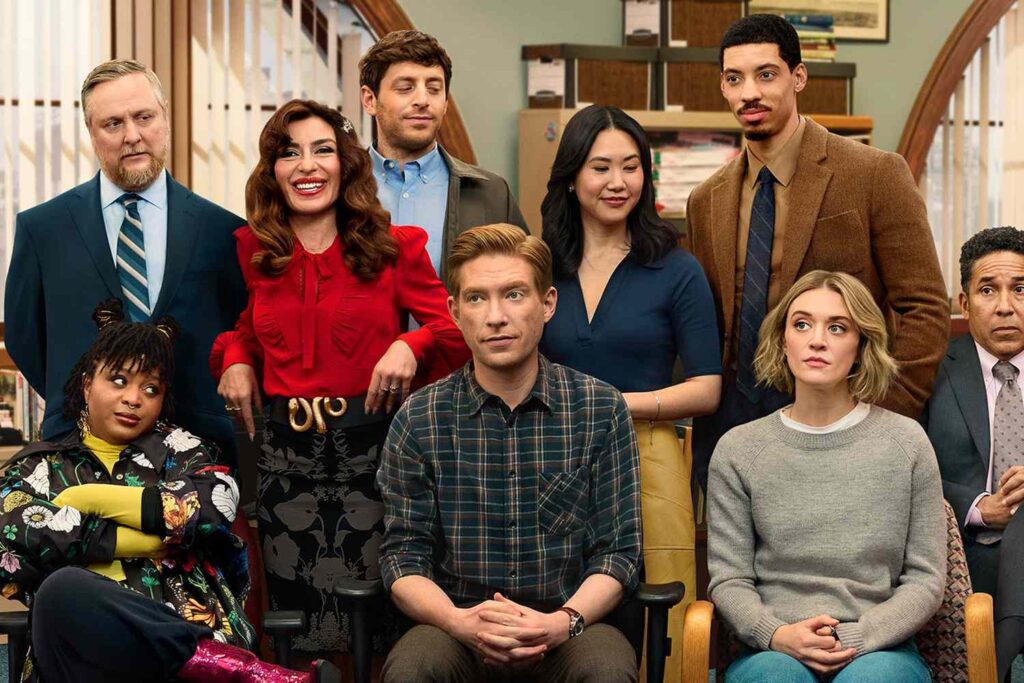
The cast forms a mix of energy, uncertainty, and heartfelt ambition around Ned and Oscar. Mare Pritti, played by Chelsea Frei, is perhaps the show’s quietest force. A former servicewoman, she stands rooted against Ned’s near-naivety, offering wisdom and skepticism in measured doses. Her journey from military order to newsroom disorder brings moments of quiet reflection and sharp humor. Then there is Esmeralda Grand, performed with zing by Sabrina Impacciatore, who bursts onto the scene as a brash rival and slowly becomes something more textured; her biting lines hide deeper pains, even if her arc sometimes leaps ahead too quickly. Tim Key’s Ken Davies, bumbling and likable, represents the awkward dance between corporate management and local newsroom realities, sidestepping the most cartoonish clichés of the genre in favor of smaller, more believable gestures.
The staff’s blend of nervous energy and scrappy determination paints the Truth-Teller as more than just a setting. Every offbeat news pitch or derailed staff meeting builds into a tangled but familiar workplace tapestry: an eye roll here, a muttered aside there, letting the humor build quietly alongside moments of real anxiety. Through these small exchanges, the narrative lets us into a community that at times feels on the verge of collapse but never quite surrenders.
Every offbeat news pitch or derailed staff meeting builds into a tangled but familiar workplace tapestry: an eye roll here, a muttered aside there, letting the humor build quietly alongside moments of real anxiety.
Where the show really separates from its forerunners is in its pacing and use of streaming’s shorter, punchier format. The ten-episode season does not meander. It moves at a clipped rhythm, sometimes to its own advantage, sometimes at the expense of deeper character exploration. While this speed is a nod to modern watching habits, it also mirrors the reality of journalism today—stories break, shift, and disappear faster than ever.
There are times when storylines feel rushed—arcs that might have grown over weeks instead compress into a single episode. A newsroom romance flickers on, then skips a beat. An investigative scoop, so promising, is quickly sidetracked by the next digital storm. But this isn’t just a streaming flaw; it becomes a narrative choice, allowing the show to comment on the frantic, never-quite-settled feeling of contemporary journalism.

:max_bytes(150000):strip_icc():focal(684x168:686x170)/the-paper-ramona-young-gbemisol-ikumelo-090525-0cd4f3f07cf74ba8973a89d855e5677d.jpg)
The classic mockumentary tools—confessional camera asides, handheld camerawork, and pregnant silences—are deployed, but rather than milking every awkward pause for a laugh, the series lets its comedic moments ride on a sense of real tension: How much longer can this work last? Will these people continue to care when everyone else has moved on? In these moments, The Paper is not just poking fun; it is quietly mourning a dying tradition even while it celebrates those who persist.
What stands out most about the show’s sense of place is how Toledo itself shapes the staff’s experience. Unlike the mythic Scranton of The Office, this city is rendered more plainly—a slice of Midwest America caught halfway between nostalgia and decay. The local flavor, neither glamorized nor derided, feeds into the paper’s identity. There is a sense of affection for the everyday, for a place where small victories matter and defeats are personal.
Episodes like “Scam Alert!” and “TTT vs. the Blogger” set the bar for both humor and pointed social commentary. These stories draw sharp lines between the demands of viral content and the deeper hunger to tell the truth. At the heart of each episode is a challenge: how do you chase clicks without losing your soul? Sometimes the answer is handled lightly, with a good gag or a snappy exchange. Other times, the show stops and lets its characters lie awake, pondering the cost of sticking to their ideals.
While the humor is often dry and unhurried, it is not without heart. Ned’s attempts to rally the staff, Oscar’s unflappable calm in the face of chaos, Mare’s exhausted but genuine attempts to right the ship—these are moments that feel lived in. Even when things go badly—and they often do—the sense of shared struggle draws the staff together. There are as many small defeats as victories, yet it’s in these cycles of hope, doubt, and renewal that the show really finds its depth.
It’s easy to expect the familiar office antics, but The Paper wants something different. The show’s gaze is fixed not on awkward romances or playful banter, but on the harder, quieter questions. Can an institution built on facts still find its footing in a world shaped by algorithms? Can a group of unlikely colleagues choose what is right over what is profitable, even as their jobs hang in the balance? The answers are never simple, and the show doesn’t pretend otherwise. Instead, moments of doubt, humor, and frustration mix together to form something close to life in transition.
Can a group of unlikely colleagues choose what is right over what is profitable, even as their jobs hang in the balance?
Visually, the production keeps everything close to the ground. There’s a lived-in feel to every scene—the clutter of work, the stains of old coffee, the chipped paint on the office windows. The opening montage, which quickly became a talking point, says a lot in a few short clips: newspapers crumpled into crafts, used for cleaning spills, or piled up as padding for wobbly chairs. This mixture of affection and satire gently brings home the reality of print journalism’s precarious position.
The show’s real strength lies in how the emotional resonance is built not just on individual struggle, but on the shifting dynamics between team members. Each episode tests those alliances—someone considers jumping ship for a digital start-up, another sacrifices a byline for the better of the whole staff, old wounds are opened, and new friendships patched together. At every turn, the show circles back to its central challenge: holding onto something valuable when everyone and everything keeps urging you to let go.
While the show doesn’t always give each character the time they deserve, the chemistry among the ensemble is plain. In its quieter way, The Paper echoes the anxieties and quiet hopes of any industry on the brink of being forgotten. The series finds tension not only in conflicts with outsiders but also in the smaller internal battles with one’s own doubt.
This is also a show about change—about the bittersweet cost of fighting stubbornly. The Truth-Teller staff are not heroic in the conventional sense, but their resistance to simply vanish without a trace gives them a kind of everyday validity. In the end, it is this defiance against meaninglessness that gives the show weight and warmth.


For followers of Greg Daniels’ earlier work, The Paper offers a familiar, if quieter, sense of what makes a workplace truly tick. The show never tries to copy its elders, nor does it distance itself to the point of coldness. Instead, it finds a middle ground, using humor to soften sharper truths and letting sadness creep in through the edges. The culture of The Paper is not that of a sitcom—it is the messier, more complicated world of people who care, sometimes too much, about what they do.
It is undeniable that some plotlines beg for more space—Esmeralda’s evolution, Mare’s haunted reserve—but as the season closes, it becomes clear that this is not the end but the beginning of a longer story. If future seasons are given room to grow, there is every reason to believe the cast and writers can deliver on the promise of this rich, underplayed foundation.
In its last moments, The Paper leaves viewers with questions rather than answers. Can these characters weather another storm of layoffs and shrinking relevance? Will the spark of meaning survive the next shake-up or management fad? The show doesn’t pretend to know. Instead, it ends on a note of uncertainty—an honest acknowledgment that sometimes being present is the bravest thing of all.
In its last moments, The Paper leaves viewers with questions rather than answers.
The Paper finds its power in the careful balance of humor, pain, routine, and surprise. It is another workplace comedy in name, but in spirit, it is something else—a series about hope, loss, and the persistent, gentle defiance of those who refuse to stop making meaning, even when no one seems to notice. In this way, The Paper earns its place as both tribute and original, welcoming viewers to a world where the smallest acts of optimism can echo loudly in the quietest rooms.