


There is a phrase that gets thrown around too often in professional wrestling, usually deployed as a marketing campaign or a hot take desperate for engagement. “Modern classic.” It’s been applied to so many matches in recent years that it has lost most of its weight, becoming the wrestling equivalent of calling every album “essential” or every film “a masterpiece.”
And then, every once in a while, you get a match that earns the phrase back.
The World Heavyweight Championship main event of WrestleMania 42 — CM Punk versus Roman Reigns — is one of those matches. It arrived at the end of an event that, by most accounts, had been uneven at best. The build had been formulaic. The undercard had its moments but lacked a unifying through-line. By the time these two men walked through the curtain, there was a real and uncomfortable possibility that WrestleMania, that grand annual ritual that the wrestling industry has been built around for over four decades, was going to limp to its conclusion.
Instead, what we got was a thirty-plus-minute psychological epic that has already been awarded a five-star rating by the Wrestling Observer, has cleared a 9.0 user score on CageMatch, and is being mentioned in the same breath as the greatest WrestleMania main events of the last twenty years. It is being talked about as the moment Punk and Reigns saved WrestleMania 42 — and possibly the legacy of an entire era of WWE‘s product.
The question worth interrogating, though, is why. What was it about this match, specifically, that worked so completely? The answer is more interesting than any single spot or sequence. It lies in the patient construction of psychology, the weaponization of history, and the willingness of two of the biggest stars in the industry to tell a story about ego, aging, and the quiet horror of a legend running out of time.
The Underwhelming Build and the Buried History of CM Punk and Roman Reigns at WrestleMania 42
It’s worth starting with the contradiction at the center of this match: the televised build-up was, in real terms, not very good. The promo segments leaned on personal zingers and recycled mic battles. The structure of the feud felt formulaic — two guys taking turns running each other down on Monday and Friday nights with diminishing returns. By the time we hit go-home week, more than a few longtime viewers were privately wondering whether the actual match could possibly justify the months of buildup.
What rescued the build, in retrospect, was something the writers couldn’t manufacture even if they tried: a decade of real, unspoken friction sitting just beneath the surface.
The age-based jabs that Roman kept lobbing at Punk weren’t just generic insults. They were laying down a roadmap. Old Punk versus Prime Roman. The aging veteran versus the handpicked titan. By the time the bell rang, the audience understood that this was a match about more than a championship — it was about whether a 47-year-old man with miles on his body could still hang at the very top of the mountain against the biggest mainstream wrestling star since John Cena.
And then there’s the deeper history, the one the company will never reference on television but that every serious wrestling fan carries in their head. When Triple H and the WWE creative team were assembling The Shield in 2012, CM Punk pushed hard for Chris Hero — Cassius Ohno — to be the third member of the faction. The company pulled rank and installed their own preferred prospect: Roman Reigns. That decision, more than any single feud or angle, defined the philosophical divide between these two men. One was the indie-built insurgent who fought his way through the system. The other was the corporate selection who was given the system. The Shield itself, the very faction that turned Roman into a star, exists in part because Punk’s pick was overruled.
You don’t need to write that into a promo. You can feel it in the air the moment they share a ring.
Two Conceptions of Stardom Walking to the Ring
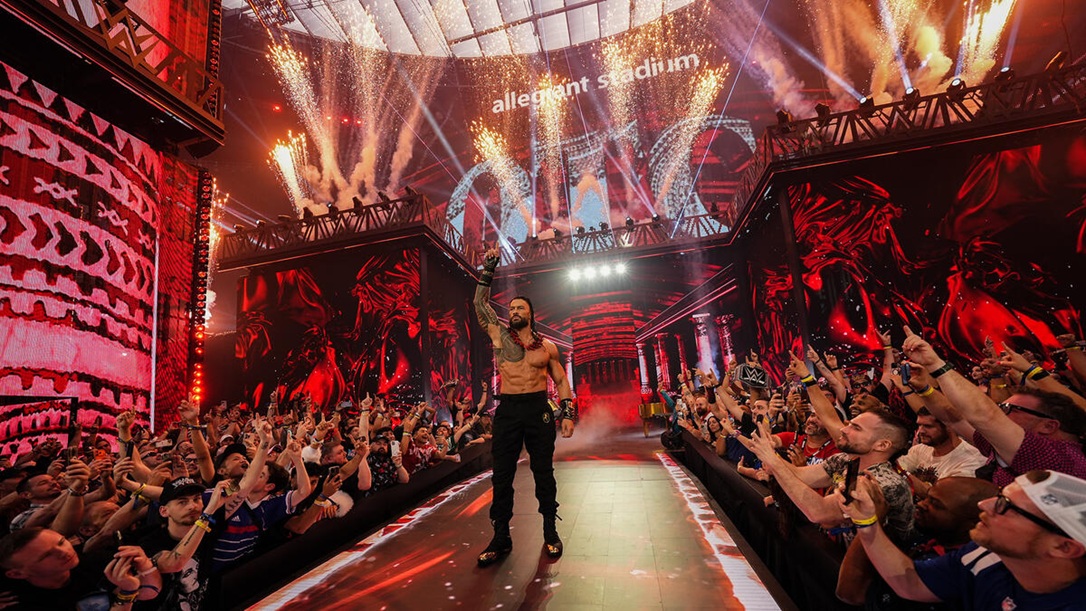

The entrances did exactly the work they needed to do.
Roman’s was a study in deliberate, almost insulting patience. The walk was glacial, the kind of slow march that fans of the high-octane modern style have learned to complain about, but which masters like Undertaker and Randy Orton built entire careers on. He was paired with a live musical performance and a montage of WWE’s past champions glaring down from the screen behind him. The cumulative effect was suffocating in the best possible way. He wasn’t walking to the ring. He was being inevitable.
Punk’s entrance was, by contrast, a love letter. His AFI-tinged theme music swelled over the crowd. His gear was layered with tributes — to friends, to family, to the people who shaped him. A pre-recorded cinematic vignette played on the screen, framing him as the people’s champion, the one who fought his way in from the outside and never stopped being one of us. Where Roman’s entrance was about the weight of the throne, Punk’s was about the weight of the journey.
Two completely different conceptions of what it means to be a star, both pitched at maximum volume, both arriving at the same square of canvas. The match hadn’t started yet, and already the central conflict had been rendered visually.
The Stare-Down and the Baby Oil
The opening stare-down has become one of the most replayed moments of the night, and not because anything dramatic happened. The two men stood inches apart and exchanged a brief, inaudible conversation. Lip-readers online have been arguing about it for days. Most of the guesses have been wrong. The point isn’t what was said. The point is what was conveyed.
Whether or not there is genuine, real-life animosity between these two — and there are credible reports in both directions — is irrelevant. What mattered was that the audience believed there was. That belief transformed the opening seconds from professional courtesy into volatile standoff. Perception, as always in this business, is reality.
The first lock-up confirmed it. Roman slipped free with embarrassing ease, and Punk immediately sold the moment as suspicious — gesturing to the referee, complaining about baby oil, accusing Roman of cheating his way out of a clean exchange. It was petty. It was funny. It was also vintage Punk strategy.
He was running the same playbook he ran against John Cena at Money in the Bank 2011. Paint the corporate golden boy as a poseur — all glistening physique and entrance pyrotechnics, no real grit. Reaffirm yourself as the authentic article in the room. Get the crowd to make a choice between substance and surface. It worked then. It worked again here. By the time Roman caught Punk with a Samoan drop and a right hand that nearly took his head off, the dynamic was set.
The thing Punk sold most expertly in those first few minutes wasn’t pain. It was shock. He wasn’t just reacting to being hit. He was reacting to the realization that this was going to hurt more than he had bargained for. That single performance choice — selling surprise rather than just impact — established the stakes for the next half hour. This wasn’t a clinic. This was going to be a war Punk wasn’t sure he could win.
“It’s Not Twitter”
One of the defining lines of the match comes early in its second act, when Roman shifts into what fans have started calling Bloodline mode — that slow, methodical, predatory pace where he just sits on his opponent and breaks them in increments. Punk, exhausted and reaching, tried to start a verbal exchange. Roman shut him down with a sentence that lands as the thesis of the entire match.
“It’s not Twitter. It’s not promo day. This is the match.”
That line is everything. The whole feud had been built on talk. Personal zingers, microphone battles, social media barbs. Punk had spent the entire build-up operating under the assumption that he could verbalize his way through this fight the way he verbalized his way through every confrontation of his career. By collapsing the entire promo war into a single dismissal — this is the match, and you don’t get to talk your way out of it — Roman stripped Punk of his last weapon.
What follows is one of the most psychologically rich sequences in recent main-event memory: Punk pausing to taunt the crowd after small advantages, mimicking Roman’s sky-pointing gesture, performing confidence with a manic edge that doesn’t quite ring true. The temptation is to read this as veteran arrogance. The much more interesting reading — and the one the match itself supports — is that it’s a desperate performance. Punk isn’t taunting because he’s in control. He’s taunting because he isn’t. Each pause is a fraction of a second he can’t afford to give up, and Roman, the most efficient predator in the modern game, never fails to make him pay for it.
When Roman finally trapped him in the Tree of Woe and started peppering him with strikes and Superman punches with a smug grin on his face, the prophecy of the build was being fulfilled in real time. The “old Punk” insults weren’t insults anymore. They were the diagnosis.
The Steps, the Powerbomb, and the Weight of History between CM Punk and Roman Reigns at WrestleMania 42
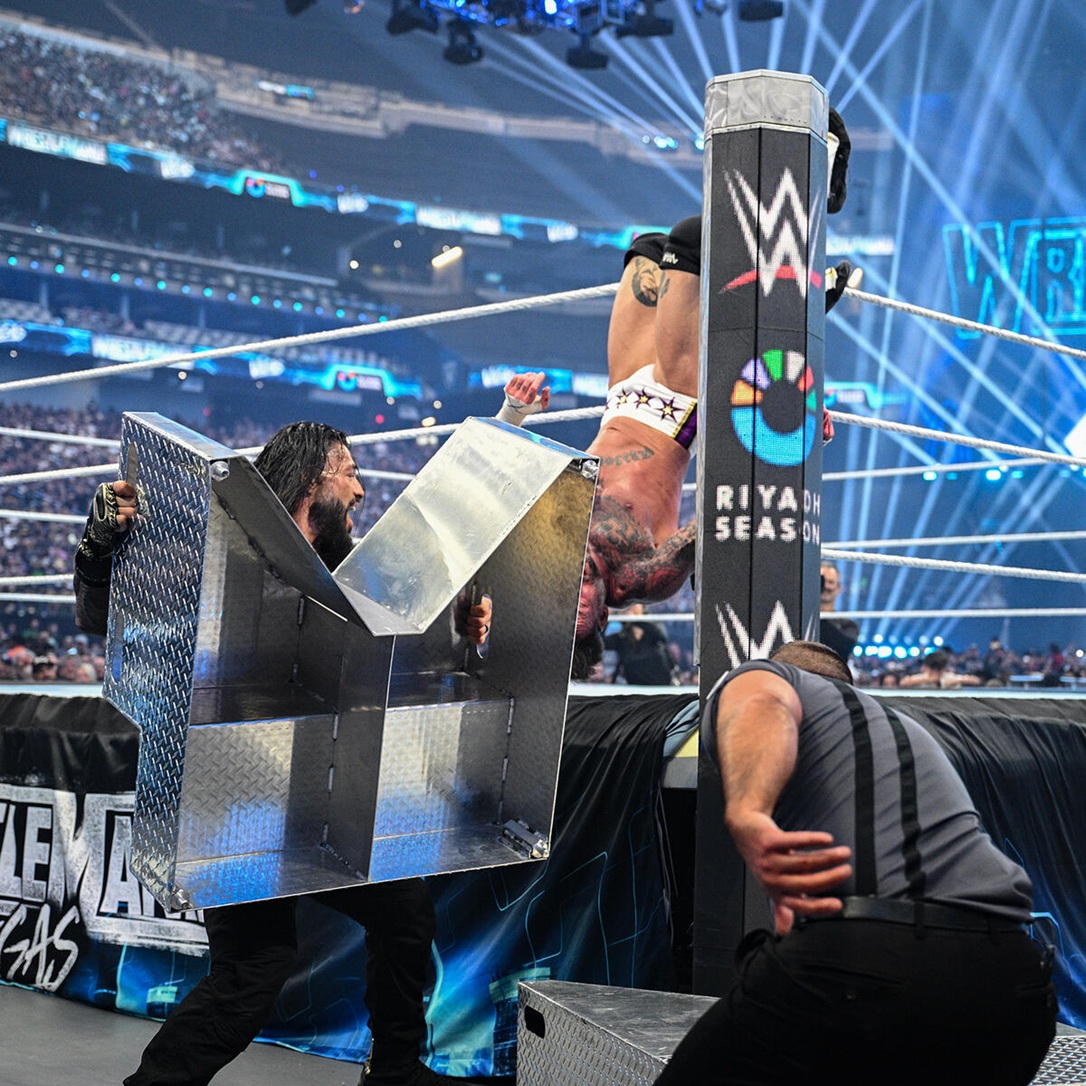

The match’s first major escalation came when Roman picked up the steel ring steps and used them as a weapon, with no disqualification from the official.
In any other context, this would be a complaint. The match should have ended right there. But the genre conventions of WrestleMania main events — and of the New Japan-style epics they’ve increasingly come to resemble — long ago established that referee discretion is a feature, not a bug. The ref allows what serves the story. And what served the story here was catharsis.
Throughout the build, Punk had crossed lines. He had brought Roman’s late father into the trash talk. He had dragged the Anoa’i family lineage into a feud that should have stayed professional. The audience, even the Punk loyalists, knew he had it coming. When Roman busted him open with the steps, it wasn’t a heel act. It was, for the people in the building who had been rooting for Roman, a long-awaited justice.
What followed was a powerbomb through the Spanish announce table that played as historical echo more than as a stunt. The visual called back, deliberately, to The Shield’s signature triple-powerbomb — the move that defined Roman’s earliest run in the company. The faction Punk had wanted Chris Hero to round out. The faction WWE built around its own pick instead. By executing a variation of that move on Punk, Roman was reclaiming his lineage. You may have helped sketch the outline, the move said, but I’m the one who became its ultimate expression.
The Technical Heart of CM Punk and Roman Reigns at WrestleMania 42
The middle of the match did something genuinely brave. It slowed down. It went to the mat. In the era of finisher-spam and dive-fests, an extended submission sequence in a stadium main event is a real risk — and the layout, widely reported to have been agented by Paul Heyman, found a way to make it land.
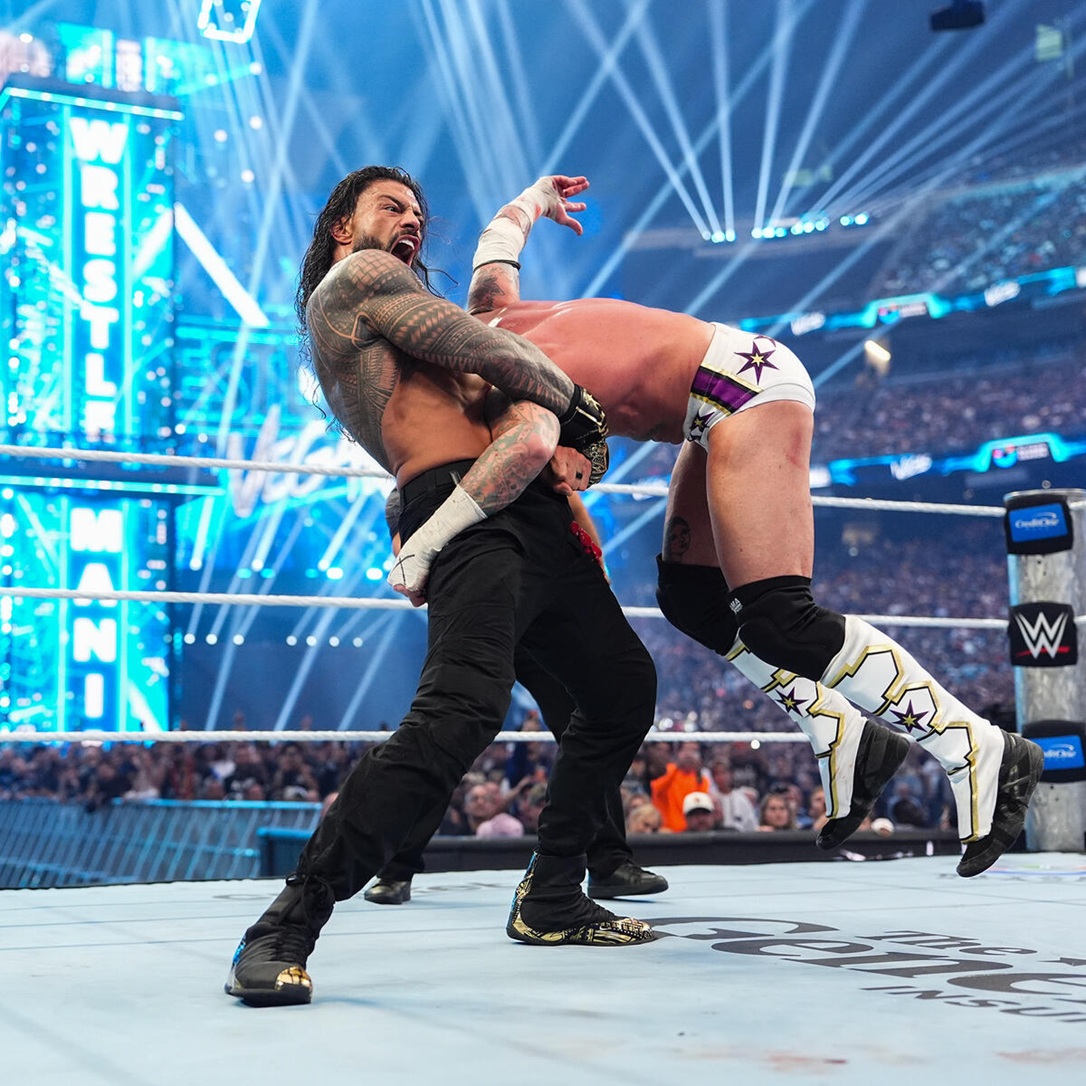
The story was told around Roman’s Guillotine choke. Punk escaped this hold not once, but three separate times, each escape with its own internal logic. The first was a simple rolling counter into a near fall — wrestling fundamentals, executed under duress. The second was a vertical headstand with a backward kick to free his head, a flourish straight out of the World of Sport tradition that Punk has always nerded out about. The third was a desperate forward-flipping pin attempt that forced Roman to break the hold to save his title. Three escapes, three different vocabularies, all telling the same story: Punk was the better technician, but he was running out of ways to solve the same puzzle.
When he finally locked in the Anaconda Vise, the building came to its feet. For a few breathless seconds, Roman Reigns — the man who has dominated the modern era like no one since Cena — actually teased the tap. He didn’t out-wrestle his way out. He punched his way out. The Tribal Chief reverted to his most fundamental advantage: he is bigger and stronger and angrier than you are, and eventually that wins.
The mid-match also gave us the great trope-collision moments — both men trying to win using each other’s signature offense. Roman attempted a GTS, Punk countered with a headkick that nearly ended the title reign right there. Punk responded by stealing the Superman Punch and even an Ula Fala gesture from a fan at ringside, two acts of pure provocation that walked him directly into the Guillotine. The “finisher theft” wasn’t decoration. It was the match articulating its central conflict: who actually owns the throne of star power in this industry, and what does it cost to try to take it.
There was even a Mongolian Chops exchange, which ended with Punk doing the unthinkable: he tried to headbutt a Samoan. The “Samoan head” gag is one of wrestling’s oldest comedy beats, but in this context, exhausted and twelve-rounds in, it played as tragedy. A reminder that even at his most cunning, Punk’s desperation was leading him into amateur mistakes.
The Wrist Tape and the Unthinkable
The match’s most theatrical sequence began with Punk slowly peeling off his wrist tape. The crowd, having been trained on Stone Cold Steve Austin and a dozen other “rolling-up-the-sleeves” babyface moments, leaned forward. They thought they knew what was coming. A bare-knuckle escalation. A Super Saiyan power-up. Something heroic.
Instead, Punk crumpled the tape into a ball and threw it at Roman’s chest.
It is the single most CM Punk gesture in the entire match. Not heroic, not triumphant. Petulant. Petty. The Chicago kid still showing through under the championship gold. A complete rejection of Roman’s aura that didn’t even bother to dress itself up in dignity.
But it was also misdirection. As the referee turned to clear the tape from the ring, Punk delivered a low blow and followed it with a GTS. The audience reaction was what wrestling people call a rolling pop — first a gasp at the audacity of a hero resorting to a heel finish, then an explosion when Roman, younger and fresher, kicked out at two.
This wasn’t a heel turn. It was a portrait of a man who had run out of options. Every layer of his game had been stripped away — the technical wrestling, the psychological warfare, the trash talk, the experience advantage. When even cheating couldn’t keep Roman down, the panic in Punk’s eyes was real and unmistakable.
What he reached for next was the unthinkable. Earlier in the match, the announcers had teased a top-rope elbow drop through the announce table, only to abort it — a move that read at the time as either creative cowardice or as a comment on Punk’s age. Here, with everything on the line, he climbed the corner one more time and made good on the threat. The flying elbow connected. The table imploded. The building lost its mind.
It was the kind of move that’s supposed to end matches. It didn’t end this one. It just hollowed Punk out further, took as much from him as it took from Roman, and made the eventual finish feel even more inevitable.
The Subverted Double GTS and the Kneeling Sell
The most sophisticated piece of in-ring writing in the entire match came in the closing minutes. Punk, dragging himself back into the ring, hit a second GTS. Roman, in a beautiful piece of selling, rebounded off the ropes and fell back onto Punk’s shoulders, perfectly set up for a second consecutive finisher.
If you’ve been following Punk’s career closely, you recognized the setup instantly. It is the exact sequence — the back-to-back rebound GTS — that he used to put away Jon Moxley in AEW and Seth Rollins in WWE. It is, in his vocabulary, the closer. The ender. The signal that the match is over and your guy has won.
Except this time, his body wouldn’t let him do it.
Roman’s weight collapsed Punk’s legs out from under him. The combination didn’t connect. The win condition that wrestling-literate fans had been conditioned to recognize was set up perfectly and then taken away — not by Roman’s defense, but by Punk’s own physical limits. He wasn’t out-wrestled in that moment. He was out-aged.
What followed was the sequence that has generated more discussion than any other. Roman hit the Spear. Punk, instead of falling flat to the canvas in the conventional sell, ended up on his knees — wobbly, dazed, eyes glazed, trapped in some terrible middle space between consciousness and collapse. Then he swung an enormous, sloppy, Terry Funk-style right hand at Roman that missed by an embarrassing margin and sent him face-first to the mat.
It was technically incorrect selling. The grammar of professional wrestling says you take a finisher and you go down. By staying upright on his knees, Punk was breaking the rules. But great writers, the ones who have learned to follow the rules, are allowed to break them in service of something bigger. The kneeling sell wasn’t a no-sell. It was a man whose mind refused to let his body quit, and a body that no longer had any idea what his mind was doing.
The three-count, when it came moments later, didn’t feel like a competitive defeat. It felt like a mercy.
Why It Saved WrestleMania
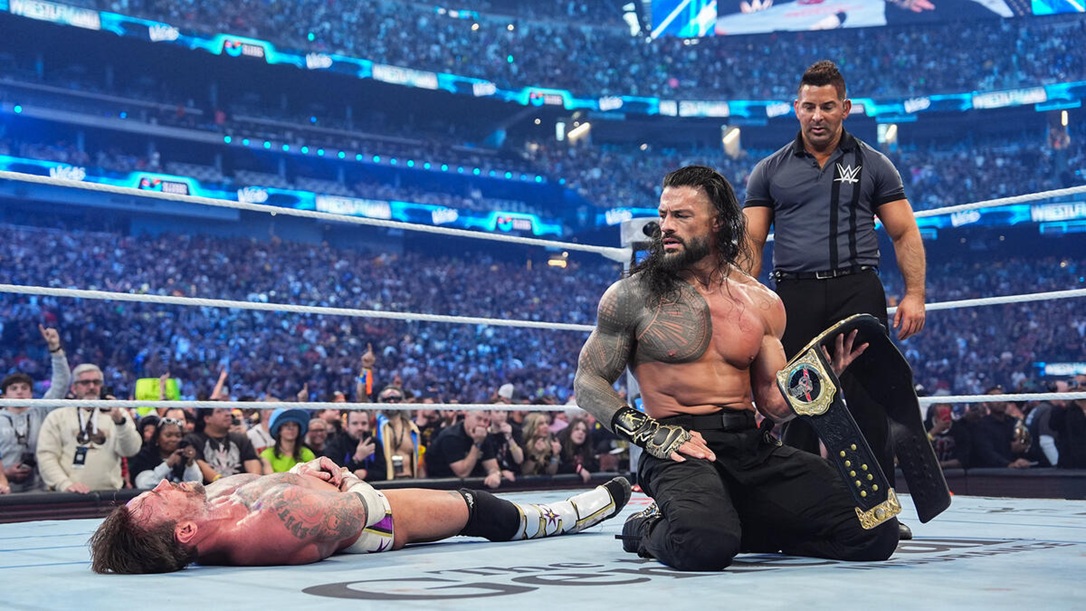
There is a kind of social-media wrestling discourse that immediately formed around this match — the takes accusing Punk of looking tired, of looking past it, of being unable to keep up. Those takes fundamentally misread what they were watching. He looked tired because that was the entire point. The story of the match was the story of a legend running out of time. The performance of exhaustion was the performance.
The validation came from the most reliable source available. Roman Reigns, who almost never breaks his Tribal Chief persona to publicly praise an opponent, broke it for this. When the final boss of the company tells you a match was something special, the work-rate complaints on Twitter become very small.
WrestleMania 42 will be remembered, fairly or not, as a card that needed saving. And it will be remembered as the night that Punk and Reigns saved it not with pyrotechnics, not with surprise run-ins, not with an avalanche of finishers — but with an honest, gritty, almost tragic story about a man trying to hold onto the sun for one hour too long.
That is what wrestling can do when it remembers what it is. It is a collaborative fiction in which two performers, given enough room and enough trust, can make us forget for thirty minutes that we are watching something choreographed. They can use age as an instrument. They can use a decade of buried history as subtext. They can break the rules of the form because they have spent their entire lives mastering them.
CM Punk versus Roman Reigns at WrestleMania 42 isn’t a great match because of the moves. It’s a great match because of what the moves were about. And in an industry that too often forgets the difference, that is the most valuable thing it could possibly be.
A modern classic, in other words. The phrase, for once, fits.