


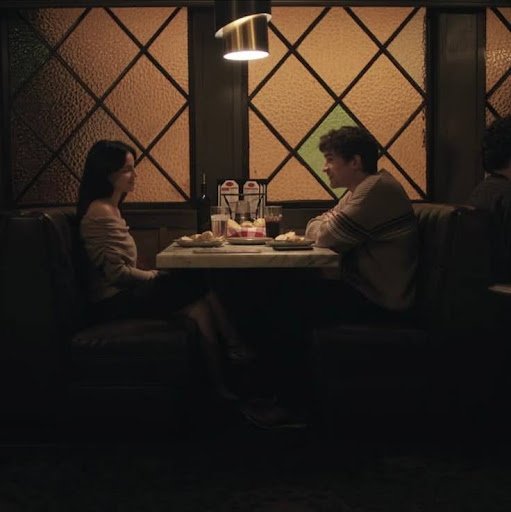


There is something unsettling about stories in which love is laced with magic. Across cultures, myths are filled with love potions, enchanted rings, divine interventions, and impossible wishes. At first glance, these stories appear to promise the ultimate romantic fantasy: to be loved completely, permanently, and without doubt. Yet they almost never end as romances, rather they end as tragedies, curses, or some mythical tales.
Curry Barker’s Obsession belongs to that genre.
Although the film presents itself as supernatural horror, its most horrific part is not the curse itself. It is the desire that makes the curse possible. Beneath its unsettling imagery lies a much older story I can think of right now, one that stretches back to Greek mythology and continues to shape the way we imagine romance today. The myth of Pygmalion, that kind of terribly foreshadows what Obsession becomes. It becomes a critique of one of Western culture’s oldest fantasies: the fantasy of creating the perfect beloved.
The myth of Pygmalion is often remembered as a love story. According to Greek mythology, Pygmalion, a gifted sculptor, grows dissatisfied with the women around him. Rather than loving a real woman, he carves one from ivory, shaping every detail according to his own ideal. The statue is so beautiful that he falls in love with his own creation. Moved by his devotion, Aphrodite grants his wish and brings the statue to life.
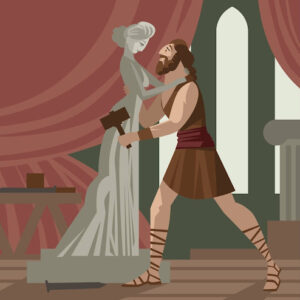

The story has traditionally been read as miraculous, a celebration of love rewarded by the gods. But from a contemporary perspective, the miracle is far more complicated. The narrative emerges almost immediately: it is Pygmalion who is given the power to define a perfect woman, and it is his desire to see a woman like he wanted to see. The perfect woman is not someone who exists independently; she is imagined, shaped, and ultimately brought to life according to a man’s vision of what she should be. The story invites us to celebrate his dream, but what happens when in reality, one person’s fantasy becomes another person’s whole existence?
The myth never asks. We never asked.
And let me be honest, in the movie, Bear’s desire was understandable at first. Like countless protagonists before him, he wants to be loved. Cinema has spent decades teaching audiences to sympathize with lonely men who long for impossible romances. We are used to watching desperate men ache for someone who cannot love them back, hoping their one-sided devotion will eventually be returned.
But Curry Barker slowly exposes the danger hidden inside that familiar fantasy. Bear does not simply wish that Nikki would choose him. He wants certainty. He wants a world in which rejection becomes impossible. In other words, he wants love without risk.
But love has always involved risks because it depends upon another person’s will. Someone can choose us today and leave tomorrow. They can misunderstand us, disappoint us, or reject us altogether. Those possibilities make love emotionally frightening, but they are also what make it meaningful. A relationship only carries value because both people remain free to continue choosing each other.
Someone can choose us today and leave tomorrow. They can misunderstand us, disappoint us, or reject us altogether. Those possibilities make love emotionally frightening, but they are also what make it meaningful.
As Nikki loses control over her own mind, the consequences become impossible to ignore. The forced obsession consumes her, leaving little of the person she once was. Yet Bear never stops to ask what this has done to her. Instead, he clings to the fact that she is finally with him. By asking, “What’s so bad about being with me?” he shifts the focus away from Nikki’s suffering and back to his own need for love and validation.
This is why the film feels strangely mythic. If Pygmalion had Aphrodite, Bear has the One Wish Willow. The Willow functions much like the cursed objects and enchanted trees found throughout mythology and folklore. It does not create desire out of nowhere; it simply grants what already exists in the heart of the person making the wish. Like the Monkey’s Paw or the countless fairy tales in which every wish comes with a price. His wish is granted, but only by stripping Nikki of the very thing that makes love meaningful; her ability to choose.
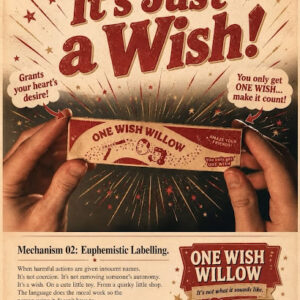
Across mythology and folklore, enchanted love was always there. Whether in medieval romances, or European folk tales, spells that manipulate affection don’t produce genuine intimacy. They produce compulsion, dependence, madness, or destruction. The lesson is remarkably consistent across centuries: emotions created through force cease to be emotions at all. Obsession modernizes that lesson. No wonder, Bear believes Nikki’s heart should be altered to satisfy his own loneliness.
This same fantasy has fascinated feminist scholars for decades. Women have often been positioned as “the Other,” existing primarily in relation to men’s experiences rather than as complete subjects themselves. They become wives, muses, mothers, lovers, or ideals before they are allowed to become fully autonomous individuals. Nikki’s transformation reflects that situation.
As the film progresses, what disappears is not only her independence but her interiority. We become less certain that her emotions belong to her. She gradually stops functioning as a person with her own desires and begins functioning as the fulfilment of someone else’s, by her constant memory lapse and screaming her heart out “it’s not me” says the same thing.
The similar thing appears in a recent book that I read, The Stepford Wives by Ira Levin, where independent, outspoken women are replaced with perfectly obedient robot versions of themselves. The wives are not loved for who they are but for who their husbands want them to become.
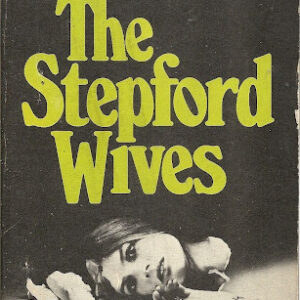
Their personalities, ambitions, and individuality are treated as flaws to be corrected rather than qualities to be cherished. Many romantic narratives celebrate a female partner who never leaves, never questions, never changes their mind, and never chooses differently. So the real horror is the delusional belief of some men that love becomes more perfect once a woman couldn’t just refuse anymore. Popular culture often presents this as emotional security. Obsession asks us to imagine what that same fantasy would actually look like if it became real.
Pygmalion never had the woman’s side of the story. His miracle is rather celebrated. But in Obsession, we are no longer watching the creator admire his perfect creation. The shift is subtle but profound.
The perfect beloved is a myth, not a person. We create flawless versions of those we desire because myths cannot contradict us, disappoint us, or walk away. Real love however, begins where the myth ends. It belongs not to perfection or certainty, but to the difficult everyday choice of loving someone who remains irreducibly human.