




I sometimes think the great tragedy of my generation is that we learned to look at ourselves before we learned how to be ourselves. Social media didn’t just give us the tools for self-presentation; it built the stage and left us there under a fluorescent light where every misstep was instantly witnessed and archived. I grew up inside this glow, carrying half-formed identities and fragile insecurities, long before I had the emotional vocabulary to name what it was doing to me. Some days I still don’t have that vocabulary, only a vague dizziness, as though the scrolling never stopped, even when the screen is dark. For most of my generation, community or a social structure devoid of social media didn’t even exist. Before we understood politics or desire, we were already absorbing outrage and curated bodies, even a colonial inferiority complex we could not yet place. Somewhere along the line, these platforms became not just tools but the atmosphere of our adolescence.
When I say my relationship with social media is complicated, it’s not an attempt at coyness. It’s a confession. Because the truth is that I am both exhausted by the constant noise and completely shaped by it. It is a dependency wrapped in disdain. I open Instagram before I brush my teeth, and then spend the rest of the day complaining about how drained and overstimulated I am. I hate how the algorithms manipulate me, yet I return to them for comfort, identity, community. It has rotted parts of my mind, no doubt, but whole rooms of my identity would be empty without it. I cannot deny that much of who I am, my tastes, my odd pockets of knowledge, my humour, my moral frameworks, my politics, even my private griefs, found articulation because somewhere, in some convoluted corner of the internet, someone else named the same thing. The internet made my world larger, long before I understood the dangers of being so visible and unguarded. I sometimes wonder what parts of me would exist if I hadn’t been online so early, so constantly, so vulnerably.
But I also know that without social media, I would never have seen Bangladeshi identity displayed so boldly on global stages. Growing up, the world felt like a pyramid tilted against us. Western aesthetics, politics, and narratives dominated our screens long before we had the capacity to question why. Being Bangladeshi meant being peripheral, the background character of global narratives. We were “developing,” “third world,” “problematic,” “inferior,” and “in need of “saving”—words inherited from the same systems that colonized us, and never saw us as protagonists.
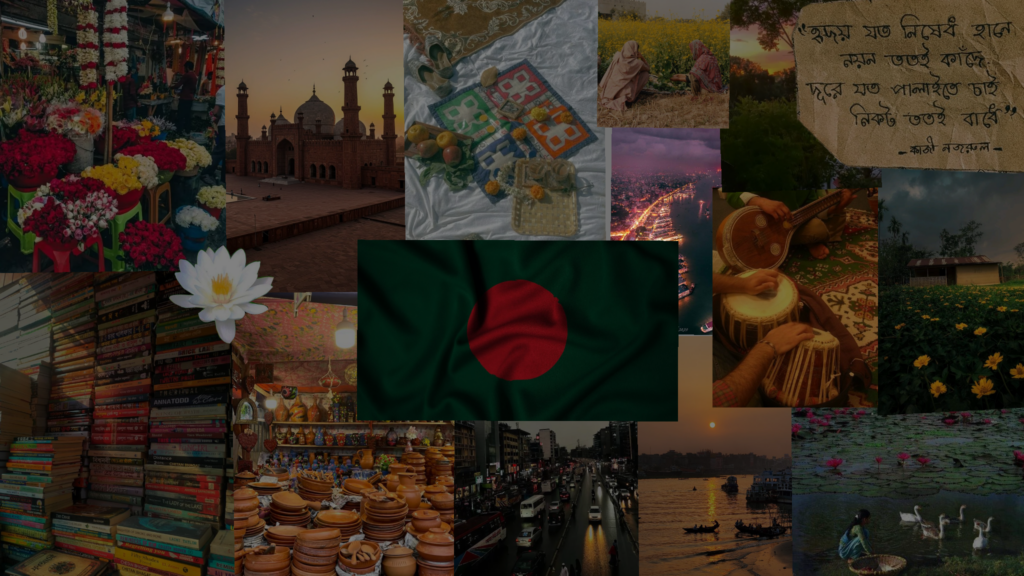
And then something extraordinary happened: local voices began to claim space online. Bangladeshi girls in cotton sarees appeared on TikTok and went viral in Brazil. Young poets wrote in Bengali and English and fragments of both, and strangers abroad shared their work with reverence. Bangladeshi music charted in global lists. Suddenly, the global gaze was no longer passing over us, it was stopping, lingering, appreciating. The validation was intoxicating, not because we needed Western approval but because for the first time, we were visible beyond stereotypes. Our chaos, humour, rituals, contradictions, art, music, and imperfections were finally part of the global conversation.
This is what deshi social media gave us: a mirror big enough to contain our complexity.
But complexity is rarely comfortable. The same platforms that empowered us also exposed the fractures within us, magnifying everything we resist acknowledging offline. The deshi internet is a creature of its own. It has its customs, its dialects, its particular rhythms of cruelty and camaraderie. It is a place where politics, patriarchy, pop culture, and personal ego bleed into one another until no one remembers where one ended and the other began. It is a vast emotional market, constantly open, constantly demanding. And I have lived long enough inside it to know it does not merely reflect our society; it accelerates it, distorts it, simplifies it, and weaponizes it.
It is a place where politics, patriarchy, pop culture, and personal ego bleed into one another until no one remembers where one ended and the other began.
The political toxicity alone could fill an entire dissertation. The Bangladeshi online ecosystem is a battleground thick with propaganda, manufactured outrage, misinformation, hyper-nationalistic fervour, sudden moral panics, and the daily performance of ideological warfare. I have watched polite and timid personalities in real life transform into miniature demagogues online, reciting party-approved lines with a zeal rarely found outside stadiums. The algorithm rewards this behaviour, anger travels faster than nuance, certainty performs better than doubt, and simplistic narratives fit more neatly into the architecture of a newsfeed.
The political pages, the troll farms, the extremist-religious groups, the propagandist meme accounts, they all thrive on this predictable psychology. It is not that Bangladeshi politics created online vitriol. It is that social media gave it an infinite amplifier and the illusion of consequence-free participation. What used to be whispered in tea stalls can now be broadcast to tens of thousands in seconds. And when something is repeated loudly and often enough, people mistake volume for truth. You begin to see a different Bangladesh online, one that is more polarised, more hysterical, more vindictive than the one you encounter on the street. Except, slowly, the online mood leaks into the offline world, and the two begin to overlap until you cannot tell which one corrupted the other first.
In this climate, the decay of empathy is not an accident; it is the logical result of a digital environment constantly rewarding mockery. I’ve watched meme culture, especially among deshi youth, descend into something almost feral. Sarcasm sharpens into mockery. Irony morphs into dehumanisation. Entire communities become punchlines. Tragedies become memes within hours. Harassment is disguised as humour, misogyny as “facts,” religious intolerance as righteous clarity. Someone’s private humiliation becomes public entertainment. The line between humour and cruelty evaporates. There is a kind of lazy amnesia at the heart of all this: no one remembers the harm caused twelve hours ago because there is always fresh content to consume. Consequences never arrive. Everything is content, and content is disposable. But the people in that content are not.
And then there is the Bangladeshi manosphere, which has metastasized into a digital subculture so pervasive that calling it a fringe group would be delusional. It exists at the intersection of half-digested religious dogma, imported Western misogyny, meme-page bravado, and a deep, unarticulated anxiety among young men who feel unmoored in a rapidly changing world. Most of them are not reading serious ideological texts or engaging in philosophical study. Young men, drowning under expectations they cannot meet, turn to the internet for answers and find creators who tell them that dominance is their birthright and that their failures are the fault of feminism, modern women, and “Western corruption.” They absorb these ideas through joke formats, TikTok lectures, YouTube sermons, viral snippets of pseudo-self-help, and bootleg worship of creators like Andrew Tate. It is masculinity not as a belief system but as a collection of memes: the “alpha male” and the “sigma grindset.” Each idea is delivered in less than 30 seconds, stripped of nuance, and drenched in patriarchal certainty.
Young men, drowning under expectations they cannot meet, turn to the internet for answers and find creators who tell them that dominance is their birthright and that their failures are the fault of feminism, modern women, and “Western corruption.”
The deshi version of this manosphere is uniquely shaped by our social insecurities. Joblessness, economic pressure, generational frustration, and a lack of healthy emotional outlets turn boys into easy targets for digital radicalisation. The algorithm sees the slightest flicker of insecurity and feeds it validation: videos that tell them they are superior by default, jokes that blame women for every disappointment, religiously tinted content that romanticises control and obedience. Before long, this curated feed becomes a worldview. And in this worldview, women are either saintly or sinful, never human. Boys who have never held a sincere conversation with a girl become self-appointed experts on “female psychology.” Online harassment becomes sport. Threats become performance. Patriarchal violence becomes aesthetic.
Men we expect to be harmless offline, defy expectations behind screens by parroting lines they barely understand. The internet gives them a dictionary of dominance, and they wield it with a kind of insecure confidence that would almost be funny if it weren’t so dangerous. Because online misogyny is never just online. In Bangladesh, the boundary between digital violence and real-world harm is alarmingly thin. Rumours spread, screenshots leak, private photos circulate, identities are exposed, and reputations are destroyed with no path to redemption. Lives have been shattered because a few anonymous adolescents needed entertainment. And when confronted, everyone shrugs it off as “It’s just online.” But there is nothing “just” about a world where humiliation can be permanent.
Yet I cannot dismiss the internet as a purely destructive force, not without lying to myself. Because for every hateful manosphere page, there is a feminist collective dismantling misogyny with wit and courage. For every hyper-religious hate group, there are diverse communities protecting each other’s freedom of thoughts and practices. For every troll farm, there is a grassroots fundraiser saving someone’s life. The same platforms that drain my empathy have also expanded it. I have found communities that taught me the shape of my own identity, exposed me to art and literature I would never have encountered in my physical surroundings, introduced me to people who feel like distant siblings.
The internet is merciless, but it is also miraculous.
And it is especially miraculous for those who have been silenced offline. For many marginalized people in Bangladesh, social media is not merely a pastime; it is survival. It is the only place to speak without interruption, to share pain without being dismissed, to imagine possibilities the real-world refuses to offer. Offline, they may be ostracised or silenced; online, they can be part of a collective imagination. I have seen people use Facebook groups to escape abusive households, to raise funds for medical emergencies, to pressure institutions into accountability. I have seen strangers offer comfort to other strangers at 3 a.m. with a sincerity that feels almost impossible outside the digital world.
But this duality, the intoxicating sense of connection and the slow erosion of inner quiet, is precisely what makes the relationship so exhausting. I know that doomscrolling is ruining my attention span, shortening the half-life of my emotions, weakening my capacity for sustained thought. I know the instant dopamine cycles are rewiring something delicate in my brain. I know the constant exposure to curated lives creates an impossible standard against which I measure myself. And yet, every day, almost without thinking, I open the apps again. The muscle memory is undeniable. It is not a habit anymore; it is an instinct.
Deshi social media is particularly punishing in this regard. There is a cultural expectation that one must be reachable, responsive, and visible. The group chats, the forwarding chains, the flood of greetings, the debating forums, the performative indignation, the unspoken social rule that leaving a group is a declaration of war. They demand constant participation, constant presence, constant negotiation of social etiquette. To opt out is to risk alienation.
Meanwhile, Instagram turns identity into a visual currency. Among deshi users, aesthetics matter almost as much as sincerity. There is an unspoken hierarchy of coolness maintained by filters, curated feeds, carefully angled photos from cafés, abstract captions hinting at inner turmoil, and silent stories signalling sophistication. Everyone constructs a version of themselves sharper, cleaner, and more cinematic than reality. And everyone knows this and still participates.
There is an unspoken hierarchy of coolness maintained by filters, curated feeds, carefully angled photos from cafés, abstract captions hinting at inner turmoil, and silent stories signalling sophistication.
YouTube, in contrast, is the kingdom of normalization. YouTube teaches people how to think without them realizing they are being taught. This is where misinformation spreads with the speed of wildfire: spiritual miracle claims, pseudo-political analyses, fabricated scandals, misogynistic sermons, conspiracies about feminists and foreigners. The commentary channels present themselves as truth-tellers while recycling the same prejudices that have plagued our society for decades. These creators become digital elders, the new uncles of the internet, passing down bad advice with absolute confidence.
And then there is the earliest platform most Bangladeshis joined: Facebook. The eternal giant, somehow still alive, still powerful, still shaping minds. Facebook is where our parents formed their political identities, where relatives post chain messages about morality, where school groups share exam leaks, where hate mobs assemble, where deeply disturbing communities can thrive, where meme pages weaponize humour, where businesses find a platform, where activism begins, and where shaming campaigns find their victims. It remains, paradoxically, both the heart and the underbelly of the Bangladeshi internet.
What frightens me most is how early we were exposed to all this. Childhood and adolescence are years defined by vulnerability, yet many of us experienced them under the unrelenting scrutiny of the digital world. Before our personalities solidified, we were already trying to perform them. The internet did not give us time to be privately confused, privately awkward, privately wrong. Every phase was public. Every insecurity visible. Every mistake searchable. How could this not distort something fundamental?
And so, I find myself caught in the same contradiction as everyone else: aware of the harm, yet unable to detach. My disdain for deshi social media is sincere, but so is my dependence. The platforms that drain me also sustain me. They are my window into the world and my cage. They are my teacher and my bad influence. They are the reason I discovered parts of myself, and the reason some parts of my mind feel permanently overstimulated. I have tried to take breaks, but the truth is that the internet is not something my generation logs into anymore. It is the backdrop of our lives, the place where identity, community, politics, economy, desire, and despair all converge.
I do not know if there is a solution. Perhaps the only honest stance is ambivalence. Perhaps the healthiest relationship one can have with deshi social media is to accept its contradictions: the intimacy and the violence, the connection and the alienation, the opportunity and the manipulation. It is a flawed mirror, but it is the only mirror we have.
Perhaps the healthiest relationship one can have with deshi social media is to accept its contradictions: the intimacy and the violence, the connection and the alienation, the opportunity and the manipulation.
There are days when I wonder what kind of person I would have been if the internet had entered my life later, if I had been allowed a childhood un-filmed, a self that developed away from constant comparison. But then I think of all the communities I would never have found, all the books and films I would never have discovered, all the people I would never have spoken to, all the ideas that would have passed me by. And I know, despite everything, I would not trade that.
Maybe this is what it means to be a deshi digital native, to hold both gratitude and exhaustion in equal measure. To navigate a world that overwhelms us yet reflects us. To mourn what we lost growing up too online, even as we celebrate what we gained. To critique the internet mercilessly while admitting that without it, we would be lonelier, quieter, less seen.
I no longer seek resolution in this tension. Perhaps the most honest relationship one can have with deshi social media is to accept it as a flawed companion, one that reveals our worst impulses but also amplifies our best. One that mirrors our violence but also our creativity. One that exposes our prejudices but also our potential.
We are a nation still grieving old wounds-colonial, political, cultural-and still learning how to narrate ourselves without apology. Social media, for all its chaos, gave us the microphone. We may not always use it wisely, but we are using it, and that matters. Because the moment we tell our own stories, we stop being shadows in someone else’s.
My relationship with deshi social media is not healthy, not virtuous, not simple. But it is real. And in a world where so much of our identity has been historically dismissed or distorted, reality-messy, contradictory, unromantic-might be the closest thing we have to liberation.