


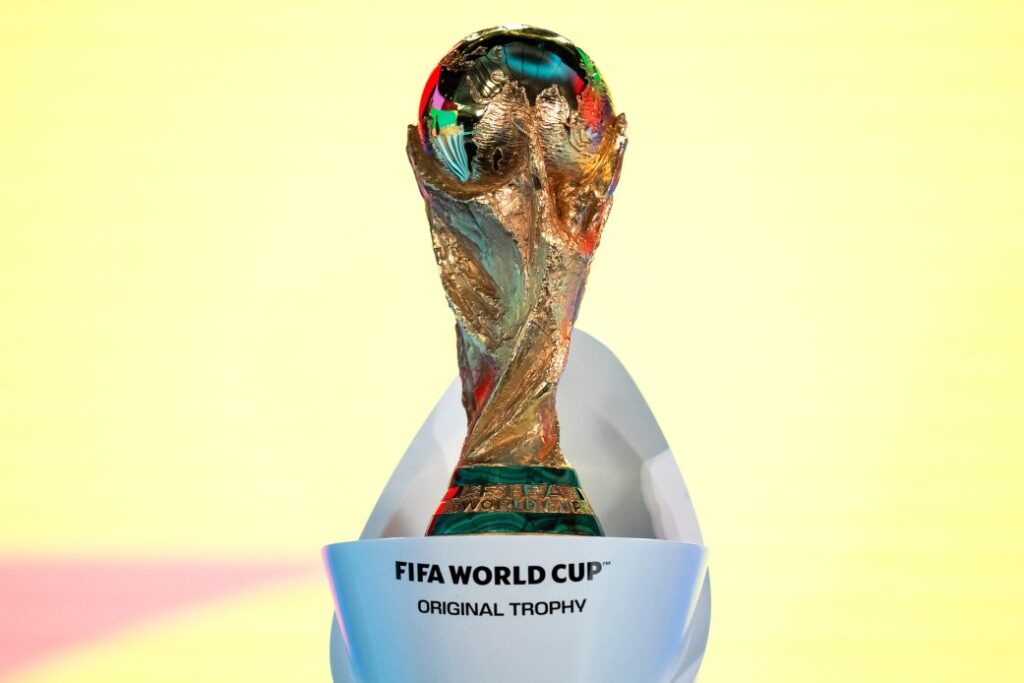


There is a particular kind of despair that descends on you when the spectacle you have loved your whole life starts to resemble the very forces it was supposed to offer an escape from. The FIFA World Cup, the planet’s most-watched sporting event and the tournament that has given entire nations a reason to believe in something, arrived in North America on June 11, 2026, with the uneasy aura of a celebration that no one was entirely sure how to feel about.
It is, depending on whom you ask, the biggest, most ambitious, and most inclusive World Cup in history. It is also, by almost every measure, the most chaotic, the most nakedly commercial, and the most politically compromised one ever staged. The two things, it turns out, are not contradictory. They are the same story, told from different angles.
To understand why 2026 feels like such a rupture, you need to understand something about the way the internet has changed what it means to be a football fan and, by extension, what it means to watch sports at all.
The Algorithm in the Stands
There is a theory, circulating with some force in the technology world, that sport is one of the few remaining arenas where artificial intelligence is genuinely powerless. Sam Altman, among others, has argued that no one will pay to watch robots or programs compete, that the irreducible human drama of athletic contests (the injury, the comeback, the choking under pressure) is precisely what machines cannot replicate. Sport, on this reading, is a sanctuary: the last thing that is inalienably and definitively human.
There is some truth in this. But the argument has a blind spot. It assumes the value of sport lies only in what happens on the pitch. It ignores the vast industrial apparatus surrounding that pitch: the governance, the ticketing, the broadcasting deals, the sponsorship arrangements, and the geopolitical negotiations, all of which have long since ceased to have anything to do with the drama of eleven versus eleven. And it is here, in the apparatus, that the 2026 World Cup has become something altogether different from what the romantic account of football would have you believe.

For decades, the World Cup arrived on our screens pre-packaged in mythology. The games were the main focus. The controversies, the corruption, the bribery, and the host-nation selection scandals existed on a separate track, reported in separate columns by people who covered business and politics rather than sport. Football journalism and football criticism occupied distinct registers. Fans were invited to bracket their misgivings and simply watch.
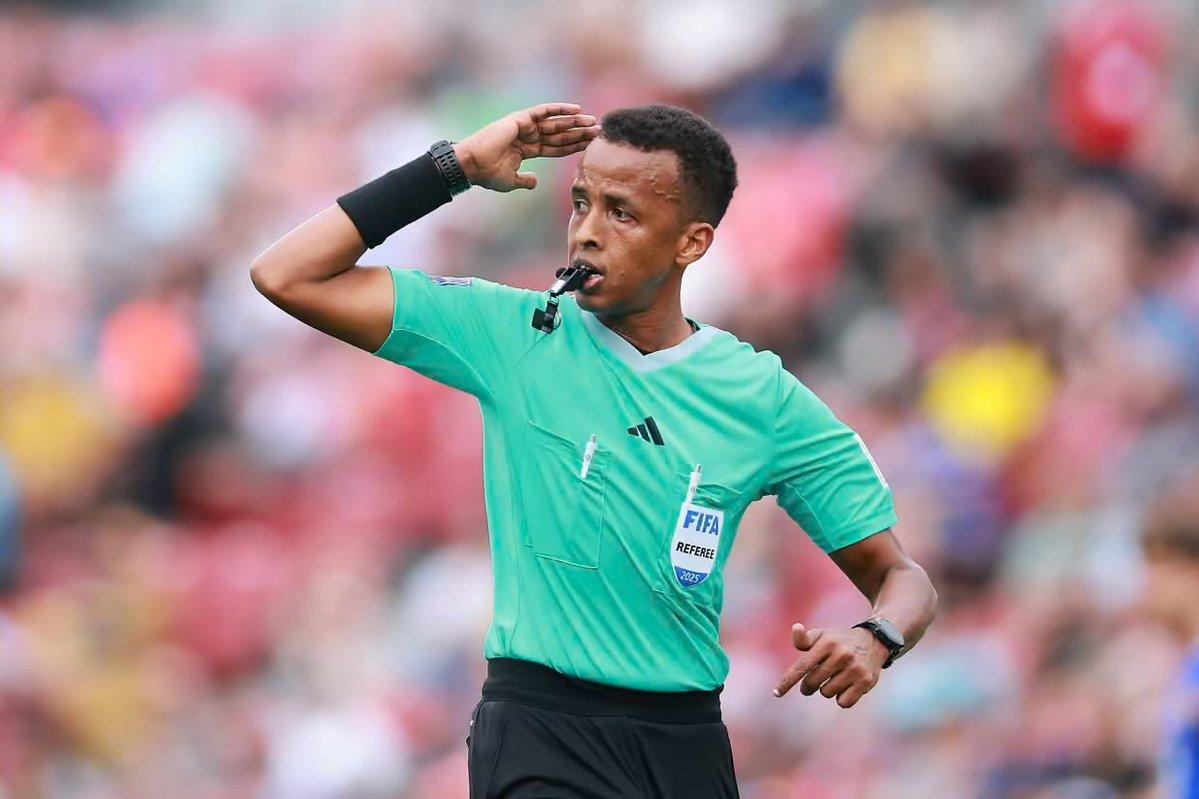
The internet, and specifically social media in its current hyper-curated, algorithmically supercharged form, has made that bracketing impossible. In 2026, the same person who watches the opening match also scrolls through a viral reel showing members of the Senegal national team being subjected to lengthy security searches at an American airport. They read a thread explaining that Omar Abdulkadir Artan, named the best African referee of 2025 by the Confederation of African Football, was turned away at Miami International Airport by US Customs and Border Protection, which offered no explanation other than “vetting concerns.” They watch a clip of the Uzbekistan squad being inspected by bomb-sniffing dogs, a scene so grotesque in its symbolism that it went viral internationally within hours.
This is what is new. Not the outrages themselves; those have always been there. What is new is the inability to unsee them.
The Tournament of Exclusion
“On one hand, it has more teams than ever participating. On the other hand, because of the policies of the Trump administration, it looks more like a World Cup of exclusion than inclusion.” – Jules Boykoff, author of Red Card: The 2026 World Cup.
Let us be precise about what happened in the days before the tournament kicked off, because precision matters when the events in question are being contested and minimized in real time.
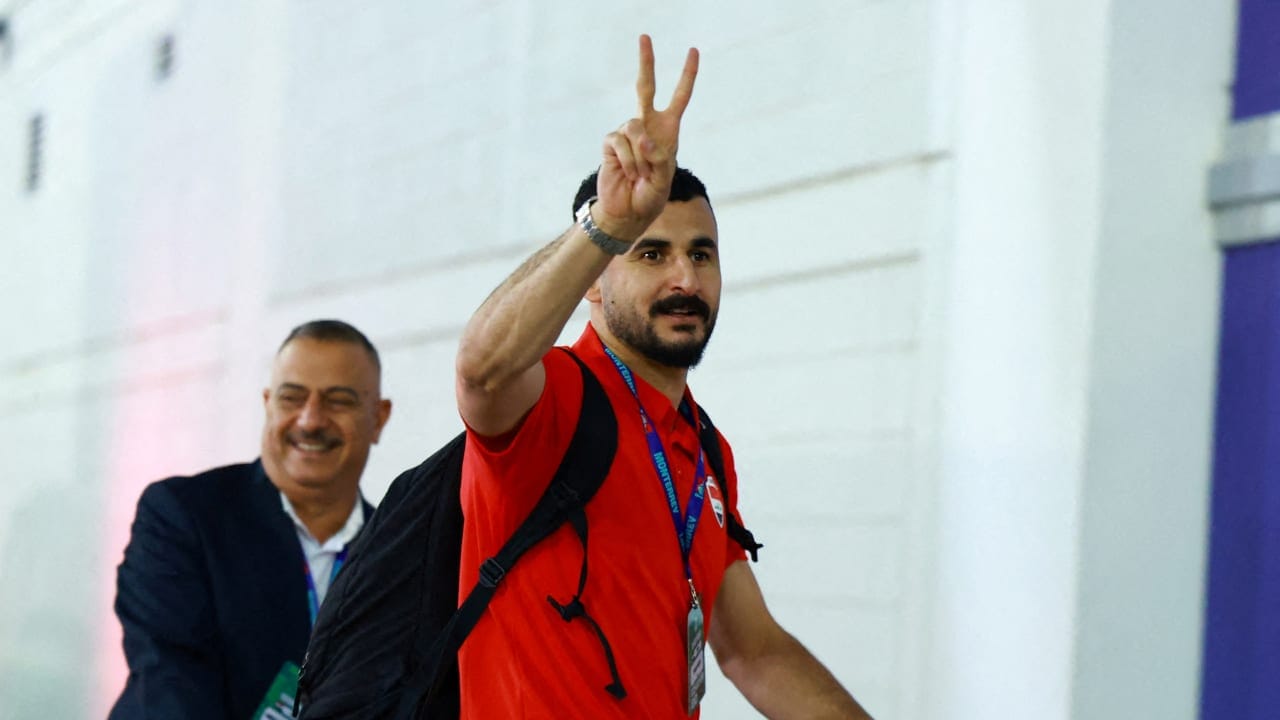
The Swiss footballer Breel Embolo had his visa placed under review and was only able to join his team days before the group stage began. Aymen Hussein, a leading player for Iraq, was held at a US airport for nearly seven hours. The Iranian national team spent days navigating visa procedures at the US Consulate in Turkey; the United States ultimately permitted their entry only on match days, while fifteen members of the delegation were denied visas outright. The South African squad arrived significantly later than planned because part of their delegation could not obtain travel documents in time. Scottish supporters, eligible under the ESTA visa-waiver program, had their travel authorizations revoked just days before departure, leaving many with non-refundable flights and hotel bookings and no recourse.
And then there was Omar Abdulkadir Artan. A decorated FIFA referee traveling on a diplomatic passport. Denied entry. Sent home. The White House’s executive director for the World Cup task force, Andrew Giuliani, said the decision was taken “for very good reasons” but provided none. FIFA announced Artan would not officiate at the tournament. No appeal, no process, no explanation.
Amnesty International, in a report issued before the tournament began, described the situation with characteristic precision: the US had deported more than 500,000 people in 2025 alone, more than six times the number of people who will watch the World Cup final inside the MetLife Stadium. ICE agents, the report noted, had been explicitly not prohibited from operating inside World Cup venues, meaning foreign fans had no guarantee of safety from immigration enforcement even inside a stadium. The human rights campaign group called it the most exclusionary World Cup in the competition’s history.
Jules Boykoff, a political scientist at Pacific University, former professional footballer, and author of a book on this very tournament, put it with the economy of someone who has spent a career watching sport weaponized for political ends: “I view the 2026 World Cup as a massive paradox. On one hand, it has more teams than ever participating. On the other hand, because of the policies of the Trump administration, it looks more like a World Cup of exclusion than inclusion.”
The tournament has expanded to 48 teams for the first time, a genuinely historic broadening of the competition’s geography. And yet the broadening is essentially theoretical for any fan from a country on the US travel ban list, which encompasses Iran, Haiti, and others, who wishes to travel to the games. You have qualified. You simply cannot come and watch.
The Peace Prize
It would be easy to present what follows merely as farce. It is farce, certainly. But it is also something darker, and it is worth tracing the anatomy of how it happened.
In December 2025, FIFA President Gianni Infantino stood at the Kennedy Center for the Performing Arts in Washington, D.C., and presented Donald Trump with what he called the “FIFA Peace Prize: Football Unites the World.” It was a gold-plated trophy. An engraved certificate. A medal. The prize had been announced three weeks earlier, notably after Trump had been passed over for the Nobel Peace Prize in favor of Venezuelan democracy campaigner María Corina Machado.
There was no published list of criteria. No independent jury. No shortlist. No record of the prize ever having been discussed with FIFA’s council. It simply appeared, as Infantino’s inventions tend to do, fully formed and already bearing its recipient’s name.

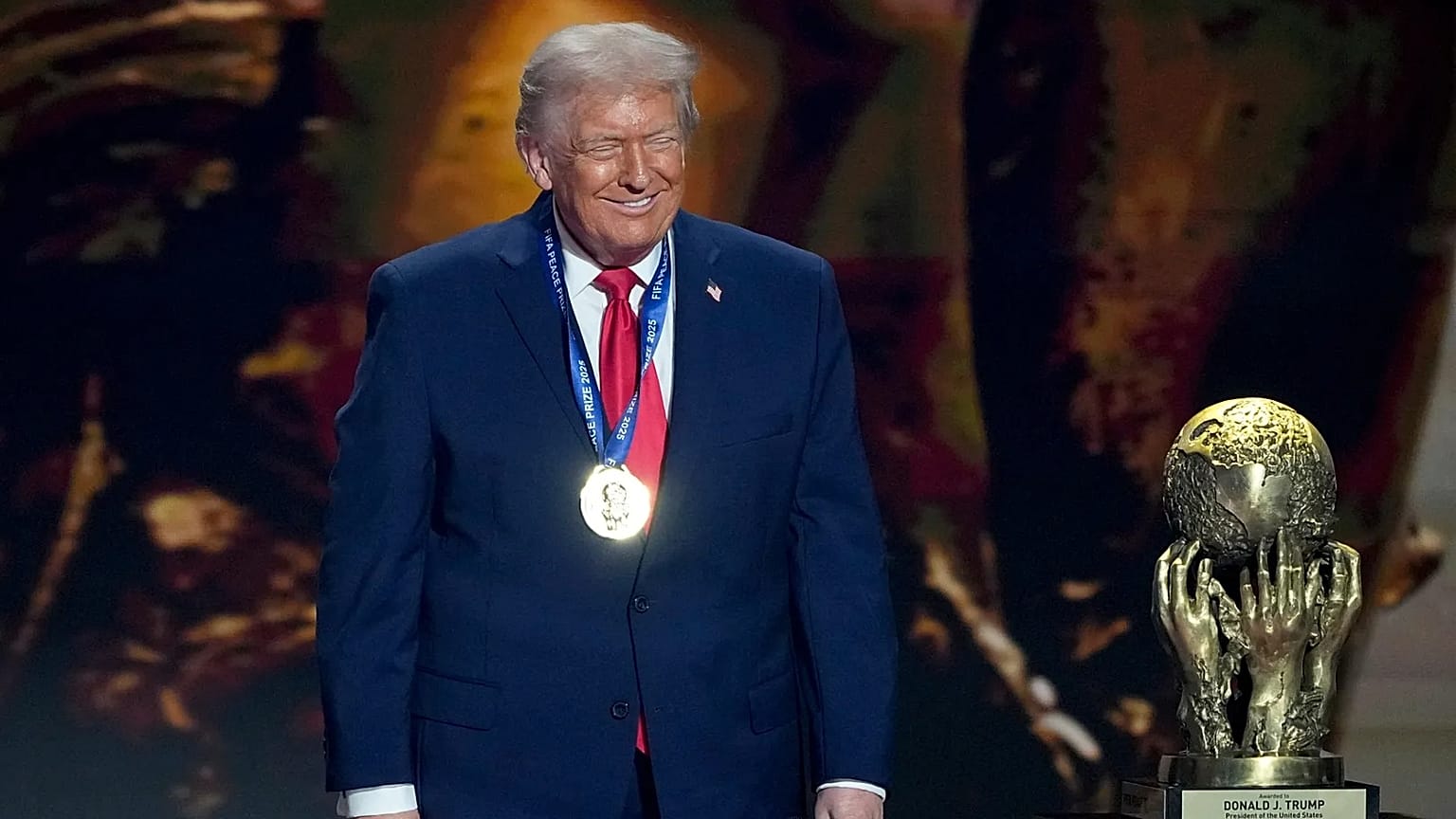
“You can always count, Mr. President, on my support and the entire football community,” Infantino said at the ceremony, “to help you make peace all over the world.” Trump received the trophy and called it “truly one of the great honors of my life.”
The Norwegian Football Federation’s president Lise Klaveness, a human rights lawyer by training, was among the first to respond in formal terms. Norway backed a complaint filed by the human rights organization FairSquare, which alleged that Infantino had breached FIFA’s own code of ethics by endorsing a sitting political leader, thereby compromising the political neutrality the organization is obligated to uphold. Australian midfielder Jackson Irvine said FIFA had made a mockery of its own Human Rights Policy. The award, FairSquare’s program director Nicholas McGeehan said, was about far more than Infantino’s support for Trump’s political agenda: it was about “how FIFA’s absurd governance structure has allowed Gianni Infantino to openly flout the organization’s rules and act in ways that are both dangerous and directly contrary to the interests of the world’s most popular sport.”
The peace prize looks even more surreal in retrospect. Infantino had, per The Daily Beast, confected the award partly to smooth FIFA’s working relationship with the White House and partly because Trump had long coveted the Nobel and never received it, and Infantino, always a reader of rooms, sensed an opportunity. That opportunity has since been complicated by a rather considerable development: the United States launched military strikes against Iran, a country that had qualified for and was scheduled to compete in the very World Cup Infantino had built his relationship with Trump around. Trump, asked whether he cared about Iran’s participation in the tournament, told Politico: “I really don’t care. I think Iran is a very badly defeated country. They’re running on fumes.”
Iran’s football federation president Mehdi Taj, for his part, said: “What is certain is that after this attack, we cannot be expected to look forward to the World Cup with hope.” Iran eventually played. Their base relocated to the Mexican city of Tijuana since the United States refused to host the squad between matches. A World Cup nation, playing in a World Cup, but camping in a different country.
What a Ticket Costs
If the immigration crisis represents the political face of 2026’s contradictions, the ticketing scandal represents the economic one and, in some ways, the more instructive failure because it reveals precisely who football’s governing body believes the sport is for.
FIFA introduced dynamic pricing for a World Cup for the first time in 2026, deploying the same algorithmic demand-based pricing model familiar from airline tickets, hotel rooms, and, most infamously, the Oasis reunion tour. Tickets initially ranged from roughly $140 to $8,680. For the final at MetLife Stadium in New Jersey, premium seats reached nearly $16,000 on FIFA’s official platform; on the secondary market, prices touched $33,000, with some resale listings reportedly approaching $2 million.
The dynamic pricing model raised costs by an average of 35 per cent across 95 of the tournament’s 104 matches. FIFA, meanwhile, collected a 15 per cent surcharge on each sale and a further 15 per cent on any resale. The organization, nominally structured as a not-for-profit, is expected to pocket around $3 billion from ticketing alone, representing approximately 27 percent of its total tournament revenue. Historically, ticketing has accounted for between 10 and 15 percent of a World Cup’s take.
The most visible consequence has been an extraordinary backfire. As kick-off approached, nearly 180,000 tickets appeared on FIFA’s official resale platform, while thousands more remained unsold on the primary ticketing site. The scalpers and speculators who had hoovered up tickets in bulk, betting correctly that demand for football’s most prestigious event would be insatiable, found that the demand did not materialize or materialized at prices that even the wealthy considered excessive. The stands at several matches were noticeably sparse in the days before the tournament began.
“It’s a real concern that you might have a world where stadiums, instead of being full of vibrant and excited fans, are instead full of rich people on their phones taking selfies for their influencer accounts.” – Victor Matheson, Professor of Economics, College of the Holy Cross.
Victor Matheson, an economist at the College of the Holy Cross who studies the sports industry, put the anxiety plainly: the risk is that you end up with stadiums full not of supporters but of wealthy spectators whose primary relationship with the occasion is photographic. It is a vision of football that would have been almost inconceivable to the sport’s founders or, for that matter, to the working-class terraces from which the global support base of the game has historically drawn its energy.
Former FIFA governance chairman Miguel Poiares Maduro, who spent years inside the organization attempting to reform it from within, told ABC News that the dynamic pricing debacle was simply the most visible symptom of a deeper pathology. “You have a sport that is becoming increasingly an elite sport,” he said. Maduro’s characterization of FIFA’s approach, commercial interests categorically overriding fan interests, was essentially an admission from the inside that the reform project had failed.
The New York and New Jersey attorneys general launched a formal investigation, subpoenaing FIFA for internal communications about ticket sales at MetLife Stadium. The word used by critics, with notable frequency, was “extortionate.”
The Selective Conscience of the Beautiful Game
The hypocrisy question is perhaps the most uncomfortable, because it requires looking not only at institutions but also at individuals: at the players who are the visible face of the sport and at the fans who love them.
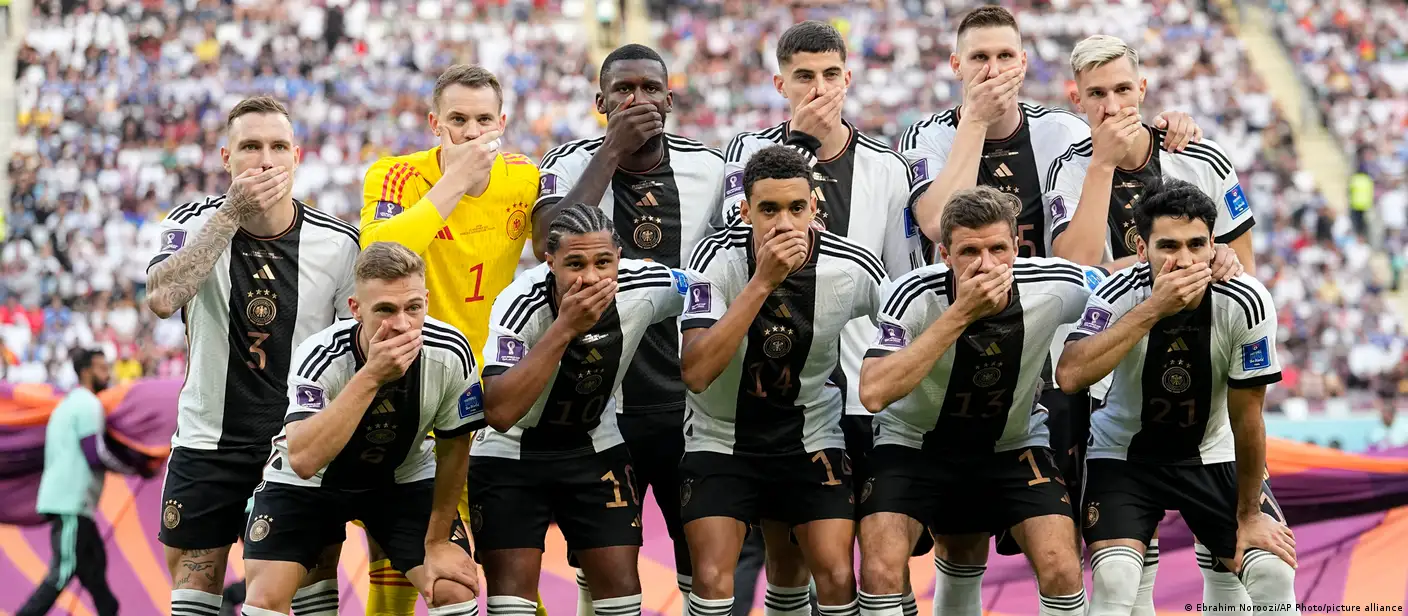
In November 2022, ahead of Germany’s opening match at the Qatar World Cup, the German national team posed for their pre-match photograph with their hands covering their mouths. “Human rights are non-negotiable,” their federation had said. “Denying us the armband is the same as denying us a voice.” Seven European nations had planned to wear “OneLove” rainbow armbands in solidarity with LGBTQ communities in a country where homosexuality is illegal. When FIFA threatened sporting sanctions, the plans collapsed, but the gesture of covered mouths remained, a moment of symbolic defiance that was covered extensively and praised widely.
Four years later, Germany’s sporting director Rudi Voeller urged his players to “keep sport and politics somewhat separate” ahead of 2026 and confirmed there would be no specialist media training around political statements, as there had been before Qatar. The players, Voeller noted, were “fully aware of the situation.” The implication was clear: they were aware, but they were saying nothing.

This is not entirely surprising. Germany captain Joshua Kimmich had already laid the groundwork for the retreat in late 2024, telling reporters that he regretted the team’s political stance in Qatar: “It took a bit away from the joy of the tournament. We expressed political opinions.” The protests had, in this reading, been a mistake—not because they were wrong on the merits but because they were distracting.
One might extend some sympathy for the difficulty of the position; these are footballers, not politicians, and the expectation that they consistently carry the moral weight of global geopolitics is genuinely unreasonable. But the contrast is illuminating precisely because the Qatar protests were so loudly celebrated as proof that athletes were awakening to their responsibilities. The silence in 2026 suggests what those responsibilities were contingent on: a host country sufficiently easy to criticize. Qatar, a small, authoritarian Gulf state, offered a comfortable target. A superpower, on the other hand, requires a different kind of risk calculation.
The Ronaldo Problem
Somewhere in the background of all of this, surfacing and receding in the discourse like an object caught in a tide, is the question of Cristiano Ronaldo.
The context is well-established but worth stating plainly: in 2009, Ronaldo was accused of rape by Kathryn Mayorga, an American model who says the incident occurred in a Las Vegas hotel room. Mayorga signed a non-disclosure agreement and accepted a financial settlement. She later filed a civil lawsuit, alleging she had been coerced into the agreement. A US federal judge dismissed the case in 2022, citing procedural grounds relating to how documents used by Mayorga’s lawyer had been obtained. The decision was not a finding on the merits of the allegations. Ronaldo has consistently denied the allegations. The case has never been adjudicated on the facts.


What has resurfaced ahead of 2026 and what has circulated again on social media with renewed virality is the broader question of how elite football processes allegations of this kind and whether the sport’s celebrity machinery functions to insulate its biggest stars from accountability that anyone else would face. The contrast with how the game treats, say, a player who speaks critically of a referee or a federation is instructive: the sanctions are swift, and the discourse is universal. The contrast with how Ronaldo’s situation has been handled within official football structures, functionally ignored and bracketed as a private legal matter entirely separate from his sporting career, speaks to a hierarchy of what football decides to take seriously.
Ronaldo was playing at the World Cup. The last time he played in the United States was 2014. For nearly twelve years, he avoided the country. Now he was here, playing under a tournament banner that proclaimed football as a vehicle for unity and peace.
The internet does not forget. It resurfaces. That is the condition of the current moment in sports: nothing is ever fully bracketed. The viral reel keeps coming back.
Involuntary Sportswashing
There is a concept that scholars of sport and politics have been circling for some time: “involuntary sportswashing.” The original term, “sportswashing,” refers to the deliberate use of sporting events to launder the reputation of authoritarian governments or institutions and to redirect attention from human rights abuses through the spectacle of athletic competition. Russia 2018. Qatar 2022. The model is well understood.
What 2026 introduces is something more perverse: a country that is generating negative publicity for itself through the staging of the tournament. The “sportsbashing,” as one analysis has called it. The US is not deploying the World Cup to soften its image; the World Cup is, in fact, serving to expose and amplify the image it actually projects. The immigration apparatus being trained on referees and players from the Global South. The economic exclusion of working-class fans. The president receiving a made-up peace prize. The military strikes against a competing nation. As Minky Worden of Human Rights Watch observed, this was supposed to be the first World Cup with a formal human rights framework; instead, it has become “defined by exclusion and fear.”
There is something additionally strange about the Saudi Aramco dimension of this tournament: FIFA struck a four-year, $400 million lead sponsorship deal with the Saudi state oil company, announced in 2024, making one of the world’s largest fossil fuel producers the official backer of the world’s most-watched sporting event. Scientists for Global Responsibility estimates the tournament will generate over nine million tonnes of carbon dioxide equivalent, almost double the average for previous World Cups, primarily from air travel across three host countries spanning thousands of miles. Football is, in the material sense, accelerating the climate crisis it officially claims to take seriously.
Yet the show goes on. It will always go on. FIFA’s tournament is too large, too financially entrenched, and too emotionally invested in by too many billions of people to be stopped by any single scandal or by the accumulation of all of them.
The Fan We Are Now
What has changed, and this is the crucial irreversible thing, is the fan.
The internet has not made football fans more cynical than they were before. It has made their cynicism visible to each other, and it has made the gap between the official narrative of the sport and its material reality impossible to sustain in the way it once was. When a World Cup is staged, it used to arrive in your living room already processed: the montages, the anthems, the commentary of universal celebration, and the deliberate emphasis on football and nothing else. That packaging still exists. But it now competes with an infinite counter-programming of context, analysis, testimony, and outrage, and that competition is increasingly one-sided.
The fan watching the 2026 World Cup is not a simpler, less sophisticated version of the fan who watched 1994 or 2006. She is someone who simultaneously experiences the game and its conditions of production. She can watch a goal and, within the same scroll, encounter a thread about the airport detention of the Iraqi team’s striker, a graphic showing the carbon footprint of the tournament compared to previous editions, and a clip of the press conference where Gianni Infantino explained that the dynamic pricing mechanism was simply “the invisible hand of market economics.”

This is a fundamentally different mode of spectatorship. It is not, as some would have it, the ruination of sport, the joyless politicization of something that should be purely pleasurable. It is the honest account of what sport has always been: a cultural practice embedded in power relations, economic structures, and geopolitical realities. The mythology of pure sport, of the beautiful game untouched by the ugliness of the world, was always an invention. The internet has simply made that invention harder to maintain.
What follows from this recognition is not yet settled. There is no consensus on what a fan owes the sport or what the sport owes its fans or whether the correct response to institutional corruption is boycott or continued engagement or something more nuanced and harder to name. The discourse is fractious, frequently exhausting, and prone to the excesses of any online conversation about something people care about deeply.
But the conversation is happening. That, in itself, is new. And it is not going to stop.
The Match Itself
There is a counter-argument to everything above, and it deserves to be taken seriously. Football, when it happens, is extraordinary. The expansion to 48 teams has brought new footballing nations to the world stage for the first time. The stadiums—whatever their logistical complications—are enormous and spectacular. The narratives that emerge from the group stage and the knockouts will be genuine and unpredictable and moving, in the way that only sport can be.
None of the structural critiques of the tournament will diminish the feeling of a last-minute goal, or the slow-motion grief of a penalty shootout, or the way a player’s face can carry the weight of an entire nation’s hope. Sam Altman is right about this much: no algorithm will reproduce it. The irreducible human drama of athletic competition remains, and it belongs to no government or corporation.
The 2026 World Cup is not, in the end, simply a story of institutional failure. It is a story about what happens when the most beloved and universal thing in the world, a sport that genuinely unites people across every conceivable division of language, class, and culture, is administered by people who have decided that its commercial and political potential matters more than its soul. The sport survives this, as it has always survived. The question is not whether the football endures. Football always endures.
The question is whether we are finally honest about the conditions under which it is staged and whether that honesty changes what we demand of the people who stage it.
In June 2026, the matches are being played. The goals are being scored. And millions of people are watching, knowing more than any World Cup audience has ever known about what lies behind the spectacle, and watching anyway, with their eyes open and their illusions, at last, somewhat frayed.