




The corridor outside the main lecture hall pressed in like a sauna. Akib’s shirt—some polyester blend the label had promised would wick moisture—stuck to his chest in transparent panels. The pattern of his undershirt showed through. Dhara leaned against the wall, clutching the handouts. Her eyelids drooped, the rims faintly red from the all-nighter. She’d swapped her usual green for a soft blue, local-made, already dark under the arms. Kabbo vibrated from three cans of Monster, knees jiggling as he ripped the seal on number four. The tab popped, metallic echo down the tiled corridor.
They looked hazed. Akib had lost his tie somewhere between the canteen and the faculty quad. His collar bent, one side higher than the other. Dhara’s hair, which usually coiled tight as phone wire, hung in loose waves, the baby hairs on her temple surrendering. Kabbo wore his exhaustion openly—sweat circles under each armpit, teeth stained orange from the energy drink.
Ahead, the lecture hall doors yawned. Light spilled onto the floor, fluorescent and clinical. From inside, the tap of a gavel against wood, then Dr. Farzana’s voice, crisp enough to shave with: “Next group, please.”
One team ahead of them. Samara and her wolves.
Akib tried to keep his breathing slow. He forced his eyes from the scuffed floor tiles and looked at Dhara. She double-checked the staple on her handouts, running her thumb along the edge until it caught and bent the metal flat. Her jaw flexed. She didn’t look up.
Footsteps. Heels on tile, approaching in perfect cadence. Akib recognized the rhythm before he saw her—Samara, leading her cohort like a CEO at a shareholder meeting. She wore a suit the color of midnight, tailored within an inch of her life, the lapels so crisp they looked laser-ironed. The girls behind her matched in softer, expensive pastels. All of them smelled faintly of oud, the expensive kind that left a vapor trail.
Samara stopped, smiled with unblinking teeth, and produced a travel-sized pack of tissues from her bag. She peeled one off the stack, offered it to Dhara.
“You’re glowing, sweetie. And by glowing, I mean sweating. It’s murder in here, isn’t it?”
Dhara’s mouth twitched. She accepted the tissue, dabbed the side of her face with a single, precise motion, and tossed the balled-up wad into the nearest recycling bin.
“Thanks,” Dhara said, voice sandpaper rough. “You might need the rest after you see our slides.”
Kabbo choked down a laugh. Samara’s eyes flicked to Akib, then back to Dhara. “Confidence. I love that for you guys.” The plural landed heavy, weighted.
Behind Samara, one of her minions checked her phone and whispered something. Samara inclined her head toward the doors. “Best of luck. But take it from someone who’s been through Iron Lady’s presentation rounds—she hates puns. If you’re going with that ‘Daddy in the ICU’ thing, maybe dial it back a notch? Farzana isn’t a fan of memes.”
Dhara’s lips parted. Then the doors swung open and the trio from Samara’s group filed in. Their shoes made no sound on the polished stone.
Akib took a breath. Inhaled the scent of his own deodorant, which had surrendered hours ago, leaving only a faint citrusy ghost. He checked his phone. No new messages, no last-minute tips from Siraj, even though Akib had texted “pls send cheat sheet” three times since dawn.
The doors sealed with a pneumatic thump. Samara’s team was up on the dais, their formation geometrically perfect—Samara centered, two lieutenants flanking, one on slides, one on support. The display screen behind them flickered. HungerDash Prime. The logo hovered in negative space, every pixel placed with surgical intent. The font felt more expensive than their shoes.
Akib squinted, tried to focus. The first slide barely had words. A single, high-resolution image: a drone, chrome and blue, slicing through a cartooned traffic jam. Underneath, the tagline: “Why Wait for Tomorrow’s Delivery, When You Can Eat It Tonight?”
Samara’s voice, amplified and caramel-smooth, rolled across the room. “Distinguished faculty, fellow entrepreneurs. We are HungerDash Prime: the future of instant food logistics in urban Bangladesh.”
She clicked. The next slide exploded in a soft beige gradient, overlaid with three icons: a clock, a burger, a drone. “Speed. Quality. Innovation.” The icons pulsed one after another. She’d timed the transitions to land with her syllables.
The sweat prickled behind Akib’s ears. He glanced at Dhara, who was frowning, eyes running calculations across every pixel. Kabbo, for once, held completely still.
Samara’s left hand hovered, palm up—a conjuring gesture. “The problem is time. Time lost to traffic, to uncertainty, to the ancient, inefficient model of human couriers.” A click. A bar chart, animated, sprouted left to right, each bar topped with a drone PNG.
Their minion number two—Akib recognized her, first-year, always wore white—began stacking model stats: drone delivery times, average per kilometer cost, payload weight. All the numbers ended in .99, a retail magician’s trick. The model drones buzzed across the slides, never landing, always in motion.
“Dhaka’s gridlock is legendary,” Samara said. “What if we leapfrogged the streets entirely? What if your Burger Daddy order could bypass the chaos—delivered, hot, in less than fifteen minutes, by air?”
From the back, a low, appreciative “Damn,” from the row of boys who’d spent the semester vaping at the canteen.
Akib’s hands locked tighter around his phone. The presentation was smooth, frictionless. No grip anywhere to catch hold. Dhara’s jaw moved side to side, grinding down a calculus problem.
“Of course, there are challenges,” Samara continued, pivoting to a slide that rippled with a soft, moving infographic of Dhaka’s skyline, little animated drones darting between buildings. “Regulatory. Technical. Cultural. But with the right team and the right technology, HungerDash Prime can make it happen.”
She landed the last slide with a flourish: a looping GIF of a burger descending gently from a drone into an outstretched hand, the bun bouncing with Pixar-perfect physics.
Silence, then polite, incredulous applause.
Dr. Farzana’s voice sliced through, brittle as dried chilies. “Impressive visuals, Ms. Khan. But I’m curious—drones in Old Dhaka? You have modeled the crash rate, I assume?” One eyebrow arched.
Samara’s teeth flashed. “Absolutely, Ma’am. The current generation uses multi-point GPS stabilization, obstacle mapping, and real-time adaptive routing. Our prediction model—” She twitched her hand at minion number two, who pulled up a pie chart radiating safe, primary colors. “—shows a delivery accuracy of ninety-four percent. The remaining six percent is within tolerable loss margins, as benchmarked by global standards.”
A brief lull. Dr. Farzana tapped her pen against the podium. “And the regulatory landscape?”
Samara didn’t miss a beat. “We anticipate rapid policy evolution. Bangladesh’s CAA is already piloting drone corridors for medical supply runs. Food is the next logical step. With public-private partnerships—” Her fingers made a steeple, a move Akib recognized from Harvard Business School YouTube clips. “—we position our brand as both agile and regulatory-compliant.”
Complete vaporware. Yet Akib felt his cynicism cede ground to the sheer assault of professionalism. Were any of them actually buying it? He couldn’t tell. He risked a sideways glance at Dhara—her eyes narrowed, mouth a flat line. She swallowed, a muscle jumping in her throat.
Samara closed. “Hungry for the future? Don’t let it go cold. Invest in HungerDash Prime. Thank you.”
Applause, sharper this time.
The team filed off the stage. Samara paused at the edge of the aisle to shoot a look back at them—a smile, a challenge, maybe a dare. The next group was up. Akib checked his handouts. The top sheet was wrinkled from his grip.
He wiped his palms on his pants, squared his shoulders. Kabbo leaned in, a whiff of Monster and mints. “They got us on the drone thing. But we still got the meme slide.”
“It’s about the landing,” Akib said, unsure if he was lying to himself or just saying it for Dhara.
“Group Seven,” Dr. Farzana announced. “Let’s see what you’ve brought us.”
Dhara cleared her throat, stood, and led the way. The handouts trembled, then steadied in her grip.
Akib followed, Kabbo at his back, into the light and the expectation.
***
Kabbo didn’t make a show of walking to the front. He swung his legs around in a single, reckless arc and planted himself on the edge of the instructor’s desk, heels drumming against the laminate. The move was so casual it had to be practiced. No laser pointer, no script, no corporate voice. The room seemed to flinch, expecting a joke. He just looked down at his battered Bata sneakers, then up at the crowd.
“It’s 2 AM. You’re hungry. You open the app, it promises twenty minutes, you wait forty. The fries arrive clumped together, cold enough to sweat. Why does this happen, every single goddamn time?”
A ripple of laughter, the kind that came from recognition. Heads tilted. Even Dr. Farzana stopped writing.
Kabbo didn’t look at the slides. “We could talk about ‘synergy’ or ‘optimization.’ Code for We Don’t Know, Either. So we called every delivery guy we could find, including three who delivered to this building just yesterday. Turns out if you order Burger Daddy at midnight, it’s made when the rider shows up. The rider is paid less for waiting than for moving.” He flicked his thumb toward the projector. “Meet the Rider Incentive Gap.”
The slide appeared: an ugly, unformatted block of Excel, numbers bleeding into each other like an unhealed wound. The crowd twitched, some recoiling, others leaning in. Dhara took over, already on her feet. She didn’t perform, just read straight from the chaos:
“Here’s the problem you don’t see in the marketing decks. Riders are penalized for lateness. They’re not paid for waiting in line at the restaurant. If the kitchen is slow, the rider loses money. If the customer cancels, the rider gets nothing. So they juggle. They batch deliveries, pool orders, and sometimes fudge the location to buy time. The system punishes honesty.”
A pair of suit jackets in the front row whispered, pens darting. Dhara’s voice, hoarse, relentless, cut through them: “This is why your burger is cold. The business model forces everyone to cheat—or starve.”
She clicked to the next slide: a map of the city, time-stamped GPS dots for every delivery made the week before Eid. The colors bled along the arteries of Dhaka, clumping at certain blocks like blood clots.
“During Eid rush, the average delay triples. The algorithm can’t predict how many riders will call in sick, or go home for the holiday, or just give up. The incentives break down. The last-mile guys suffer most.”
She paused, wiped the sweat from above her eyebrow with the tissue from Samara, and looked straight at the faculty row. “You want to fix the system? Pay riders for time waiting. Not just time riding. Give them a stake in the outcome, or at least enough to survive the month. Technology is great. Unless you solve for the human, the whole thing falls apart.”
Silence. The kind that felt like surface tension on water when a glass was about to overflow.
Kabbo cut in, softer. “You can throw drones at the problem, or gamify the whole thing. If the lowest guy on the chain can’t afford breakfast, he’s not delivering your dinner.” He kicked his heel against the desk, a nervous tic. “We’re trying to make the present not suck so much.”
The first question came from Samara. No “Thank you for your presentation,” just a straight shot: “Isn’t this all a bit… grim? Where’s the brand magic? You make HungerDash sound like a trucking company. If you want to win the market, you have to sell something people want to belong to.”
Akib felt the question slide under his ribs, a precision hit. He stood before his brain signed off on the plan. His pulse whumped in his throat. He couldn’t see his face. Probably red, probably blotchy. The old debate muscle memory kicked in, programmed by years of watching his brother walk circles around rooms like this.
He took the question full in the chest, let it sit there, and smiled. “With respect, Hunger isn’t a lifestyle, Samara. It’s a biological imperative. You can put the word ‘Prime’ on the logo, animate the burger, throw a drone in the sky—none of it matters if the food is cold and the person delivering it is miserable. That’s a lie.” He kept his voice measured. “We’re selling hot food, at 2 AM, to people who need it.”
The words rang in the air, left a faint sting. He saw the effect: a ripple down the faculty row, a brief, involuntary twitch in Dr. Farzana’s mouth.
Samara’s teeth set. “So you’re saying the brand doesn’t matter?”
Akib shrugged. “I’m saying the brand is what you do to the people at the end of the chain. If your ‘magic’ skips them, it’s just a trick.”
The faculty row sat silent. The next question—about unit economics, something they’d prepped for—sounded like a mercy. Akib let it dissolve in his ear. He barely heard Dhara field it, her voice small, steady, the numbers snapping off like piano keys.
At the end, Dr. Farzana dismissed them with a single, surgical nod. “Group Seven, thank you. Next group, please.” Her eyes lingered just a fraction longer.
He followed the others into the corridor. The instant hush made his eardrums feel naked. For a moment, no one in Group 7 moved. Kabbo let out a whistle, quick and low, then jabbed Akib in the ribs with an elbow that made Akib grunt. Dhara clutched her handouts to her chest and grinned, wild and shaky. She let herself punch Akib in the upper arm—a solid, bone-knocking hit. The surprise of it sent a spasm up his bicep. He almost dropped his own stack of handouts.
“That’s for the improv,” she said, jaw clenched around the smile like she was afraid if she unclenched, her entire nervous system would collapse.
They trailed down the corridor, a staggered procession. Kabbo walked backwards to scan the lecture hall door as if expecting applause to follow them into the stairwell. When the door opened behind them, it wasn’t applause. A murmur of students from the next group, shoulders hunched, eyes already glued to their scripts.
Dhara pressed her back to the wall, then slid to a squat, hugging her knees. Her eyes were rimmed red, from the all-nighter, from the fact that for five minutes, the room hadn’t looked away. Kabbo sat on the floor beside her, legs splayed, hands still jittering against his thighs.
Akib felt every cell in his body buzzing, like the time he’d chugged two bottles of Red Bull after fasting all day for Ramadan. His head felt ballooned, the corridor too bright, the clean tile reflecting the overheads into his retinas like a dentist’s lamp.
Dhara looked up at him. “We didn’t choke.” Voice raw. “We actually didn’t choke.”
He tried to answer. His mouth was lined with cotton. He gave a thumbs-up. That made her laugh. Enough.
“Did you see Samara’s face?” Kabbo said, voice a notch too loud. “Her cheek was twitching. Actual electricity in her jaw.”
Akib hadn’t seen it. He’d been too busy not passing out. “Totally,” he said. That made Kabbo lean back, arms folded behind his head, like he was sunbathing.
“Next time,” Dhara said, “we add firecrackers. Or a flash mob. Or maybe just wear drone hats so they know we mean business.”
She rocked to her feet, wiped her forehead, and pointed at Akib. “You—next round, you don’t get to hide. You’re leading.”
Akib nodded. Inside, the idea made his stomach squeeze, the same way his mouth watered when he thought about the first bite of a burger after a fast.
“Hey, where’s the pizza party Kabbo promised?” he said. Kabbo made a show of patting himself down, emptying imaginary pockets, then shrugged.
“I lied,” Kabbo said, unrepentant. “But I can get us shingaras from the canteen. Or we could just loiter in front of the quad and bask in our viral glory.”
Dhara snorted. Friendly. She looked at her phone, thumb flicking through a dozen notifications.
Akib’s own phone buzzed. He thumbed on the screen. Two missed calls from his mother, one message from Nodi. The message: “Smoker’s Corner? Need you.” No time stamp. He knew she didn’t mean later.
“I have to run,” he said.
Kabbo groaned. “Tell Nodi her boyfriend is now a viral sensation. She’s welcome.”
Akib almost corrected him—she wasn’t his girlfriend, anymore—but the words caught. He didn’t want to say them out loud.
Dhara gave him a salute with the handout stack, then walked off, head high, the blue of her kurti sharp against the hospital-white walls.
He jogged down the stairs, heartbeat still skipping, the taste of the win lingering bright and metallic at the back of his tongue. Past the lobby, into the sticky heat. The path to the Arts Building cut through the quad, already filling with students, some lounging in the grass, some pretending not to watch who was walking with whom.
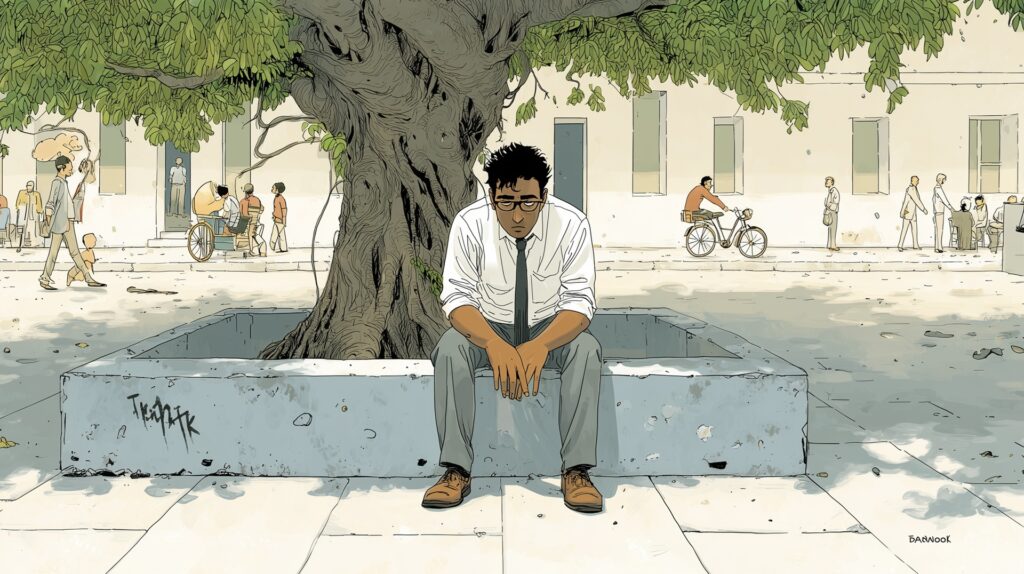
Smoker’s Corner was a patch of shade under a half-dead banyan tree, surrounded by benches caked with graffiti and the lingering smell of Gold Leaf. Three boys in black t-shirts clustered around the cigarette burns. In the middle, perched on the bench with both feet up, was Nodi, hair loose, white shirt half untucked, knees pressed to her chin.
She didn’t look at him as he approached, just kept talking to the boy next to her, a guy Akib recognized from last semester’s Literature seminar. Shuvo or Sohan. Akib never bothered to parse out the interchangeable names that floated around the Arts Building like pollen.
Nodi caught his shadow, then twisted to face him, lips parted just enough to suggest she might smile or might bite.
“You look like a boiled towel,” she said.
He shrugged. “You should see the other guy.”
She raised an eyebrow. “Did you win?”
Akib shrugged. The movement felt like someone else’s. “Hard to say. The professor didn’t throw anything at us. That’s probably a first.” He tried a smile, his mouth still parched from the adrenaline and recycled air.
Nodi exhaled a little plume of smoke. The guy beside her—Shuvo or Sohan—smirked, then flicked a cigarette butt into the patchy grass. “Congratulations,” Nodi said. A scalpel edge to her tone. “You must be the only business major in history to walk out of a lecture and come here first.”
Akib didn’t know how to answer. He sat. Heat radiated off the bench’s concrete lip, the air thrumming with the aftertaste of burnt tobacco and cheap incense. He tugged at his collar, tried to loosen it. His fingers came away damp.
“We saw your friend, earlier,” Nodi said, her gaze split between him and the canopy overhead. “The one with the weird hair and the guitar? He was carrying a box of shingaras and telling everyone he was the next Shakil Bhaiya.” She snorted. “He said you were ‘inventing the future of hunger.’ Did you really pitch drone burgers?”
He nodded. “That was the other team. We went with fixing the delivery system.” The words sounded hollow, drained of all the urgency they’d had on stage.
She considered this, then stubbed her cigarette out against the bench. “Let me guess: you solved everything by making the riders work harder for less?”
He flinched. “We argued for paying them more. Changing the incentives.”
“Of course you did.” She picked at the frayed seam on her jeans. “The only thing that ever changes is how many burgers the boss gets to eat. The rest is just PowerPoint.”
Akib wanted to protest, to explain the maps, the data, the night sweats of the last week. The words jammed in the back of his throat. He looked at her hands—thin, paint-stained, bitten nails. He remembered how she used to hold her cigarette between thumb and ring finger, a small rebellion learned from an uncle, she’d once said. He missed the easy sarcasm they used to trade, before the air always thickened like this.
He tried again. “We actually called the riders. Kabbo talked to, like, a dozen. We got their stories, how the system screws them.”
She studied him, face unreadable. “Did you ever think about actually riding with them?”
Akib faltered. “I—”
“Because if you did, you’d know no one cares about the system. They care about the cash at the end of the night. Or the cheap cigarettes. Or the girl waiting for them in a shared flat in Mirpur.” She shook her head. “You don’t fix that with a spreadsheet.”
The other boys were already lighting new cigarettes, bored with the conversation. One of them started humming the chorus from a Coke Studio cover; the others joined in, off-key, loud. Akib felt himself shrinking, the confidence of an hour ago drying up like dew in midday heat.
Nodi stood, brushed the back of her jeans, and looked down at him. “You look like a waiter at a wedding, Akib. Maybe next time, show up as yourself.”
He looked down at the white shirt, the sweat marks like tide pools, the pants still creased from the morning’s frantic ironing. He wanted to say something clever. The only words that came were, “I don’t know who that is anymore.”
She smiled then, an actual smile, the kind that made him feel like a child. “Neither does anyone. That’s the point.” She turned to go, then paused. “Seriously, though: you should try the delivery thing. Even just for a night.”
He was left in the shade, the taste of her smoke lingering. The drone of folk music from the benches swept over him, a current of voices, none of them his. He leaned forward, elbows on knees, and watched the quad for a long minute—students in kurtas and slogan t-shirts, two girls running barefoot, someone selling cones of kulfi from a battered bicycle cart.
His phone buzzed again. A message from Kabbo: “Dude. We’re trending on the class group. Hungry for the future!!! (but also, im dying pls bring snacks).”
Akib thumbed a reply: “On my way.” Then he stopped. The words stayed on the screen, unsent.
For a moment, he just watched the world move around him—the slow orbit of people who never noticed his existence, the laughter that always arrived a split second too late, the haze of sweat and sunlight and the godawful background music.
He stood, almost steady, almost free. He loosened his collar to breathe, to remember what his own skin felt like under all the borrowed fabric. He picked a direction and walked toward it, caring which club or canteen or corridor it led to.
He had won in there. Out here he was losing. And for the first time, he wanted to figure out why.