


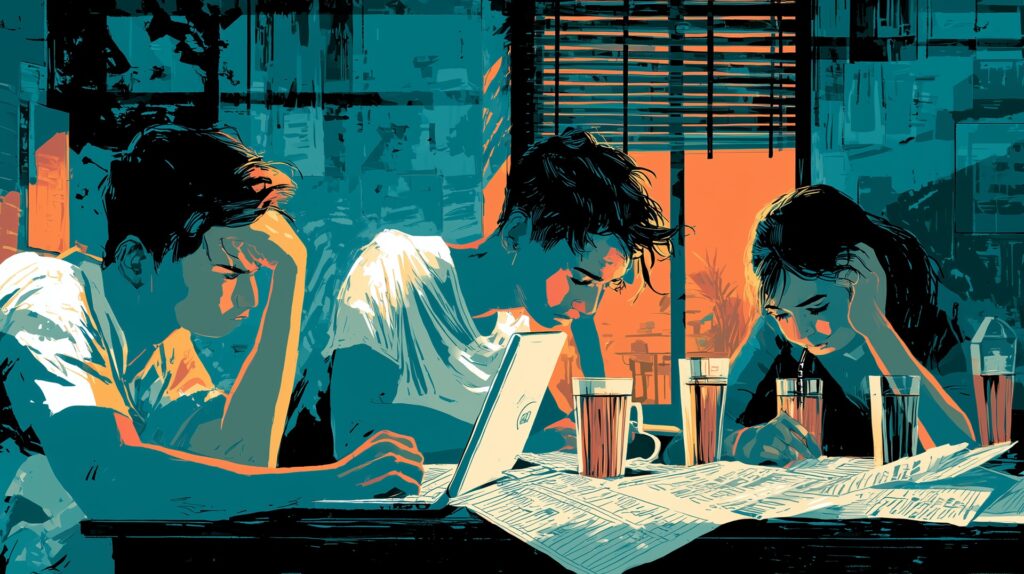


The deck was dead.
Akib felt it first through his Bata soles—library marble still sweating the day’s heat, but the cold seeped straight through rubber, numbing heels, then knees, then the hollow behind his sternum. 11:55 PM glowed green on his phone screen. One bar of battery. No new WhatsApp messages. Siraj’s icon: last-seen six hours ago.
A guard’s whistle sliced the night—two sharp bursts, then the dragged-metal screech of the rolling shutter. Akib flinched. He pressed redial. Straight to voicemail. Siraj’s voice, pre-recorded and smug: “Leave your chaos after the beep.” Beeeeeeep. Akib hung up. The screen dimmed, battery icon blinking red. He pocketed the phone before it could die in his hand.
Dhara sat two steps below, elbows on a spreadsheet printout curled like a dried leaf. The page trembled with each breath. Under the sodium floodlight her shadow pooled short and dark. She didn’t look up. “Still offline?” Her voice cracked on the last syllable.
Akib’s throat felt glued. He swallowed, tasted metal. “Voicemail.”
Kabbo paced the width of the steps, flip-flops slapping heels like faulty spark plugs. A cigarette dangled from his lips—unlit, campus security didn’t allow fire within ten meters of the book drop. He kept flicking the lighter anyway: click-click-click, sparks blooming and dying. “We paid him three packs and the Dean rumor in full. Ghosting is breach of contract.”
Another whistle. The second guard—older, mustache yellowed by years of cheap tea—shouted, “Jaw, jaw! Library closed!” His flashlight beam swept the steps, caught Akib square in the eyes. White blindness. Akib raised a hand, squinted through the slit between fingers. The beam moved on.
Dhara slapped her pen against the spreadsheet. “We’ve got thirty rows of delivery delays, a napkin doodle of a crying burger, and a meme of Daddy in an iron lung. That’s it. That’s the whole deck.” The paper rattled again—her hand or the night breeze, Akib couldn’t tell.
He pulled out his laptop sleeve. The zipper snagged; he yanked too hard, teeth screeching open. Inside, the MacBook felt heavier than yesterday. He opened the lid. Desktop: empty. Downloads: empty. Trash: also empty—Siraj had wiped his temp files before handing over the USB, claiming “operational security.” Akib had been dumb enough to feel impressed.
Kabbo stopped pacing. “Batcave?”
Akib nodded. They moved.
The path behind the library was a slit of darkness between the floodlit façade and the perimeter wall. Broken glass crunched underfoot; damp tarpaulin and stale urine drifted from the shrubs. Akib’s eyes adjusted slowly—shapes emerging: a discarded photocopy of last year’s midterm, a rat skittering across loose gravel, the sagging blue awning of the tea stall nicknamed The Batcave. Inside, a single bulb swung from a wire, casting cone-shaped shadows that pulsed like a failing heart.
Empty stools. The samosa guy had packed up; the counter was bare except for a smear of chutney dried to the color of rust. Siraj’s usual corner: vacant. ThinkPad gone. Even the brown paper bag that forever sweated oil had vanished. The only proof he’d ever existed was a cigarette burn on the plastic table shaped like a miniature crater.
Kabbo dropped his backpack. “He’s vapor.”
Dhara stepped inside, arms wrapped around herself despite the heat. She scanned the ground as if the deck might be hiding under a loose tile. “Maybe he pulled an all-nighter at some other café?” The words lacked conviction; Siraj’s operational radius never exceeded a hundred meters from free Wi-Fi and cheap samosas.
The walls tilted inward. 9:00 AM. Eight hours. Twenty percent of the grade. Academic probation—the Death List—meant no internships, no exchange, no escape route. Rafiq’s voice, older-brother smug, floated up from memory: You only get one comeback, kid. Waste it and you stay buried. Akib’s pulse thumped behind his ears.
He sat on the lone remaining stool, laptop cold under his palms. Opened PowerPoint. Blank template stared back—white void bordered by toolbars he barely knew how to use. Clicked ‘Design’: Office themes, gradients from 2003, nothing that screamed viral. His fingers hovered. Helvetica or Futura? He couldn’t remember which Siraj had chosen. Did it matter when every word he typed felt like carving epitaphs?
Dhara stepped beside him. “Let’s triage. What do we actually have?” She laid the Excel sheet between them; columns of timestamps, courier names, complaint codes. Tiny red cells bled at the edges where she’d highlighted anomalies. She tapped one cluster. “Eid week—thirty-eight percent of orders delayed over ninety minutes. Customers got the runs, yeah, cold burgers too. We can chart this.”
Kabbo flicked his lighter again—click-click—sparks leaping like dying fireflies. “Chart how? With what? My blood?” He didn’t wait for an answer, just jammed the lighter in his pocket and started walking, shoulders hunched, toward the canteen block.
Akib shut the lid. The latch clicked with the finality of a coffin closing. Dhara folded the Excel, crease sharp enough to slice skin. No one spoke. They followed Kabbo because the alternative was standing in the dark until security chased them off campus.
The canteen sat fifty meters away, a concrete shoebox with grilled shutters. Lights off, padlock dangling. Above the door a single tube-light flickered, stuttering. Akib’s shirt clung to him, sweat turning cold in the night breeze. He could smell himself—panic, nicotine, the sour stink of a day old.
Kabbo stopped under the awning, kicked an empty Coke tin; it rattled across cement. “Home sweet home.” Voice cracked.
Through the glass Akib saw movement—Matin Mama, silhouette wide as a wardrobe, wiping the counter in slow arcs. Yellow neon from the street slanted across his forearms, highlighting the gray hairs of age. Mama didn’t look up, the glance landed anyway—heavy, evaluating. Then the old man moved to the shutter chain and tugged. Metal screeched, panel sliding down until it hit waist height—three feet of open air, a mouth half-closed.
Dhara exhaled, shaky. “Permission?”
“Doesn’t matter.” Akib’s legs felt poured in concrete. He went first, ducking under, spine grazing cold iron. Inside smelled of bleach and old ghee, yesterday’s fried onions ghosting the air. His knees popped when he stood.
Kabbo crawled in after, guitar case scraping. Dhara followed, hair snagging a rivet; she yanked free, wincing.
The shutter stayed half-lowered. Matin Mama locked the chain, pocketed the key, then placed three glasses on the counter—thick rimmed, tea inside the color of rusted nails. “Main lights off.” His voice sounded like gravel stirred in hot oil. “And don’t make a mess.” He snapped a switch; only the counter bulb stayed alive, throwing a cone of amber over them, leaving the rest of the canteen in bruised shadow.
Akib nodded, throat too dry to speak. He took the first glass; porcelain hot against his palm. Bitter cha—liquor tea, sugar burnt raw. He swallowed a mouthful; the liquid clawed a path to his stomach, lit fuse.
Mama turned away, wiped already-clean tiles, giving them his back.
They commandeered the corner booth—Formica chipped, decades of pen graffiti tattooed into the surface. Dhara spread the Excel again, flattening creases with her wrist. Kabbo cracked his neck, opened the laptop. Screen glow resurrected in the dim, throwing sick light under his chin.
Akib’s cursor blinked on Slide 1. Template gallery open. White background. Blue boxes. Comic Sans lurking in the dropdown. He could smell the toner of every past failure—group projects he’d watched die because the slides looked like ransom notes. His palms prickled. He angled the screen so the sick light didn’t hit Dhara’s face, the reflection still bounced off the Formica, turning her cheekbones pale green.
He was hunting for the menu bar—where was “Format Background”?—when Dhara’s thumb slid across her phone. The screen woke. Instagram. Muscle memory betrayed her the way his did with slide transitions. Her thumb flicked once. Twice. Stopped. The glow sharpened, then pulsed—story ring, candy-pink.
The motion was small. Akib’s gut registered the change before his brain did. Dhara went rigid. The spoon in her other hand stopped mid-tap against the table’s laminate. She didn’t breathe. Then the spoon clattered, metal on Formica loud enough to make Matin Mama grunt behind the counter. Phone down. Dropped. The thud was soft, screen down, the sound cracked open the room.
Akib smelled fried onion and panic.
She stared at the dark rectangle like it had bitten her. Her shoulders rose, then caved. Air punched out of her chest. The noise surprised even her; she clapped a hand to her mouth, the second exhale came wetter. Tears, sudden and furious, streaked down to the corner of her lip, salt mixing with the metallic aftertaste of the tea. Her free hand curled into the cheap fabric of her sleeve, the one that had cost three hundred taka on a side street in Chittagong. The thread count showed under the canteen bulb like a confession.
Akib’s fingers froze above the trackpad. He heard Samara’s voice before he understood why—because Dhara’s eyes were fixed on the phone’s blank back, replaying whatever GIF had just looped. He didn’t ask. The campus had its own weather system of humiliation; you learned to read the pressure drop.
Dhara swiped the tears away with the heel of her hand, angry, like they were insects. “They printed handouts on cardstock.” Voice thick, aimed at no one. “Cardstock.” The word cracked. She laughed—short, ugly—then pressed her lips together until they went white. “I’m wearing this… this shirt. Three hundred taka. I can still smell the dye in the sweat. And my accent—you heard me, right? I said ‘deli-very’ like it had extra syllables. They probably screenshotted it for the group chat.”
The hand on her mouth moved to her collar, twisting the fabric between finger and thumb as if she could wring out the wrongness. “They’re going to hold it during the presentation. Hand them out like party favors. Beige. Perfect corners. And I’ll stand there with… this.” She gestured at the laptop where Akib’s cursor still blinked, Comic Sans leering from the font list. “I can already see their eyes. Poor scholarship kid who thinks bold headings are design.”
She wasn’t talking to him. The words spilled because the dam had finally found a crack. “My father called last night. Asked how the ‘big city’ was treating me. I told him fine. He laughed—this hopeful, nervous laugh—and said he’d told everyone in the neighborhood their girl was going to intern at Grameen. Like it was a done deal. Like I wasn’t one bad grade away from the bus ticket home.”
Akib felt the heat of her confession crawl across his own skin. He recognized the burn. The same fear lived in his ribcage, tattooed beside the Sylhet ink.
“I can’t go back a failure.” Whisper now. “They’ll smile and say it’s okay, I’ll see it—the pity. The tally of how much rice they skipped to send me here. Iron Lady, that’s what my cousins joke. Dhara doesn’t cry. Dhara doesn’t lose. If I crack, what’s left?” She laughed again, quieter. The sound folded in on itself. “Turns out Iron Lady is just tin foil.”
Kabbo had gone still by the sugar dispenser, cigarette lighter dangling from his fingers like dead weight. He looked at the floor, then at her, then at Akib—searching for the manual on how to fix people. Akib had none. He dragged his chair closer, metal legs screeching. The noise made Dhara flinch.
Akib’s hand hovered over the trackpad, finger twitching. The blank slide glared back—white void, blinking cursor, Comic Sans lurking. His throat tasted of burnt tea and tin. Dhara’s breathing was ragged beside him, each exhale fogging the laptop screen at the edges. He wanted to say something useful. Nothing arrived.
He stared at the table instead. The Formica was a battlefield of scars: ballpoint trenches, cigarette moons, the ghost-ring of a thousand teacups. And there—he leaned closer—letters gouged deep, knife-tip deep, jagged as a broken bracket. Batch 19 was here. The “9” had a tail like a whip crack. Someone had pressed hard enough to splinter the laminate down to the wood pulp underneath.
His finger brushed the groove. Splinter snagged skin. A tiny bead of blood welled, bright as a pixel. He forgot the slide. He forgot the cursor. He just stared at the carving.
“I know this guy.” The words came out dry, cracked. “Sat right here. Batch 19. Same table.”
Dhara’s sniffling paused. Kabbo stopped turning the lighter over in his fingers. Akib felt their eyes land on him.
He pulled the laptop closer, angled it away, shoved it to the far edge of the table until the near corner lifted off the surface. The cursor blinked at thin air.
“He wore sandals to his internship interview. Like, shower sandals. One strap broken, duct-tape patch. CEO of Robi now. You see him on billboards, tie knotted perfect, shoes so shiny they reflect traffic. Sat here flunking Accounting twice.”
He tapped the groove of the 9. Tiny flecks lifted, stung under his nail. The splinter throbbed, kept him tethered.
“The Glitters peak early—Year 1, Year 2—because the game hands them the dice already loaded. Year 3 the gears strip. The curve gets vertical. That’s when people like us”—he nodded at the gouged letters—”when we crawl out of the carpet.”
Dhara’s breathing steadied. She swiped her face with the heel of her hand, hard enough to leave a red patch along her cheekbone. “Origin story.” Testing the words like they were in a foreign language she suddenly understood.
“Origin story.” The phrase tasted solid, coin-shaped. Akib rolled it across his tongue again. “Heroes don’t get handouts. They get buried, then dig sideways until daylight.”
Kabbo barked a short laugh, half disbelief, half relief. “So we’re stuck in the tunnel phase. Great.” He sat straighter, shoulders squaring like someone had slipped a steel rod into his spine.
Heat crawled up Akib’s neck—strange, because five minutes ago he’d been chilled to the marrow. It was the unfamiliar burn of oxygen hitting a part of him that had never spoken aloud. He flexed his fingers over the gouged wood, tracing the B of Batch. The splinter stung again, kept him honest.
Kabbo pinched out the splinter in his own thumb, barely a flinch, then started drumming a pattern on the Formica—a fast, asymmetric rhythm, more Morse than music. The sound vibrated up through the table, into Akib’s elbows. Kabbo’s eyes tracked the rhythm, mouth tight, jaw flexing side to side like he was chewing glass. Then, without preamble, he reached over and snatched Akib’s laptop, flipping it open with such force the hinge creaked.
“Give it.” The voice was unfamiliar—clipped, no sugar. He started typing before Akib could react, hands heavy on the keys, punching the words onto the slide like stamps on a passport.
First line, big and loud: THE HUNGER OF 2 AM.
He deleted the old title—”Optimizing Last-Mile Delivery Logistics”—without ceremony, then scrolled for the next slide and wiped it too. Fired out the next heading: THE BETRAYAL OF HOT FOOD. No commas, no MBA jargon.
Dhara watched, eyes sharp now, face smeared with salt tracks, mouth twitching at the ends. Her hands moved, almost involuntary, smoothing the spreadsheet, then flipping to the back, where the margins were blank. She uncapped her pen and started making a list—Akib caught only fragments: “Who eats at 2:00,” “Exam season = doubled orders,” “First Eid alone?”
Kabbo’s rhythm went from the table to the keyboard, each key hit with staccato clarity. He kept the background white, the font black, every line capitalized, urgent, pulsing with a hunger the canteen’s strongest cha couldn’t dampen. He didn’t touch the design beyond that—no gradients, no clip-art. Just story, layered slide by slide. He built a narrative out of the ashes of the spreadsheet:
Slide 1: “WHAT YOU ORDER AT MIDNIGHT DEFINES YOU.”
Slide 2: “EID IS FAMILY—BUT SOME OF US EAT ALONE.”
Slide 3: “A COLD BURGER AT 2 AM IS A BROKEN PROMISE.”
Slide 4: “EVERY DELIVERY FAILURE IS A FAILURE OF TRUST.”
Slide 5: “WE DON’T DO LOGISTICS. WE DO HOPE.”
Akib’s skin prickled. He watched Kabbo work, half-expecting a punchline or meme to undercut the melodrama. Kabbo didn’t so much as smile. He only paused to take a gulp of tea, then wiped his mouth and typed even faster. On the last slide, Kabbo pasted the meme of the Burger Daddy mascot in the iron lung, blew it up to fill the whole frame, then wrote in thick Arial under the image: “THIS IS A CRY FOR HELP. SO FIX THE SAUCE.”
For one long moment, no one moved. The canteen clock ticked, Matin Mama muttered at the sink, and somewhere in the distance, the security whistle blew a last time.
Dhara broke the silence. “That’s it. That’s the deck. No more edits.”
Akib wanted to ask if they shouldn’t at least align the text, or pick a better font, or maybe rebuild the graphs. The words jammed in his mouth. The deck wasn’t pretty. It wasn’t even functional by Siraj’s standards. It was alive. He could feel the slides crawling under his skin, burrowing. He could see, for the first time, how an auditorium full of beige-blazer Glitters and stone-faced faculty might actually stop and look.
He reached for the laptop. Kabbo held it a second longer, eyes pinning Akib’s with a force he’d never registered before. “We can’t out-beauty them. Everyone’s been hungry at 2 AM. Even Samara. Especially Samara.”
He let go. Akib’s hand was already on the keyboard, fingers sweating. He hit save, then Ctrl-P, and the machine chattered out the first copy, each page plain paper, each heading dense with black ink.
Dhara took the printout and fanned through it. She read the first slide, then the last, nodded. Her hands stopped shaking.
She grabbed the next printout, hands steady now, and stabbed the staple through the corner so hard it bent the metal back on itself. “We’ll blitz the rest in the morning. No point in rehearsing when nobody’s slept.” Kabbo nodded, already shutting the laptop. The screen’s glow faded, leaving the afterimage burned green behind Akib’s eyelids.
Matin Mama shuffled over at three AM with a tray of reheated potato chops and a bottle of Sprite. He set it down, grumbled something about “youth these days,” and retreated to the storeroom without waiting for thanks. When the door slammed, Kabbo hissed, “He’s a legend,” and divided the food three ways with a fork he wiped on his shirt. Dhara bit into hers, didn’t care that it was cold in the middle, wiped her mouth on a napkin so thin it disintegrated.
There was a drift in time after that. Akib closed his eyes, let the sounds layer over each other: the clink of glassware, the distant, rhythmic slap of a mopping crew, the throat-click of Kabbo’s breathing as he dozed upright. He thought of the deck—those capital-punched slide titles, the meme mascot in the iron lung, the way nothing lined up. He couldn’t tell if he was proud or just too tired to care. He pictured the audience, the faculty row, the snickering Glitters. He pictured Dhara’s knuckles white on the handout, holding it like a shield. That was enough.
Azan cut the dark just before sunrise, the call to prayer rising through the half-open canteen windows. Akib opened his eyes and the world had cooled a shade; the air held a bite; the tables shone wet with dew. Kabbo jerked awake, blinked twice, and immediately started poking at the printouts. Dhara had curled sideways in the booth, knees up, she uncoiled and stretched, lips pressed tight, eyes rimmed red.
They cleaned the table. They packed the laptop, the crumpled handouts, the empty food wrappers. Matin Mama was gone; his towel hung over the sink like a flag at half-mast. The main lights stayed off, so they navigated by the kitchen’s blue glow and the slow bleed of dawn through the grilled shutters. On the way out, Dhara stopped, pulled the door wider, and bowed her head just enough to clear the frame. She didn’t look back.
They moved through the quad single file, the flagstones cold and slick underfoot. Kabbo carried the guitar case, though he hadn’t played it in weeks; the strap dug into his shoulder, he didn’t shift it once. Akib watched their shadows tangle, then snap apart as they crossed under the street lamps. He felt his shirt stick to his back, the fabric clotted with old sweat. Their steps left a muddy trail behind them, streaks on the perfect red brick.
At the lobby steps, Kabbo stopped and set the guitar case down. He fished for the lighter, flicked it once, and this time the flame caught, haloing his thumb with orange. He grinned, shrugged, and flicked it off again. They waited in silence until the first light of the day hit the glass doors, the sun’s warmth spilling over the campus.
Akib looked at the others, at the mess of stains on their sleeves and the wildness of their hair. He felt his own pulse settling, slow and deliberate, each beat a little louder than the last. He almost laughed. Instead he said, “If we go down, we go down loud.”
Dhara smiled. The curve barely made it to her eyes. Real, though. “Let’s make them remember it.”