


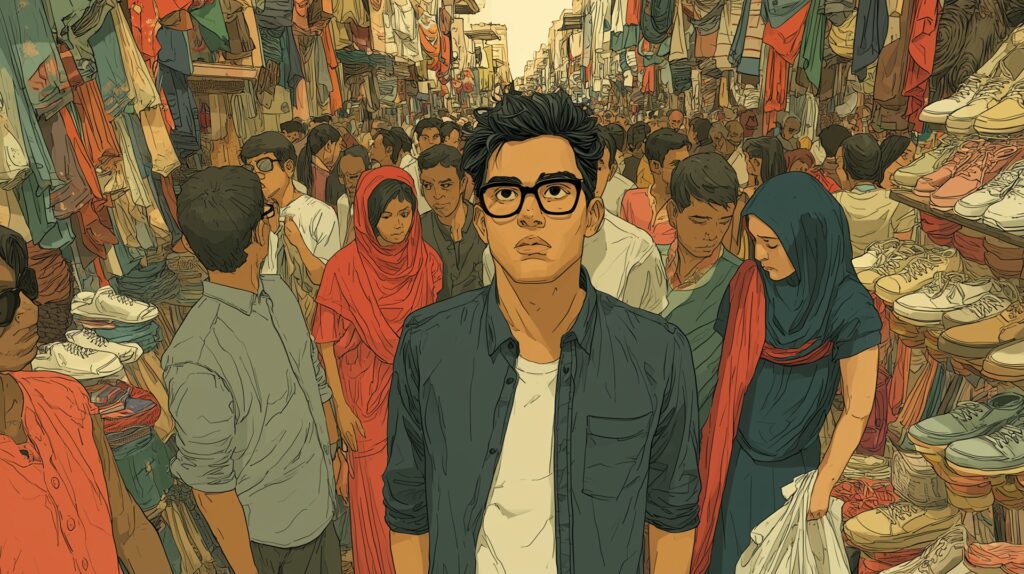


Ahsan stepped out of the rickshaw and the city pressed in. Vendors. Schoolkids. Beggars. A wall of CNGs locked fender-to-fender, horns blaring. The heat hit like walking into a furnace—102 degrees, sweat already pooling under his arms. He blinked sunscreen from his eyes, checked his phone. Nearly tripped over a pyramid of plastic sandals.
Nusrat blocked the path ahead, one hand raised, palm out. School principal style. “Focus, children.” She wore her oldest shalwar, navy blue and indistinguishable from any market auntie, but her hair was tied with an American scrunchie and her sunglasses—fake Fendi—sat perched with intent. Her eyes scanned the market. Suspicious. Calculating.
Sadia gripped his elbow. Bright eyes behind cheap aviators, Target shirt already dark at the armpits, her knockoff tote losing its shape in the humidity. She leaned close. “Fire drill or hostage negotiation?”
Ahsan’s lips twitched. Didn’t answer.
Nusrat gathered them close, voice low. “Three stops. Dupatta World, Men’s Corner, then the tailor. Don’t linger. Don’t make eye contact unless you’re ready to barter for your soul. And don’t—” She glared at Ahsan. “—say anything in English. This isn’t your university campus. This is the jungle. They’ll smell you.”
He wanted to argue. He’d grown up here, spent every Eid and wedding traipsing through these alleys. Then he caught his reflection in a mirrored display: Ray-Bans, Dri-Fit tee, sneakers so white they looked photoshopped. His skin four shades lighter than any other man on the block. He could see the BDT signs spinning in the vendors’ eyes.
Sadia squeezed his arm. Electric jolt. “Don’t worry. Just look grumpy and say, ‘Bhai, eto dam keno?'” She grinned, teeth too perfect for this country.
Pride flickered. Pointless, but there.
Nusrat took point, carving through the throng. Never slowing for human or animal. “We’re not tourists. We’re on a schedule.” The crowd parted. Pulled by inertia or the sheer force of her purpose. Ahsan and Sadia walked in her wake, air growing thicker, the stall calls ratcheting up.
The first shop was a shoebox. Batik and beadwork crammed between a mobile repair stall and a bakery window fogged with flies. Three steps from street to sales floor. Ceiling barely cleared Ahsan’s head. Light the color of dirty honey. Three women sat cross-legged on a raised platform, hands slick from rolling fabric. The far wall was a hallucination: green, gold, sequined blue, purple so dark it swallowed light. Overhead, a single fan spun. Dying propeller.
Nusrat dropped her bag on the nearest chair. “Two wedding sarees. Nothing polyester, no pastels.”
The shopkeeper rose. Tan shirt, ringed fingers, permanent sweat shadow. He looked at Ahsan and Sadia. Calculated their bank accounts in two seconds. Smiled.
“For you, Apa, only best. Exclusive Indian Silk.” He pulled down a bolt, slapped it onto the table. Unfurled it with dramatic flourish, beads raining onto the floor. The color screamed red. Border stitched so thick it stood up like a fence.
Sadia whistled. “Wow. That’s bright.”
The shopkeeper’s eyes flicked to Ahsan, then back to Nusrat. “Eighteen thousand Taka. For you, sixteen.” English. Crisp and deliberate.
Ahsan did the translation reflexively. Two hundred dollars. For one saree. The number hurt. “That’s highway robbery.”
The shopkeeper’s smile widened. Gold canine. “Sir, this is not ordinary saree. Imported. See the work. Feel the weight.”
Nusrat lifted the fabric. Pinched it. Dropped it. “Synthetic. You think I’m a foreigner?” Her accent went deliberately thick.
He switched to Bangla. “Apu, please. Wedding season, prices are up. But you—sister of returnee engineer—will get the real rate. Just say how much.”
Ahsan’s shirt stuck to his spine. The shop was an oven. Air tasted like lacquer and sweat. He wanted to leave. Wanted to say never mind. But Sadia was reaching for her phone, thumb poised to snap a photo. He plucked it from her hand, set it on the counter. “Not here.”
He wanted to buy the thing and get out. Scam or not. He pulled out his wallet, flipped it open. His Visa caught the light.
The shopkeeper’s expression went tender. He took the card, turned it over. Hesitated. “Machine not working. Cash only.”
Ahsan’s jaw clenched. He hated this. Hated counting notes, hated the performance when everyone knew the outcome. He dug for his money clip.
Nusrat’s hand shot out. Flat-palmed. Hard. Smacked his wrist with a crack.
She barked a laugh. “Bhai, are you mad? You want Ammoo to die from shock? Put your toy away.” Then to the shopkeeper: “Chacha, are you charging us for the saree or the whole shop?”
She squinted at the fabric. “You call this Banarasi? My cat sheds better silk. Half thread, half chemical. Don’t insult my intelligence, Uncle.” She flicked the border with an expert snap, pinky aloft. Let the fabric slither onto the grimy counter.
The shopkeeper pressed a palm to his heart. Wounded. “Apa, if you find better anywhere in this market, I will close shop and serve you tea for a year. My honor.”
“Honor!” Nusrat’s voice was acid. “Last week my neighbor bought the same saree for ten five. She didn’t cry for three days about the price. Chacha, you want my money or you want to send your children to Oxford?” She turned to Sadia, stage-whisper loud. “If he asks more than twelve, I’ll drag him to the police.”
Heat crept up Ahsan’s neck. The other customers had stopped pretending to shop. Two older women in fluorescent hijabs. A boy reading cricket scores. The shop junior—patchy mustache, kohl under his eyes—watched like this was a contact sport.
The shopkeeper raised both hands. Surrender. “Apa, for you, fourteen. Last offer. If I go lower, my wife will leave me.”
Nusrat snorted. “Tell her to pack her bags.” She spun, hooked Sadia’s sleeve. “Come. We’ll go to New Market. They’re honest there. Not like these thieves.”
She started for the door.
Ahsan grabbed her wrist. “Nusu, what are you doing?”
She hissed low. “This is the only way. If you pay now, he’ll spit on our name.”
He swallowed. The urge to bolt. “He’s already giving a discount. We’re talking about 150 dollars.”
Nusrat glared. “It’s not the money. It’s the principle. If you can’t haggle, you don’t belong here.”
He pressed his palms to the counter. “I do belong here.”
The shopkeeper hovered. Eyes wide. Watching.
In some parallel universe, Ahsan would have kept up the scene. Played his part in the ritual humiliation. Not today. He was tired. Sunburned. Shirt damp and clinging. “Just give him the money. Let’s go.”
Nusrat looked at him like he’d spat in her tea. “Coward.” So quiet even the shop boy might have missed it.
***
They stormed out. Nusrat half a stride ahead, plastic bag pinched tight, handles biting through skin. She didn’t look back. Just carved through the market flow like a city bus. The crowd yielded only so much. Ahsan trailed. Sadia at his shoulder. Both careful not to step on the bag dragging behind Nusrat’s heels.
He reached for it. “Let me—”
“Don’t.” She didn’t break stride.
He held up both hands. Surrender. Invisible to her. Seen by every other shopper in a ten-foot radius. “Fine. But you don’t get to be mad at me for wanting to pay for something.”
“You sound like an American cartoon.” Nusrat shot back. Never slowing. “You think money is a magic key. It’s not.” She bulldozed through a huddle of teenage boys at a fuchka cart. The tallest one’s shoulder clipped her bag. He got out of the way like everyone else.
Sadia peeled off. Drawn to a stall selling beaded bangles. Ahsan and Nusrat kept arguing. Stalls whizzed past: glass cases of cell phones, pyramids of fake Crocs, a man selling surgical masks. The city moved on. Immune to family drama.
Ahsan pressed until he was beside her. Shoes scraping broken tile. “You’re being cheap. It’s a wedding. It’s supposed to be special.”
She stopped. Just like that. The flow of the alley kinked behind them. Shoppers bunching up. A rickshaw wallah cursing, skidding to a halt. Nusrat planted herself, sari bag bright at her side. “I’m not cheap. You’re stuck in your West logic. Time isn’t money. Dignity is money. Rules are money. Ask yourself what you’re buying.”
Eyes on his back. Every stall owner. Every beggar kid. Every mother balancing a baby on her hip. “I didn’t want to waste everyone’s time for five dollars. I value my time more than the discount.”
She jabbed a finger at his chest. Hard enough to sting. “It’s not about your wallet, Ahsan. It’s about our market. You come here, throw dollars around like confetti, raise the prices for everyone else. When you fly back to Jersey, the shopkeeper will still charge me eighteen thousand because he thinks we’re all idiots. You aren’t being generous. You’re breaking the ecosystem.”
He stood there. Chest heaving. Sweat pooling in the small of his back. Something in him wanted to laugh. To tell her she was being dramatic. But she stood her ground. Face a mask. Every word for his benefit alone.
Behind them, Sadia drifted back. Thin bangle circling her wrist. She stopped at a respectful distance. Let the siblings finish.
Nusrat spun on her heel. Strode toward the curb. Ahsan followed. Sadia trailing. The slap of her sandals out of sync with the street rhythm. Two rickshaws idled at the mouth of the alley. Pullers slouched in seats, chests bare and slick, eyes half-lidded with heat. Nusrat scanned. Selected the one whose driver looked least likely to collapse before Mirpur Road.
They climbed in. Sadia first, then Nusrat with the bag, then Ahsan. Awkwardly folding in his knees. The seat groaned. The puller—a boy, no, a man, barely—shot a glance over his shoulder. “Gulshan, right?” Teeth perfectly white. Pitch memorized. “Fifty Taka for foreigner Bhai. Thirty more if traffic jam.”
Nusrat rolled her eyes. “Forty. And don’t take the main road.”
Ahsan dug in his wallet. Thumbed two red 50s. Peeled one. Offered it forward. “Keep the change.” Loud enough for Nusrat to hear.
The puller blinked. Caught the bill. Folded it into his waistband with a practiced flick. “Thank you, Bhai!” He started pedaling. Calves corded. The whole conveyance shuddering.
Ahsan waited for the rebuke. None came. Nusrat stared at the passing stalls. Lips pressed flat. Sadia shifted closer. Thighs sweat-stuck in the backseat humidity.
The market funhouse receded. Replaced by traffic blur. Then the slow boil of arterial roads. Air dense with frying oil, engine exhaust, something faintly chemical. The rickshaw’s canopy flapped. Filtering sun through mottled blue vinyl. Painting the world in cheap aquatic glow.
Sadia nudged his knee. Leaned in. “You know she’s right, don’t you?” Voice low. Edge of a smile buried in it.
Ahsan said nothing. Eyes on the passing oblivion. A beggar with a blindfolded child. A goat gnawing a plastic bag. A billboard for skin whitening soap that seemed to leer down at him personally. Nusrat didn’t look back once. He felt like a prop. The good son. The returnee. Now a walking cautionary tale. He wondered if she’d ever let him forget this. Or if it would get grafted onto the bone. A new family myth.
The rickshaw hit a pothole. Nusrat’s bag tumbled. Sari peeking from its mouth. Recrimination in fabric. She tucked it back in. Fixed her sunglasses higher up her nose.
Another snarl of traffic. The rickshaw idled in a crush of buses. The city’s noise rising. Synchronized. Migraine-bright. Ahsan looked at the back of the puller’s neck. The way it glistened under the sun. Tried to remember the last time he’d seen a grown man exert himself for his sake. A version of himself wanted to say something gracious. Reach forward. Thank the boy. But the words felt like sand in his mouth.
Forty minutes to arrive. The last five just inching through the security checkpoint. Guards poking their heads in, eyes scanning faces, waving them on with late-shift lethargy. Nusrat hopped out first. Handed the puller a second note—smaller, enough for tea—and marched toward the building. Sadia followed. Feet landing light and certain. Ahsan lingered. Watching as the puller counted the notes. Grinned. Then—just for a moment—looked straight at him with a glint of pure disbelief.
He stepped onto the pavement. Heat curled up around his ankles. Relentless. He could see Nusrat in the lobby. Talking to the doorman. Already constructing the narrative for whoever would listen. Sadia stood just inside. Waiting for him. Silhouette haloed by flickering fluorescents.
He joined them. The lobby was cold. Air recirculated to sterility. Nusrat didn’t look up.
“Thanks for the ride, Bhai,” Sadia called to the rickshaw. Like she meant it.