


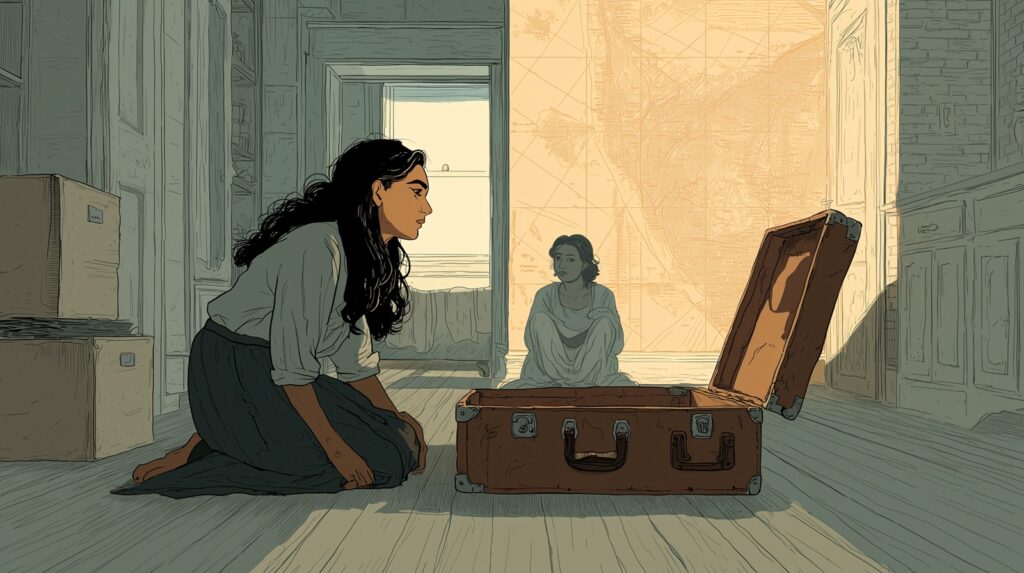


It has always been around, just never in the middle of the living room.
For as long as I can remember, it’s just, there. Not in a particularly important place. Not displayed, not quite hidden either. The way certain objects settle into the architecture of a house until no one questions them anymore. Like my old school bag on the top shelf. Or those dishes my mother never seems to use.
In my father’s old apartment—my previous home—it sat under a side table in the hallway, wedged between the umbrella stand and a shoe rack that had long ago lost its symmetry. When I was small, I used to sit on it to tie my shoelaces. Later I would balance grocery bags on top of it when my hands were full. Then I left for university, the shoe rack got replaced. It stayed right there.
The suitcase.
No one ever opened it. Or at least, not that I can remember. It was a hard-shelled suitcase, with a tired brown colour that had faded unevenly over time and made it all the more unnoticeable. Scratches covered its surface like faint cartography. A few ancient airline stickers clung stubbornly to its corners, their letters half-peeled away. Once, when I was twelve, I tried to read one of them and got as far as Calcutta before my father casually nudged it back under the table with his foot.
I didn’t ask questions. Children raised in this house learnt early which curiosities are productive and which are not. I should have, though. Asked about it. Given it’s currently in the middle of my living room. Or rather, my mother’s living room. I am in charge of the new “keep or throw” game we have been at for the past couple of weeks, and today, the object of the question is the suitcase.
Now, in the middle of my mother’s new apartment, it looks decidedly odd. It’s a beautiful apartment, no doubt, bought by someone with clearly impeccable taste (that would be my mother). With clean corners and crisp white walls. The furniture is modern—muted pastels and pale wood. My mother likes things minimal and subtle.
The suitcase does not match anything.
“Do you remember this, Abbie?” my sister Ana asks, poking it lightly with her foot. She’s sitting on the floor again, despite being surrounded by two couches and an ottoman.
“I remember it being around,” I say.
“That’s it?”
“That’s it.”
Ana crouches beside the suitcase and runs her finger over one of the peeling stickers. “Was it Dad’s?”
I shake my head. “Grandma’s.”
“Dadi?”
“Yeah.”
Another beat of silence. Mom says something from the kitchen. I am ignoring that, for now. I am… not mad, but sort of irked at her. After all, the suitcase, among many things, became my headache thanks to her. Well, her and Father. Because they are getting divorced. Amicably.
That is the word everyone keeps using. Not the word I would like to use.
The separation has been unfolding for months, with a kind of measured politeness that feels almost theatrical. Papers have been signed and furniture has been divided with clinical efficiency. My father moved to a smaller apartment across the river. My mother chose one here. They’re fine, though, Mom and Dad. They meet sometimes for coffee. They discuss finances like colleagues managing a joint project.
I suspect their friends are impressed. Nothing left in disarray, everything calculated and organised. Bravo.
For all the planning that went into the divorce, nobody seemed to know what to do with the suitcase. It appeared this afternoon during the final exchange of leftover items. My father dropped it off along with a few boxes of books and an old kitchen mixer that was a wedding gift, though from whom—neither of them remembers.
“This was my mother’s,” he said, setting the suitcase gently by the door. “I suppose one of you should decide what to do with it.”
Then he looked at me. Not at Ana. Which is not surprising. I am unofficially in charge of the loose ends, eldest daughter that I am. It’s not a burden. Most days. At any rate, we all—me, Mom and Dad—are collectively treating Ana more like an affected party than a participant in this farce. Her new fascination with spending most of her time holed up in her room and her latest, slightly unreasonable obsession with Pilates—both of which, coincidentally, have surfaced at the height of the divorce—have both of our parents worried enough. Typical of Ana. She will be okay, though. Personally, I’m not worried.
Anyway, given she has just been sitting around, I make her call Dad after he gets home, partly because she talks to him more these days, and partly because I don’t feel like explaining the whole situation twice. She dials him without moving from the floor, still crouched next to the suitcase. He picks up quickly.
“Hello?”
“Hi, Baba,” she says, in that easy, almost cheerful tone she always uses with him. “Did you get home?”
“Yes, yes. Just now. Everything okay?”
Ana glances at me. I nod toward the suitcase.
“We have a question,” she says. “About the suitcase you left.”
A small pause on the other end. “What about it?”
She puts the phone on speaker without asking and sets it on the floor between us.
“Abbie wants to know what’s inside,” she says.
I roll my eyes. Of course. Just like Ana to put it on me.
“She says she can’t decide what to do with it if she doesn’t know anything about it.”
His voice comes through the speaker, sounding faintly distracted, like he’s walking around while talking. “I told you, I don’t know much about it.”
“Nothing? You must remember something,” Ana insists. She uses that tone—slightly dreamy is what I like to call it—as if she just believes something to be true hard enough, it is.
“Not really,” Dad says, as I expected.
Ana sits cross-legged now, tracing one of the scratches on the suitcase with her finger. “What about your mother?” she asks. “Did she talk about it?”
“My mother didn’t talk about many things.” He doesn’t sound upset. Just matter-of-fact. Ana’s expression changes slightly, but she doesn’t push that part.
“So what do you know?” she asks instead.
“Well.” I hear him shifting, probably pacing. “I know it came with her when she moved.”
“Moved where?”
“To Dhaka. After her marriage. Then to Paris, when we all moved here. I’ve grown up with it in the house much like you two.”
I look at the suitcase again, properly this time. The scratches suddenly seem older than they did a minute ago.
Ana tilts her head. “Was it always full of… things?”
“I wouldn’t know.”
“You never opened it? Or Dadi?”
“I’m sure she did,” he says. “Just not with me around.”
I lean back against the couch. “What happened to it after she died?” I ask, a little louder so he can hear me.
Another pause. “It just… stayed. Your mother kept it,” he adds.
I look at Mom, who is standing by the kitchen counter pretending to wipe an already spotless surface. She has clearly been listening the whole time.
She shrugs when she notices me watching. “It was there when I married into the family,” she says. “It seemed important.”
“You never looked inside?” Ana asks.
Mom smiles faintly. “Some things don’t feel like yours to open.”
“So it’s just been following us around for thirty years?” she asks.
Something like a laugh comes from the other end. “Something like that.”
“Well,” she says, glancing at me again, “Abbie has to decide what to do with it.”
“If you want to throw it out, that’s fine,” he says. “It probably just has old clothes and things. Call me if you decide to look into it and find anything interesting.”
She hangs up before I can say anything else.
I look back at the suitcase. Poor thing. For no discernible reason, it reminds me of Polo, our childhood cat, on the night we found him. He was lonely and abandoned and, quite unbelievably for a stray, fat. And pitifully old. Everyone said no way. I picked him up anyway. Nobody argued; Mom just grumbled a bit about fur and diseases. For as long as I can remember, I held that unimpeached privilege in this house. What I asked for, I got.
It was not an inconvenience for anybody, though. I wasn’t raised to ask for a lot, and I didn’t. Barring the occasional stray cats. Besides, Ana was just as firm about not leaving Polo out on the streets. I am pretty sure she would have thrown a full-blown tantrum then and there if anyone objected.
“It probably just has old clothes and things,” my father said on the phone earlier. “If you want to throw it out, that’s fine.”
The suitcase that reminds me of Polo looks strangely sad at that phrase. Throw out. I feel this bizarre need to hug the suitcase.
What?
“Are you alright?” Ana asks. “You look like you’re going to pick it up.”
“Please don’t pick it up,” my mother says hurriedly. “It’s full of dust and stuff. You will give yourself an allergy attack.”
“Don’t be absurd,” I say, if only to admonish myself. “Why would I pick it up?”
The apartment grows quiet again. Then, unexpectedly, Mom speaks up. “Well, this feels like a test.”
“Huh? A test of what?”
Mom just shrugs. She probably has something in mind, but I decide against prying. I return Ana’s “what’s that about” eyebrow scrunch with a shrug of my own as Mom bids us goodnight and walks to her room.
Ana nudges the suitcase toward me.
“So,” she says. “What will it be? Keep or throw?”
I kneel in front of it. Up close, the suitcase smells faintly of dust and something older—like paper, or spice. I feel a little silly. No reason for so much indecisiveness over an old suitcase.
Except it feels strange to be handling it, like a weird relic or something. I look closely at it. The lock is simple. A metal clasp worn smooth by time.
Ana leans forward.
“Abbie,” she whispers excitedly, almost in childlike mischief, “open it.”
I almost don’t want to. I have a feeling that whatever is inside will be far more than what I want to deal with tonight. Or this week.
“Come on,” Ana urges. She has that look on her face that makes her seem like she’s ten years old again. I shake my head a little, then take a breath and press down on the clasp.
The lock clicks. And slowly, carefully—I lift the lid.