




It is strange, the things one remembers. The smell of the earthen stove in the yard, wood smoke and damp clay and something older underneath, animal and green. The tea threatened to boil over, the lid clattering its small urgent warning while Samira stood in the doorway between the inner rooms and the yard with her arms folded across her chest. And then, cutting through all of it: the tinkling of Mejhomami’s glass bangles, a bright clatter with each flourish of her wrist, punctuating the gossip the way a conductor’s baton punctuates music. Samira was not quite listening and not quite not listening, in the particular half-attentive posture one adopts when a story is familiar enough to follow without effort.
“The drunkard killed her, I tell you,” Mejhomami was saying, her voice carrying the satisfied gravity of someone delivering news that only they were privy to. She adjusted the fall of her sari over one shoulder and chewed her betel leaves with slow, ruminative authority. “That’s why the sardar is donating to the temples. To bury the rumors.”
Samira went to the hissing teapot and brought it down from the stove with the stained folded towel, and she stood there in the yard counting cups—eight in all, lined up like soldiers on the tray—and thinking that this, too, was a kind of information, the number of cups, the number of women who had come to hear and to add to and to carry forward the story of a dead girl. She poured carefully, the amber stream steady and fragrant, and thought, without meaning to, of the girl’s hands. The way they always moved slightly in front of her, as though ready to absorb a blow.
It had not been a secret. Not really. The bruises surfaced where they could not be entirely concealed—at the collar, at the wrist—purple and greenish-yellow in the way bruises always are, that ugly chromatic spectrum of healing that the body insists on making visible. The girl wore them under the folds of her sari, and the folds of her sari never quite covered them. She had a way of laughing nervously and shaking her head when anyone looked too long, a reflexive gesture Samira had come to understand as its own kind of answer.
She had seen her sometimes at the morning bazaar. They had exchanged greetings. Nothing more.
It was her mother who brought up the tamarind tree.
“The sun’s already tilting,” her mother said, pulling the edge of her sari forward. “I should leave soon. Can’t be wandering about with the telpitha after dusk.”
Mejhomami clicked her tongue and nodded. Samira’s mother continued, after a pause weighted with implication. “Near the sardar’s house. It’s not right anymore.”
The tamarind tree had always been old, its branches bent into the crooked arthritic postures of extreme age, but now—after the death—people had begun to say the girl was there. Trapped, as such girls were supposed to be trapped, married still to the place of her unhappiness.
Samira could not bring herself to believe it, and she was not entirely sure why. Perhaps it was only that the girl had seemed so fundamentally alive in the particular way of people who were suffering—hyper-present, watchful, the eyes always calculating small distances. It seemed wrong to imagine that such vitality could be converted into something so theatrical. It seemed too much like something invented by people who had never had occasion to be afraid.
She thought of the girl’s hands again. The way they moved.
She thought of the nervous laugh, and what it had been concealing, and how many mornings she had said good morning and walked on.
*
After her guests had gone, Samira cleared the trays and cups in the particular methodical silence of a woman alone in her own house, which is a different silence from any other. Her husband was in Calcutta. He was often in Calcutta. She had long since made her peace with the arrangement, which suited her in ways she did not examine too closely.
She had everything she needed: the water pump in the yard, the chickens, the cow, their dog Moti, who was large and rangy and devoted to her, and who had been behaving strangely for the past several days—whining at nothing, pressing his nose to the gap at the base of the gate—in a manner she had attributed to foxes, or the phase of the moon, or some irritant in the air she herself could not detect.
She did not notice he was gone until three hours had passed and she went to call him in.
The gate was open. She did not remember leaving it open; in fact she was almost certain she had not, but the gate was open and Moti was gone, and what remained was the cooling dark of a spring evening, and the first insects beginning their noise, and the soft shape of anxiety forming in her chest like a stone settling into mud.
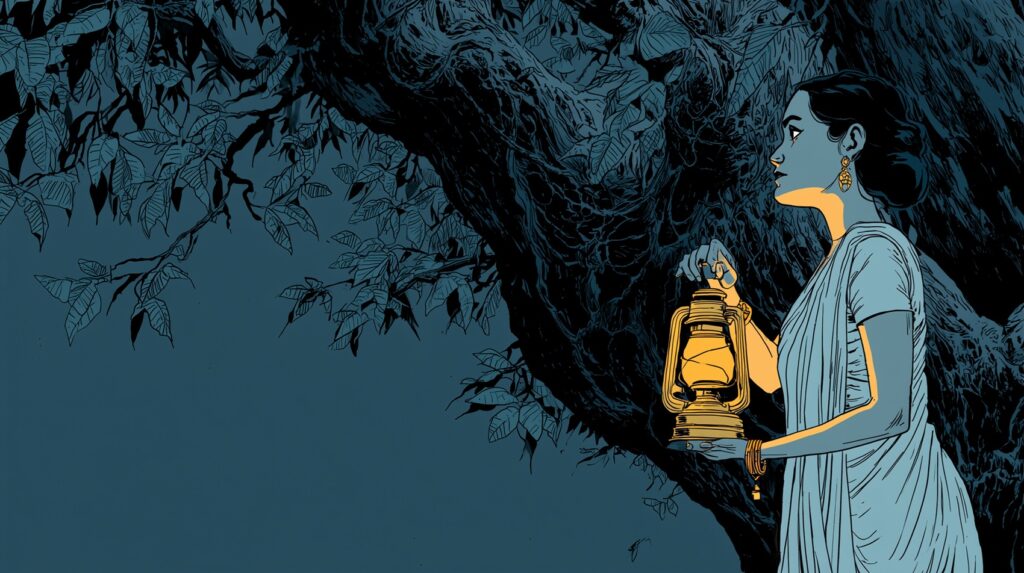
She thought: he never goes far. She took the lantern. She pulled her sari’s veil over her hair and went out into the dark, calling his name in a whisper, feeling faintly foolish.
It was not quite dark yet, the sky still held some memory of the glaring summer sun, the shapes of things still separable from the general blackness, the road a paler ribbon between the denser silhouettes of trees. She walked further than she’d intended, distracted by the task of listening for him, until she found herself near the walls of the sardarbari without quite having decided to go there. She silently cursed Moti. The sardar was a particular man about his property, his red amaranths, his sense of territorial sovereignty, and the last thing she wanted was to present herself at his gate explaining that her dog had been making free with his garden.
She was calling Moti’s name in the lowest whisper that could still be called calling, watching for movement in the bushes along the outer wall, when she realized she was standing under the tamarind tree.
She thought of her mother. Pushed the thought aside. Nonsense, she told herself, using the word her grandmother had used, flat and final as a door closing, and moved the lantern forward to peer into the undergrowth—
And there was the tail, wagging.
Moti looked up at her from behind the leaves with his eyes burning white in the lantern’s glow, and she felt the brief pure relief of finding something lost, which is one of the cleanest feelings available to a human being and that lasts, typically, for about two seconds.
His muzzle was red. A dark, definite red, not the ambiguous dark of shadow.
There was something in his mouth. A chunk of something, raw and glistening, with a frayed piece of beige fabric attached. The fabric was the color of the sardar’s son’s kurta, a man Samira had seen a hundred times at the market, loud and loose-mouthed, the smell of country liquor preceding him like a personal announcement.
She moved the lantern.
He was there in the undergrowth: the sardar’s son, or what the night had made of him. The kurta was torn open and dark and wet. The wine bottle had shattered; the pieces lay scattered around his head as though it had been dashed there with force, and one jagged shard had gone into his eye in a way Samira registered and then immediately tried not to have registered. The shard had driven deep, the hand that drove it leaving no other mark anywhere on him that she could see, no struggle, nothing. As though he had simply been stopped.
Moti was at the belly now, unhurried and thorough.
The scream that came up Samira’s throat met the night air and then didn’t. It stopped. She did not afterward know why, whether from shock or paralysis or some older and less nameable instinct. She stood there with the lantern, breathing.
And then—from above her, from the tamarind tree, from among the crooked branches—a sound. Not a wind, though it moved like one. A low keening whistle: the first notes of a song she recognized from funerals.
She looked up.
The aachol of a white sari hung from the branches. She saw the fabric first, the trailing edge of it moving in no particular breeze—and then she saw her. The sardar’s daughter-in-law sat in the tamarind tree with her feet turned backward and her shakha-bala still circling her wrists, the white shell bangles and the red lac bangles that a Bengali wife wears until her husband dies first, and which this girl had never been permitted to remove. There was a thin red line at her throat, precise as a wire. Her skin had gone the dark greenish color of a bruise that had gone very deep.
She did not look like the creature from the stories. She looked like herself, only altered. More present, somehow, than she had ever seemed in life, as though death had stripped away whatever it was she had always been performing.
Her eyes were steady. Almost gentle.
She raised one finger to her lips.
When she spoke, the voice came up from somewhere below the sound of the insects, below the small movements of the night, from some register that Samira felt in her sternum rather than heard with her ears.
“Let him eat.”