


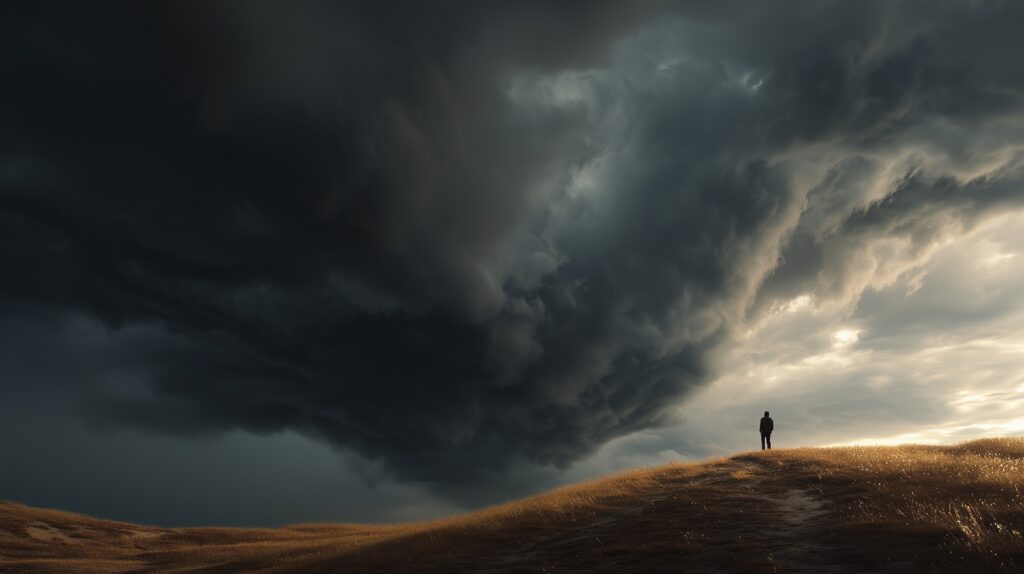


There is a science to forecasting storms. Meteorologists don’t just look at the sky and guess; they measure the subtle shifts in barometric pressure, track wind shear, and analyze satellite data showing the buildup and movement of complex systems. A storm doesn’t simply appear. It gathers. Its arrival is preceded by a hundred small, often imperceptible, tell-tale signs. For those who know how to read them, the forecast is clear long before the first drop of rain falls.
Political change, especially of the malignant kind, operates in much the same way. A nation doesn’t fall into authoritarianism overnight. The storm gathers slowly. The pressure drops with each compromised institution and hollowed-out political norm. The winds shift with every new policy that targets a vulnerable minority group, with every piece of dehumanization that enters the mainstream. For most people, busy with the demands of daily life, these signs are invisible. They are atmospheric disturbances that don’t register until the sky has already turned black.
But when you’ve lived through a political hurricane once before, you never forget the feeling of the air changing. You learn to recognize the signs. My silence on political matters here on UpThrust hasn’t been born of apathy or ignorance. It is, instead, a heavy quiet of a reluctant weatherman who has seen this forecast before in a different part of the world and is now watching, with a sense of dreadful familiarity, as the same storm system builds on a new horizon. It is the exhaustion of knowing what is coming and feeling utterly powerless to stop it, a dual ennui born from the political climates of two nations I have called home: Bangladesh and the United States. I feel politically homeless, an observer haunted by the ghosts of a past I thought I’d left behind, now seeing them manifest in my present.
The Slow Letting Go
My disillusionment with Bangladesh has been a slow burn, a reluctant, painful letting go of an identity. For years, I believed that my roots there defined the very essence of my belonging. That faith, however, has been systematically dismantled, not by a single cataclysmic event, but by a thousand cuts.
When the student movement of 2024 ousted the long-standing government of Sheikh Hasina, a flicker of hope ignited in the hearts of many, myself included. The subsequent formation of the National Citizen Party (NCP) in early 2025 felt like it could be the dawn of a new era. It was a movement born from the raw, revolutionary fervor of a liberal youth who dared to imagine a different Bangladesh, a “Second Republic” free from the dynastic corrosion and authoritarian rot of the past.
Yet, from my vantage point across the ocean, that initial euphoria has curdled into a familiar disappointment. The NCP, saddled with the monumental task of steering a deeply polarized and institutionally fragile nation, appears to be faltering. The language of liberation is struggling to translate into the prose of governance. Powerful factions, including emboldened Islamist groups, are jockeying for influence in the vacuum, and the dream of a truly secularism in Bangladesh, discrimination-free state seems as distant as ever.
This political letdown is compounded by a deeper, more unsettling societal shift. The fundamentalism that once felt like a fringe element has moved closer to the mainstream. It’s not just in the overt acts of intolerance, but in the silence that follows. It’s in the countless people who are willing to turn a blind eye, to tacitly condone a regression away from pluralism, so long as it doesn’t disrupt their daily lives.
A Familiar Chill in a New Home
I’ll be honest. I didn’t want to come to the United States when I moved here. Leaving behind the intricate tapestry of friendships and a life I had painstakingly woven felt like a kind of death. But circumstances dictated a new beginning, and over time, I started to see the promise of America. It wasn’t the idealized, picture-postcard version, but something more real and, in its own way, more compelling. It was a place where people fought, loudly and passionately, for what they believed in. The system was flawed, deeply so, but the struggle for its soul was waged in the open.
Then came the new presidential administration in January 2025. And in the six months since, the political climate has shifted with a speed and severity that has left me breathless. It is the state of American politics, far more than the slow-motion tragedy of my homeland, that has left me truly and profoundly disheartened.
Because I have seen this movie before.
The daily news cycle has become a torrent of grim affirmations. We are witnessing an unprecedented consolidation of executive power aimed squarely at the most vulnerable. The administration’s budget reconciliation bill threatens to strip healthcare in the United States from between 12 and 17 million people. The promised immigration crackdown has materialized with chilling efficiency, with accelerated deportations and expanded immigration detention.
Perhaps most terrifying are the inroads being made to weaponize citizenship itself. The United States Department of Justice has been directed to prioritize denaturalization, granting broad discretion to its attorneys to strip Americans of their status for a range of offenses. Legal scholars have rightly sounded the alarm, calling this a perilous step toward creating a tiered system of belonging, where rights are conditional and identity is subject to the whims of the state.
The Weight of Witnessing
And so, I find myself in a self-imposed political silence. I haven’t abandoned UpThrust. I will continue to write, to explore the intersections of culture, technology, and the human condition. But I cannot, for my own sanity, continue to engage in the day-to-day political combat. The emotional toll is too high.
It feels like a Sisyphean task—a gathering of immense energy to research, analyze, and write, only to bear witness to the boulder of progress rolling further and faster down the hill. What is the point of meticulously documenting a downward slide? To scream into a void that seems to absorb all light and sound?
This is not an admission of defeat, but an act of self-preservation. It is a strategic withdrawal. And yet, even in this grim forecast, there are moments when the clouds part. Just last week, seeing the grassroots energy that propelled Zohran Mamdani to a stunning New York City mayoral primary victory gave me a genuine, unadulterated flicker of hope.
But then I look up at the national radar, at the larger storm front, and the grim reality sets in. These small, brilliant flashes of light are, I fear, happening in the face of overwhelming political headwinds. The larger forces at play—the deep-seated political polarization in the United States, the erosion of democratic norms, the populist appeal of fascism—are immense.
To hold onto hope, one must learn when to engage and when to step back, to replenish the well of one’s own spirit. For now, I must bear witness in a different way, not as a commentator, but as a quiet observer, drawing sustenance from the small wins while bracing for the larger tempest. We are in for a long, dark winter. My silence is not a sign that I have given up. On the contrary, it is a belief that this nation, for all its profound and terrifying flaws, still contains a spark worth protecting. And protecting that spark sometimes means shielding it from the winds of a hurricane, waiting for the day when it can once again be fanned into a flame.