




A while ago, I read a piece in “The Globe and Mail” about how Bangladeshis abroad clustered together for news during the Great Monsoon Revolution of Bangladesh. A blind Bangladeshi writer in Vancouver described how a Bangladeshi friend narrated protest videos to her in real time. This is perhaps the “Desi Bubble” – the tendency of South Asian Diaspora communities to cluster together abroad – at its finest. The bubble stands at the heart of finding your people when all else is unfamiliar.
I also have the same heart. When my family & I visited the Maldives, we always – maybe unintentionally – searched for Bangladeshis. The Maldivians looked like us, yes, but the sound of Bengali in a foreign land was honey. Every time we met someone, they treated us to something: a boat ride, a lunch, going as far as inviting us to family dinners. Why? Because they, too, felt at home.


This phenomenon isn’t limited to geography. Six years, fifty-one boys, 24/7, with no real world touching us except in the forty minutes of a computer lab: that was my life in cadet college. When admission season ended, and all of us finally left for universities scattered across the country or abroad, something strange happened. We found each other again. Not necessarily our old batchmates, but cadets from different cadet colleges whom we’d never met. They shared our vocabulary, our discipline, and our inside jokes about PT parades and mess food that no civilian classmate understood. We built new circles immediately, the same way Bangladeshis do abroad.
At first glance, it felt like relief. However, in reality, we had built a wall. We never learned to mix with “others”. For more than half a decade, we took structured belonging for granted. Now, many of us can’t socialize outside our familiar circles. We simply weren’t used to people outside our usual “cadet” circles. They were unfamiliar. More often than not, the same happens when we go abroad. The sense of belonging and familiarity with fellow Bangladeshis is so strong that we forget to meet new people in a new country.
The bubble, however, doesn’t reach everyone the same way. For lakhs of Bangladeshis going abroad to support their families, it isn’t a comfort at all.
Rather, it’s often where the harm starts. Most workers heading to the Gulf states or other countries leave after paying exorbitant fees to local middlemen, their fellow countrymen, for a life that turns out to be nothing like what was promised. Before even going overseas, the workers are left in debt. The trust that made the arrangement – the familiarity of a fellow Bangladeshi, “Why wouldn’t we believe them?” – is the same trust that gets exploited.
And once they finally arrive, the bubble doesn’t just fail to help. There are no familiar faces waiting, no one narrating their news back home, and certainly no dinner invitations. In the Gulf, the kafala system is still practiced, where a worker’s legal right to even exist in the country belongs to a single person: the employer. The employers often seize passports on arrival, leaving workers with no papers, no way to change jobs, and no way to leave.
This is exactly where the Desi Bubble bursts. For a cadet, a tourist in the Maldives, or a blind writer in Vancouver, the bubble is a warm shelter that finds you when you’re lonely and gives you a taste of home. For a migrant labourer, the picture is far darker. The “home” within reach is the very thing that put him in debt, and the country he lands in offers no bubble at all. The same word can’t possibly describe both experiences. One is a shelter, while the other is a setup.
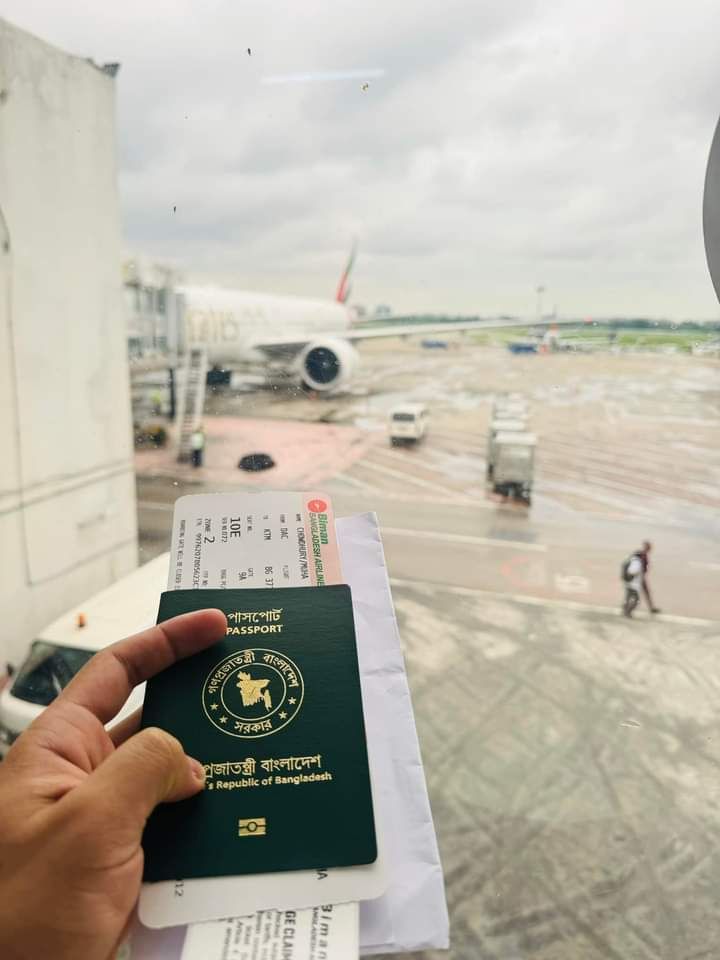
Every year, the same airport sends off both kinds of travelers. In one terminal, families take photos before flights to universities abroad, tracking each other’s flights online until they land. In another, men queue with the famous checkered plastic bags migrant laborers often use.


Both are leaving the country through the same gates, and both carry the same word on their documents: probashi. However, only one of them is flying towards the familiar “Desi Bubble”, and not everyone who leaves through these gates comes back whole.
As I write this, it’s September, and the same airport brought home from Cambodia thirty-eight Bangladeshis who had left for jobs advertised on Facebook and WhatsApp, hoping to be computer operators and call center executives. Instead, according to their accounts, they were trafficked into scam compounds, forced into fraud, and beaten when they missed their targets. The cruel irony: those who returned reported that some Bangladeshis involved in human trafficking tried to pressure and intimidate the trapped workers, going as far as to prevent them from returning.
We love to talk about the diaspora as a warm, unified community bound by shared language and heritage. In truth, the “bubble” is a privilege reserved for those who can afford its entry fee. For everyone else, that same sense of trust isn’t a safety net. It is the very tool used to exploit them before they even board the plane. Both leave the same home, through the same gates, carrying the same word on their passports. But only one of them gets to carry the bubble with him.