




Summary
Anchored by powerhouse, controlled performances from Ranveer Singh, Akshaye Khanna, and R. Madhavan, Dhurandhar excels in its patient, atmospheric depiction of deep-cover infiltration in Karachi’s Lyari.
Overall
-
Acting
-
Plot
-
Cinematography
-
Music
Aditya Dhar’s Dhurandhar – Part 1 arrives less like a single film and more like the opening move of a long, staged experience. At 214 minutes (3 hours 32 minutes), it demands the kind of attention people usually reserve for prestige television. You have to watch processes unfold. You have to sit with strategy across years. You have to see relationships harden into routine, and routine turn into survival. The film is marketed like an event. It plays like a season: dense, modular, and built around slow pressure. For much of its runtime, that approach works. The filmmaking often feels confident, controlled, and atmospheric. The action lands like consequence, not choreography.
Yet the most interesting thing about Dhurandhar is not only its scale or craft; it is the tension inside the story itself. The film is drawn to espionage’s moral fog of lies, aliases, double games, and institutional compromise. At the same time, it keeps reaching for something cleaner and firmer. It expresses ambiguity, but it also wants certainty.
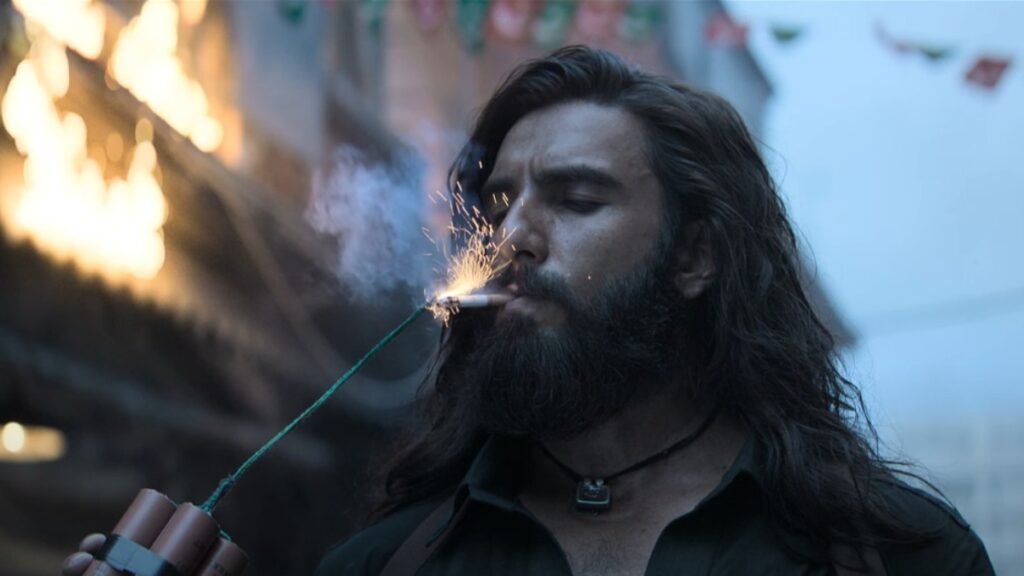
The narrative begins in the long shadow of the 1999 IC-814 hijacking. The film frames that moment as humiliation, shock, and institutional failure. It utilizes that aftershock as a launchpad for a new doctrine: less reactive, more patient, and more invasive. Ajay Sanyal (R. Madhavan) sits close to the top of India’s intelligence machinery. He proposes Operation Dhurandhar, a long-game strategy. The plan is not immediate retaliation; it is to place assets deep inside hostile ecosystems and let time do the work. At the center of that strategy is Jaskirat Singh Rangi, who becomes Hamza Ali Mazari (Ranveer Singh). This is not a simple alias. It is a constructed identity, designed to survive inside Pakistan’s underworld. The primary setting is Karachi’s Lyari, and the story moves within the orbit of gangster-powerbroker Rehman Dakait (Akshaye Khanna).
The dramatic question is simple but brutal: how do you survive in a world that punishes uncertainty? The film’s answer is time. Survival comes from years of earned trust. It comes from calibrated silence. It comes from knowing when to disappear. It comes from letting another man believe he owns you. Some of the film’s early stretches are strong because they treat infiltration as endurance. This is not a story where undercover work becomes a montage followed by a breakthrough. It lingers on mechanics. It shows listening more than speaking. It shows learning the rhythms of a neighborhood where a wrong look can end you. In these scenes, Dhurandhar earns real credibility. You can feel a person slowly being reshaped into a tool.
The dramatic question is simple but brutal: how do you survive in a world that punishes uncertainty? The film’s answer is time.
That same commitment to long-form realism shapes the viewing experience. The film wants to feel lived-in. If you like procedural density and slow world-building, the sprawl can be immersive. If you want the clean propulsion of a traditional theatrical thriller, the film can feel like a patience tax.
Formally, the film is divided into eight titled chapters. Each heading appears like a signpost in a long novel. The device is not just decorative; it is practical. The cast is huge. The factions multiply quickly. Alliances shift. The chapters give the audience places to breathe, reset, and re-enter. At its best, the structure suggests real intention. The film seems to think in arcs: entry, consolidation, betrayal, retaliation. It is not chasing neat three-act beats. Instead, it builds long stretches of connective tissue, then punctures them with jolts. Every so often, something spikes the air: an interrogation, an ambush, a humiliation, a betrayal. These moments remind you the world is unstable, even when the plot moves slowly. The film keeps expanding. It introduces new players and new threads. It adds factions, motives, and subplots. Yet it sometimes neglects the emotional tether that makes complexity feel urgent. Complexity is not the problem. Complexity without felt consequence becomes work.
There is also an identity question the film never fully resolves. Is this an espionage thriller that contains a gangster saga, or a gangster saga with espionage injected into it? The answer is often “both,” and that hybridity can be exciting. Lyari is not treated as an exotic backdrop; it is shown as a working ecosystem, with its own codes and economies of fear. You can feel two strong engines competing for dominance. For a film this crowded, Dhurandhar makes a smart choice: it does not use the ensemble as decoration. Most characters want something concrete; they seekpower, leverage, protection, revenge. That clarity gives the scenes bite. The world feels staffed rather than staged, which matters when you are asked to live inside a story for more than three and a half hours.


Ranveer Singh gives one of his most controlled performances as Hamza/Jaskirat. He dials down showiness and plays alertness, restraint, and calculation. His body language suggests readiness even in still rooms. The film gives him a line “Main ghayal hoon, isiliye ghatak hoon” (“I am wounded, and that’s why I’m dangerous”) and Ranveer carries that wounded edge without overplaying it. Even so, the writing often treats Hamza as an instrument rather than a psyche. The film admires his competence. It watches him adapt and execute. It gestures toward the inner cost of undercover life- loneliness, paranoia, identity erosion- but does not always stay with that corrosion long enough to make it tragic. Interior damage is often replaced with competence as spectacle. You end up watching a man do his job well more than watching what the job does to him.
Akshaye Khanna, as Rehman Dakait, is the film’s most volatile presence. He does not play menace as a single note; he plays it like weather:humiliation, pride, grief, suspicion, calculation,all moving at once. When the film reaches its highest pitch, it often does so because Khanna makes power feel personal. Rehman is not just an obstacle. He is a man doing constant math with his feelings.
Madhavan as Ajay Sanyal, embodies institutional dread, the kind that never fully sleeps. His strongest moments are those in which the film states the job’s brutal arithmetic: “We have to get it right every time; they have to get it right only once.” The line is chilling. It should be the story’s engine. The frustration is that Sanyal’s moral weight is not always matched by an equally deep look at Hamza’s emotional damage.
“We have to get it right every time; they have to get it right only once.”
Technically, Dhurandhar – Part 1 often looks excellent. This is where the “event” design becomes obvious. Even when the structure resembles television, the film does not look like television. It has big-screen muscle in its images and sound. The cinematography renders Karachi and Lyari as pressurized spaces. The interiors are dim. Lanes are tight. The air feels thick with sweat, dust, and proximity. When the camera stays close, the city becomes a threat. You feel how fast a wrong glance can turn into a death sentence. The production design also deserves credit. The setting does not play like “foreign flavor.” It plays like a functioning system with daily logic.
The score is grim and propulsive when it needs to be. The use of older Bollywood tracks adds a strange sheen: nostalgia coating brutality. In the right scenes, the needle drops do more than add style; they create disorientation. They remind you that the familiar can sit beside the lethal. The action choreography favors physical realism. Fights are messy and humiliating. Gunplay does not grant invincibility. Violence is not staged to look cool; it arrives like consequence. That grounded approach strengthens the film-until repetition dulls the impact. The editing keeps the story coherent despite the length, though in some chapters, their transitions feel abrupt. More importantly, the editorial philosophy seems to be: if it was shot, let it breathe. That patience can create immersion; it can also drift into indulgence.
The film is at its best when it treats violence as currency rather than spectacle. Violence comes from systems, not just from set pieces. Interrogations are savage. Power is intimate. Bodies become messages, leverage, waste. In the best Lyari sequences, Karachi feels like an organism: paranoia circulates, alliances shift, and brutality lands with bureaucratic logic. This approach is why the violence can be effective. It does not feel like “cool violence.” It feels like conditions operating. If you accept the world-building, the ugliness feels coherent, even necessary. It reinforces the idea that Hamza is not navigating cinematic obstacles; he is navigating a living ecosystem that punishes weakness and rewards cruelty.

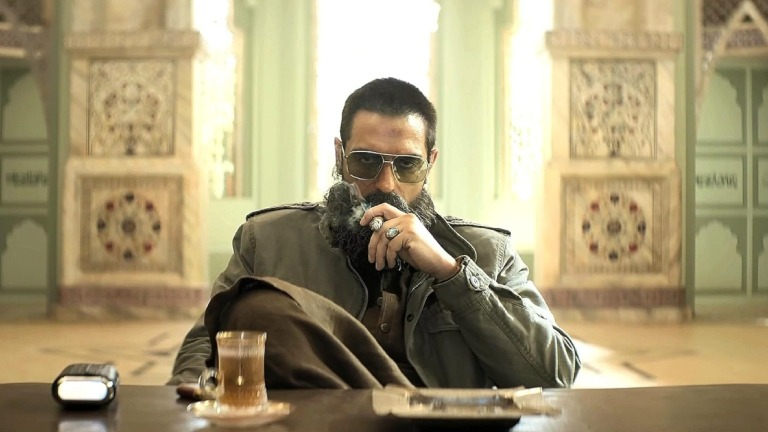
Still, escalation can become texture, and texture can become noise. The film leans so heavily on brutality as proof of seriousness that shocks stop revealing anything new. You may not learn more about Hamza’s soul or Rehman’s contradictions. You learn more about the film’s appetite for extremity. Violence can fit the theme and still feel excessive if it stops adding consequence or insight.
At 214 minutes, the runtime is not a footnote; it is the experience. Dhurandhar can feel like a high-end series projected onto a giant screen: long connective tissue, periodic adrenaline spikes, and an insistence on not compressing. Some viewers will read that as confidence and value the detail and refusal to simplify. Others will experience it as bloat and feel the film confuses exhaustiveness with depth. Often, both reactions are valid, depending on the sequence.
The climax shows the risk clearly. Rather than tightening into a crisp escalation, the film opts for a prolonged action episode. It is well-shot and physically coherent. It is also stretched so far that tension begins to evaporate. Realism is a virtue. Realism plus repetition becomes endurance.
The film also includes mainstream release valves. These moments seem designed to preserve star-cinema pleasures rather than deepen the theme. There is a song detour. There is an extended chase. There is a romantic beat that arrives just as political texture thickens. These scenes can be enjoyable on their own. In context, they dilute momentum. You can feel the film trying to be both a severe espionage saga and a broad crowd-pleaser. Those impulses do not always align.
Dhurandhar weaves in real terror incidents and political milestones:Kandahar, Parliament, 26/11. The intention is to raise the stakes beyond personal vendetta. The story sits inside a recognizable timeline of national trauma. That anchoring can make the fictional plot feel more urgent. The film goes further by using real audio and archival footage, introduced with on-screen text emphasizing authenticity. The impact is undeniable. Nothing staged carries the weight of real voices and real images.

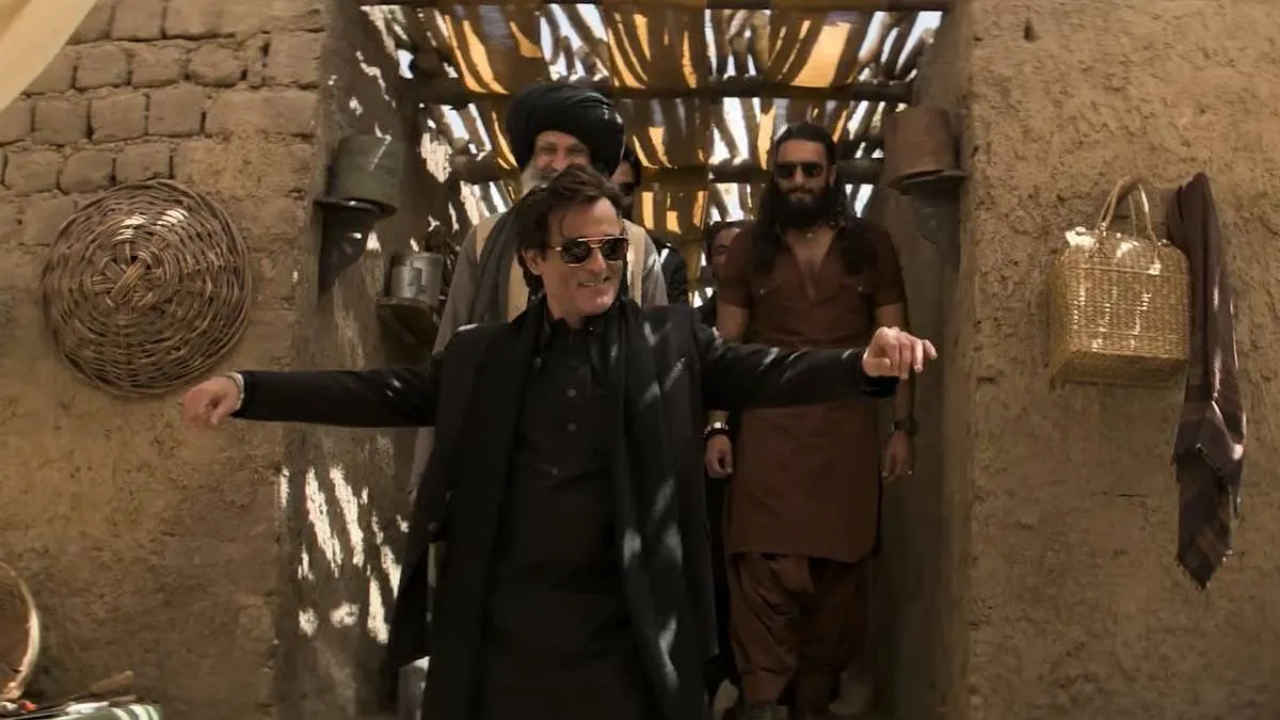
That power does come with an ethical hazard. Archival material can collapse the boundary between verified history and dramatized inference. A film can blend reality and fiction responsibly if it is careful about what it implies. Here, the technique sometimes feels like amplification: it borrows grief to charge a fictional narrative with moral authority, even as the surrounding story still wants the freedom of invention. It is a potent tool, and a loaded one.
The film’s most consequential tension is both political and dramatic. Spy stories thrive on instability: truth is partial, motives are mixed, and victories are compromised. Dhurandhar understands that on a mechanical level. It is full of double-crosses, bait, controlled friendships, and shifting loyalties. Yet it repeatedly reaches for clean moral conclusions.
One could argue this is context-faithful. If the story is set in Pakistan’s terror-linked underworld, characters will speak and act accordingly. Depicting slogans, symbols, and networks may be narrative accuracy rather than messaging. Many global spy thrillers depict national antagonists without symmetrical humanization, and audiences accept the genre’s asymmetry.
But Dhurandhar sometimes moves from portrayal to insistence. It builds a labyrinth of espionage and politics, then compresses that complexity into certainty. Instead of letting moral fog linger, it keeps reaching for clarity that feels less earned and more predetermined. This does not only shape politics; it shapes drama. When a spy story is too eager to be sure, it flattens the unease it spent hours building.


The film hints at discomfort early on. It suggests vulnerabilities inside Indian institutions too:political compulsion, hesitation, compromise. Those moments promise accountability rather than chest-thumping. Yet the narrative often retreats from that complexity, toward the fantasy of a corrective strong hand.
The film ends on a line designed for applause:
“Yeh naya Hindustan hai. Yeh ghar mein ghusega bhi, aur maarega bhi.”
As a slogan, it works. As a dramatic landing, it is blunt. The issue is not that the film depicts moral compromise; spy fiction depends on compromise. The issue is framing. Here, compromise is not paired with tragedy, grief, or introspection. The film’s best passages understand infiltration as slow violence and identity as erosion. The ending chooses catharsis.
Some viewers will read that as overdue candor-a refusal to soften the premise into moral mush. Others will see it as the story stepping away from its most interesting self. It chooses comfort in conviction over the unsettling power of doubt.
Because this is Part 1, the ending functions less like closure and more like a banner being raised. If Part 2 questions that banner, this moment may read as provocation. If Part 2 salutes it, this moment will read as destination.
One area in which the film’s confidence looks more like habit is its writing of women. Several female characters function as collateral. They appear as infatuation, silence, or brief authority followed by disposal. The film sometimes treats intimacy as leverage rather than sanctuary. That could be an unsettling, meaningful idea. The problem is that the film does not consistently grant women full personhood inside the political and criminal machinery.
Several female characters function as collateral. They appear as infatuation, silence, or brief authority followed by disposal.
In a story so attentive to systems-gang systems, intelligence systems, state systems-this absence feels less like a side issue and more like a missing layer of realism. When half the population is written mainly as function rather than force, the world-building becomes less complete.
Taken on its own terms, Dhurandhar – Part 1 is often gripping and frequently impressive. It is a large-canvas spy saga with grounded action, suffocating atmosphere, and a strong central triangle of performances. Ranveer Singh brings controlled restraint. Akshaye Khanna brings unstable menace. R. Madhavan brings institutional dread. The chaptered structure and focus on long-game infiltration give the film an unusual texture for mainstream Hindi cinema. At its best, it makes espionage feel like lived time, not just plot.
As a first installment, it remains a lavish setup that may later be reframed. If Part 2 complicates the certainty-emotionally, politically, ethically-then Part 1 may retroactively feel like deliberate groundwork. If Part 2 doubles down, then Dhurandhar will stand as a long, often arresting spy epic that brushes against greatness and then chooses reassurance over doubt. Either way, it is a film built to be argued with,and one that wants to thrill you, impress you, and, finally, tell you what to feel.